
Written by Dirgha for DifferentTruths.com, this insightful analysis explores caste hierarchies, institutional responsibility, and modern education following the IIT Mandi controversy.
Key Takeaways
- Caste Normalisation: Inherited hierarchies easily infiltrate modern educational institutions, operating subtly through representation, language, and everyday social norms rather than explicit violence.
- Intent Versus Impact: A legal finding regarding a lack of discriminatory intent does not fully address the deeper social meaning or psychological impact of reproduced inequality.
- Critical Examination: Educational spaces must actively question inherited traditions and hierarchical knowledge systems rather than allowing them to pass as unquestionable common sense.
An Indian Institute of Technology is commonly imagined as a symbol of modernity, merit and knowledge. Yet a recent controversy at IIT Mandi has brought an older question into this supposedly modern space: who decides what counts as normal, legitimate, and respectable knowledge about caste?
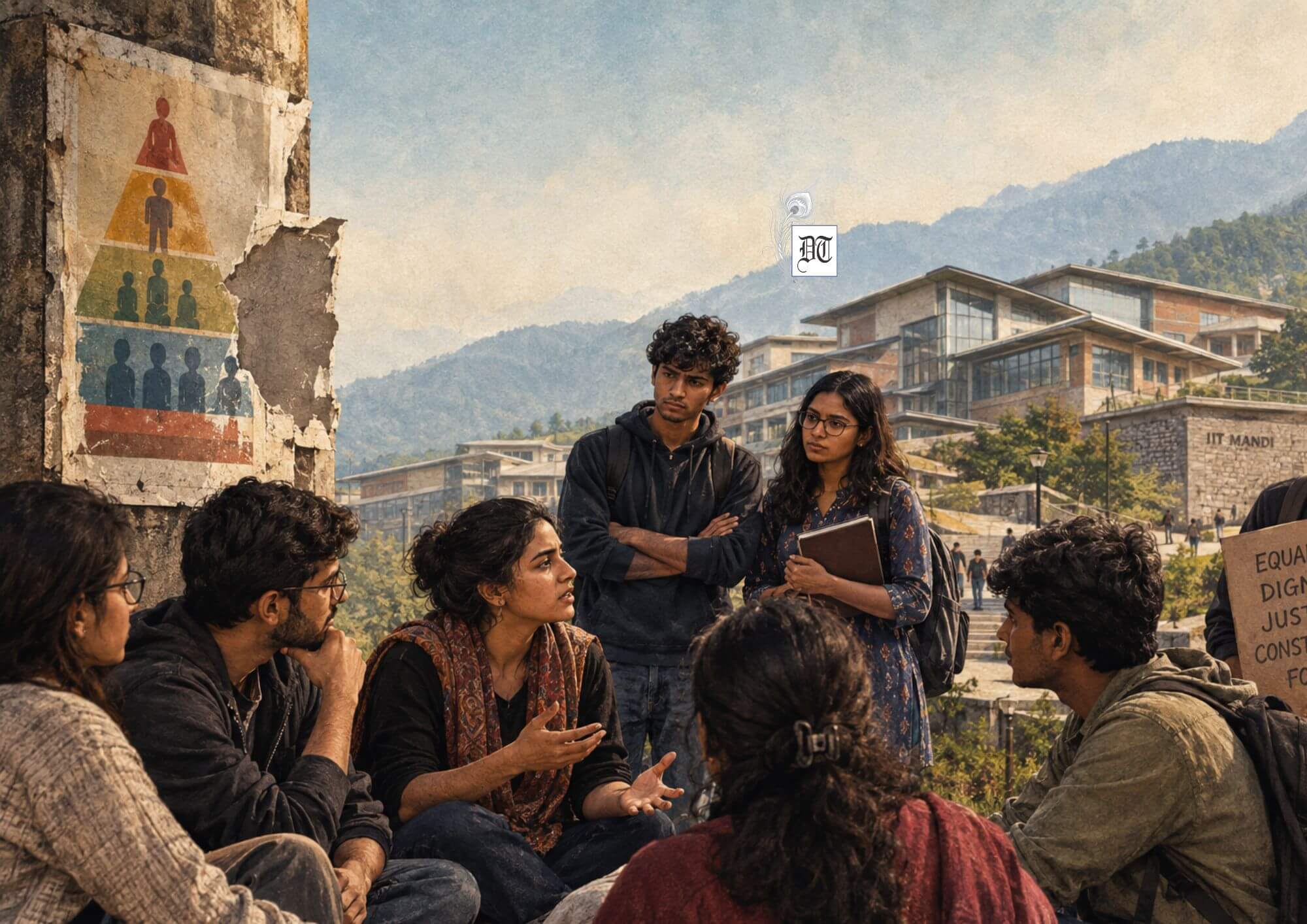
On September 4, during Janmashtami celebrations at IIT Mandi, a poster titled Bhagavad Gita – The Timeless Wisdom was displayed outside the institute’s auditorium. The poster presented the four varnas and assigned them different social roles. While Brahmanas were associated with spreading God’s message, Kshatriyas with protecting society and spirituality, and Vaishyas with sustaining the economy, Shudras were described as having the role of “serving higher classes”. This wording drew criticism for reproducing caste hierarchy.
The institute subsequently ordered an inquiry and distanced itself from the poster. The committee’s findings, reported on September 13, are important: it found no evidence that the poster was intended to insult or harm a community, concluded that the Scheduled Castes and Scheduled Tribes (Prevention of Atrocities) Act did not apply in this case, and recommended counselling and sensitisation of the students involved. It also found that the event was not officially organised or approved by an institute body and that the poster reflected an individual student’s interpretation rather than IIT Mandi’s institutional position.
These findings raise a question that goes beyond individual intention: Does the absence of intent to discriminate mean a representation cannot reproduce a discriminatory hierarchy?
Caste does not survive only through explicit acts of violence or openly expressed hatred. It can also survive through what becomes normal. In a caste society, dominant groups have historically possessed considerable power to determine which social arrangements are treated as natural, traditional or legitimate. Once a hierarchy is repeatedly represented as the proper order of society, it can begin to appear less like a historical structure and more like common sense.
This is why the wording of the IIT Mandi poster matters. Describing one group as “higher” and another as existing to serve it does more than assign different occupations. It places those occupations within a hierarchy of social worth. The issue is therefore not simply that different groups are given different roles; it is that these roles are presented within an unequal structure in which one group is positioned above another.
The controversy also highlights the relationship between caste and knowledge. Historically, hierarchy deeply structured access to religious and intellectual knowledge in the caste order. Who could learn, interpret, and transmit sacred knowledge was tied to social power. When a caste hierarchy is presented through the language of “timeless wisdom”, it becomes necessary to ask: whose interpretation of tradition is being presented as universal, and whose experience of that hierarchy is absent?
This does not require rejecting religious texts or treating every reference to ‘varna’ as automatically casteist. Rather, it requires examining how texts are interpreted and represented in particular social contexts. An educational institution should be a space where inherited ideas can be questioned, contextualised and debated—not simply presented as unquestionable social norms.
This is also where the idea of the subaltern becomes relevant. A hierarchical system does not merely divide people; it determines whose position is treated as authoritative and whose position is defined in relation to those above them. When a community is repeatedly described through service to “higher” groups, hierarchy becomes embedded in the very language used to describe social roles. The person placed at the bottom is not merely given a different occupation; they are positioned within a structure of superiority and inferiority.
The institute’s inquiry is therefore significant, but the legal finding should not end the cultural conversation. The SC/ST Act has specific legal requirements, and the committee’s conclusion that its provisions did not apply must be distinguished from the broader question of how caste hierarchy is represented. A legal finding about intent and applicability is not necessarily a complete answer to the social meaning of a representation.
Caste-based humiliation can also operate subtly. It does not always take the form of physical violence or an explicit insult directed at a particular individual. Being reminded that one’s community occupies a supposedly lower position can carry psychological and social meaning, particularly when that hierarchy has historically been associated with exclusion and untouchability. Such forms of humiliation can operate through representation, language and social norms.
The IIT Mandi controversy therefore deserves attention not because it proves that the institute itself endorses caste discrimination—it does not—but because it demonstrates how easily inherited hierarchies can enter spaces imagined as modern and meritocratic. The question is not only whether a student intended to hurt someone. It is also whether a modern educational institution can recognise when an old hierarchy is being reproduced as “normal”.
If education is genuinely about knowledge, then inherited hierarchies must be open to examination rather than protected by tradition’s authority. The challenge before institutions like IIT Mandi is therefore not simply to prevent deliberate discrimination but to cultivate spaces where the meanings and consequences of caste can themselves be questioned.
Picture design by AI

Dirgha Datar is an MA English with Communication Studies student at Christ (Deemed to be University), Yeshwanthpur Campus, Bengaluru. Originally from Madhya Pradesh, her academic interests include Dalit literature, caste politics, representation, and contemporary Indian society. Her academic engagement with literature focuses on questions of caste, identity, marginalisation, and social representation. She is particularly interested in exploring how literature and cultural narratives engage with lived experiences and structures of inequality in contemporary Indian society and culture.


 By
By
 By
By

 By
By