
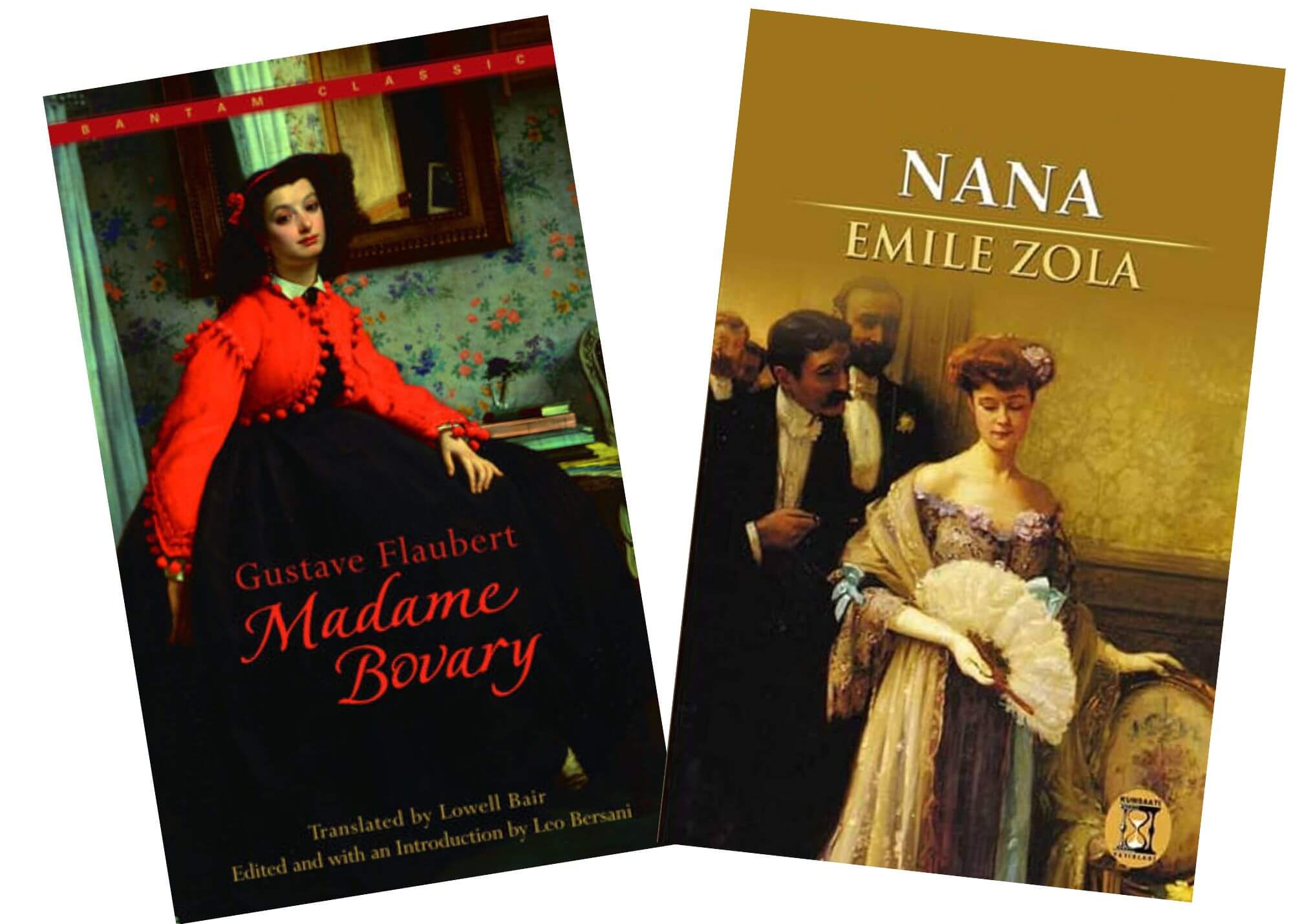

Ruchira explores the provocative legacy of 19th-century French literature, examining why masterpieces such as Madame Bovary and Nana were banned on DifferentTruths.com.
AI Summary
·Flaubert’s Madame Bovary chronicles the tragic descent of a woman disillusioned by marriage, leading to infidelity, ruin, and suicide.
· Zola’s Nana depicts the meteoric rise and grim demise of a Parisian courtesan during the crumbling French Second Empire era.
· Both controversial classics challenged 19th-century societal norms, exploring female autonomy and sexuality, which ultimately sparked intense public moral outrage.
As a student of English literature, I had the privilege of reading some masterpieces of global literature, a few of which were in translation. From Russian Titans like Tolstoy, Chekhov, Gogol, and Gorky to other stalwarts such as Victor Hugo, Alexandre Dumas, and Maupassant, I have explored a wide range of authors. I also encountered two notable European classics that sparked public outrage; the response was so intense that both works were banned for a significant period. Madame Bovary by Gustave Flaubert and Nana by Émile Zola, both French novelists, were written during the late 19th century, specifically between 1856 and 1888. Let us take a closer look.
Madame Bovary
A leading character in the novel is Charles Bovary (husband of the eponymous Diva), a shy, oddly dressed teenager who struggles in medical school. It ultimately becomes a health officer in the public health service. He marries the woman his mother has chosen for him, the odious but supposedly wealthy widow, Héloïse Dubuc. Charles sets out to establish a practice in the village of Tostes, located in the Seine-Inférieure department of the Normandy region.
One day, Charles visits a local farmer, Théodore Rouault, to treat his broken leg. There he meets Théodore’s daughter, Emma, a beautiful, convent-educated woman. young woman. Emma possesses a poetic sense of style and yearns for luxury and romance, inspired by the popular novels that she devours. Charles is immediately drawn to her, and (fortunately?) after Héloïse dies, he courts Emma. They marry with Emma’s father’s blessings.
At a lavish ball, Emma dances with a vicomte but soon realises how dull and meaningless her conjugal life is. In an attempt to revitalise her spirits, Charles relocates his practice to the larger market town of Yonville-l’Abbaye. Emma gives birth to a daughter named Berthe, but motherhood disappoints her. She becomes infatuated with Léon Dupuis, a law student who shares her literary and cultural interests. Then Léon departs for Paris to continue his studies. Emma hopes that Charles will gain a better local reputation when he attempts an innovative operation to cure a local inn servant, Hippolyte, of his clubfoot. However, as ill luck would have it, the surgery is botched, ending in amputation. Shocked and disappointed, Emma begins a blame game targeting her spouse.
Subsequently, Emma gets involved with a wealthy and charming landowner, Rodolphe Boulanger, and gradually contemplates an elopement. However, Rodolphe does not share her enthusiasm; instead, he promptly ends the relationship by delivering a letter to Emma on the eve of their planned departure. The shock of his rejection leaves Emma severely ill, and she briefly turns to spirituality.
Upon her recovery, the couple attends the opera in nearby Rouen at Charles’ insistence. The performance reignites Emma’s passions, and she encounters Léon again, who is now educated and working in Rouen. They begin an affair. Emma indulges her desire for luxury goods and clothing; she makes lavish purchases on credit from a local merchant, Lheureux. The crafty man arranges for her to have power of attorney over Charles’s estate.
Later, when Lheureux demands repayment of his money, she tries crowdfunding but is turned down by everyone, including Rodolphe. In despair, she swallows arsenic and kills herself. Devastated, Charles quits his job, liquidates his assets, and starts anew. Following his death, their young offspring, Berthe, is taken in by her grandmother, who passes shortly afterwards. Eventually, she lives with an impoverished aunt, who sends her to work in a cotton mill.
Nana
The story centres on Anna “Nana” Coupeau and chronicles her journey from a streetwalker to a high-class prostitute during the final years of the French Second Empire. The novel opens on a night at the Théâtre des Variétés in April 1867. Eighteen-year-old Nana creates a sensation on stage in La blonde Vénus (The Blond Venus), a fictional opera in which she plays the lead role. Her first public performance astonishes all of Paris. When asked to comment on her talents, Bordenave, the theatre manager, states that a star does not need to know how to sing or act: “Nana has something else, dammit, and something that takes the place of everything else.”
Just as the crowd is about to dismiss her performance as terrible, a young man named Georges Hugon shouts, “Très chic!” From that moment on, she captivates the audience. The author describes this pivotal moment: “All of a sudden, in the good-natured child, the woman stood revealed—a disturbing figure with all the impulsive madness of her gender, opening the gates to the unknown world of desire. Nana was still smiling, but with the deadly smile of a man-eater.”
The rest of the narrative depicts Nana’s passionate, whirlwind relationships with various men, each of which ends in tragedy. Philippe Hugon is imprisoned for stealing from the army to lend Nana money; the wealthy banker Steiner goes bankrupt trying to please her; Georges Hugon stabs himself with scissors in anguish over her; Vandeuvres burns himself after being financially ruined by her; Fauchery, a journalist and publisher who earlier criticised Nana in a scathing article but fell for her later, eventually faces financial ruin. Even Count Muffat’s faithful love for her is an exercise in futility.
The novel concludes on a poignant and melancholic note. Suddenly, Nana disappears from the glamorous circles of Parisian society, leaving no trace of her whereabouts. Her belongings are put up for auction. It is later revealed that she has moved in with a Russian prince, while her infant son – fruit of one of her wild adventures – is cared for by an aunt who lives near Paris. When a smallpox epidemic breaks out, Nana returns to nurse her son; tragically, he dies, and she contracts the disease.
The concluding lines are so vivid that they remain etched in the readers’ minds forever: “What lay on the pillow was a charnel house, a heap of pus and blood, a shovelful of putrid flesh. The pustules had invaded the whole face, so that one pock touched the next…”
Meanwhile, outside her window, the crowd is heard madly cheering, “To Berlin! To Berlin!”, signifying the start of the Franco-Prussian War, which ended in defeat for France and the fall of the Second Empire.
By today’s standards of openness and liberalisation, one might opine that these novels reek of feminism. But in tradition-ridden orthodox 19th-century European society, such elements of passion, coquettishness, flippant attitudes and blatant sexuality on the part of women (the two heroines) were unthinkable!
Picture of bookcovers from bookstores

Ruchira Adhikari Ghosh brings a liberal, wide-ranging outlook shaped by extensive travel across India and abroad. Educated at Holy Child School, New Delhi, Sacred Heart Convent, Ludhiana, and Panjab University, Chandigarh, she holds a Master’s in English Literature and a postgraduate diploma in Journalism and Mass Communication. With three decades in media, she writes on travel, books, music, performing arts, women’s issues, and especially food, drawing inspiration from rich life experiences. She is our Features Editor.



 By
By
 By
By