
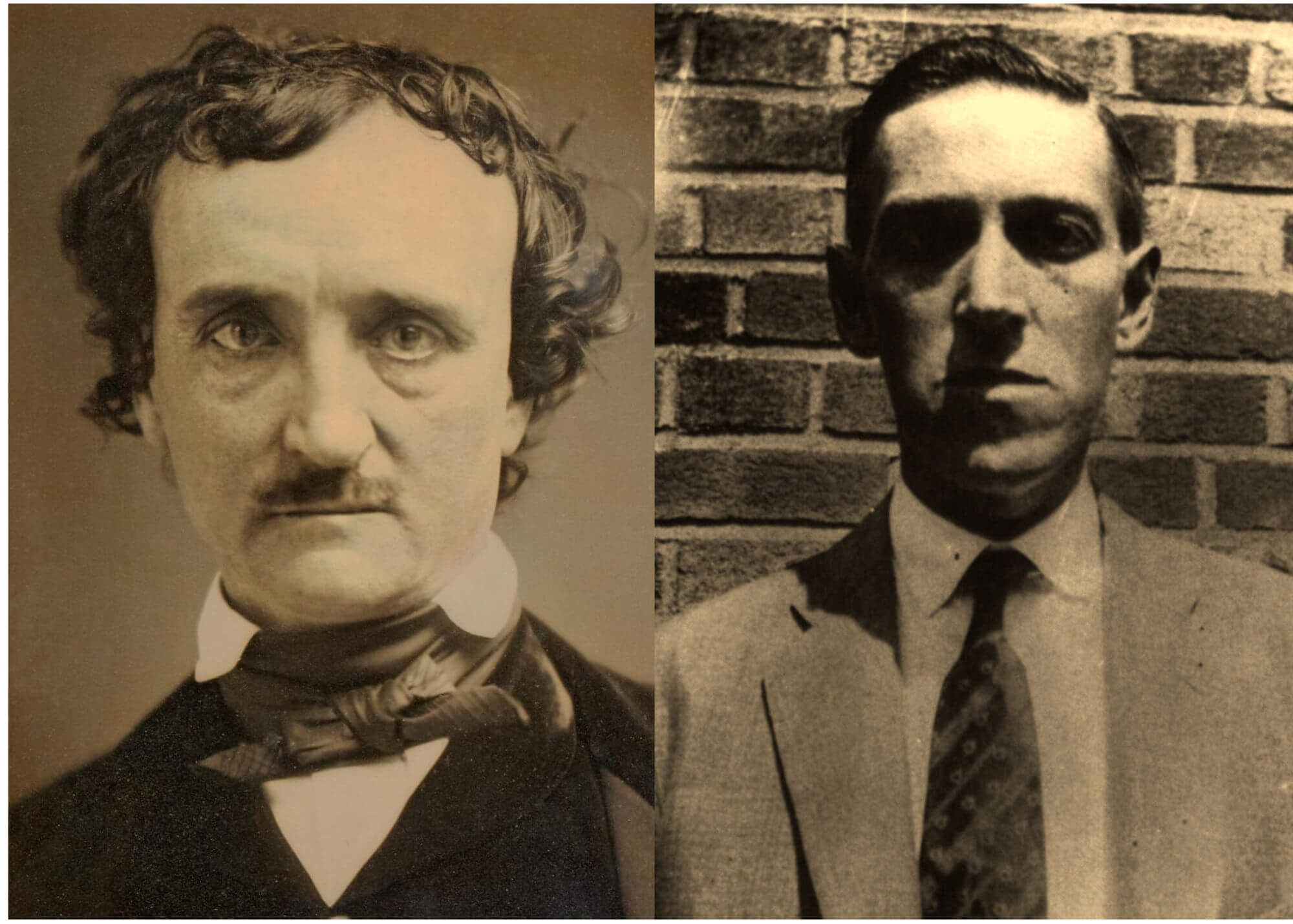
Akash for DifferentTruths.com probes Poe and Lovecraft: two dark masters whose terror reshaped literature’s soul and cosmic imagination.
AI Summary
· Comparative analysis contrasts Poe’s claustrophobic psychological terror with Lovecraft’s expansive cosmic nihilism, tracing horror’s evolution from Gothic Romanticism to existential dread.
· Examines style, madness, death, architecture, and science: Poe’s musical precision and interior collapse versus Lovecraft’s antiquarian grandiosity and epistemic annihilation.
· Notes shared themes—fear, the unknown, and atmosphere—and acknowledges controversies, especially Lovecraft’s prejudices, while highlighting enduring global influence.
Few names in the annals of Gothic and horror literature command as much reverence as Edgar Allan Poe and HP Lovecraft. Though separated by nearly half a century, the two authors remain spiritually intertwined within the dark corridors of literary imagination. Poe may be regarded as the melancholic prince of psychological terror, whereas Lovecraft emerges as the prophet of cosmic insignificance. Both men transformed horror from mere sensational entertainment into an intellectually and philosophically profound literary form. Yet the nature of their terror, their stylistic apparatus, their philosophical orientations, and their understanding of humanity differ significantly.
Poe’s world is claustrophobic, feverish, and deeply internal. His horrors arise from guilt, madness, obsession, decay, and the disintegration of the human psyche. Lovecraft, by contrast, shifts the locus of terror outward into the immeasurable abyss of the cosmos. In his universe, humanity is insignificant, fragile, and ignorant before ancient extraterrestrial powers whose existence annihilates all comforting notions of meaning and order. Poe’s terror whispers from the catacombs of the soul; Lovecraft’s echoes from the cold immensities of space and eternity.
A comparative analysis of these two literary titans reveals not merely differences in technique but also the evolution of horror itself, from Romantic Gothicism to existential cosmic dread. Their works, though distinct in philosophical orientation, share certain thematic affinities: fascination with death, the unknown, forbidden knowledge, and the limits of human comprehension. Both authors reshaped the architecture of fear and profoundly influenced generations of writers, filmmakers, philosophers, and artists.
Historical and Intellectual Contexts
To understand the divergence between Poe and Lovecraft, one must first examine the historical environments that shaped them.
Poe wrote during the early nineteenth century, a period deeply influenced by Romanticism and Gothic sensibilities. Romantic literature emphasised emotion, imagination, individual suffering, and the sublime. The Gothic tradition, inherited from writers such as Horace Walpole and Ann Radcliffe, revelled in haunted castles, madness, supernatural suggestion, and atmospheric dread. Poe absorbed these traditions but refined them into something psychologically sophisticated. His fiction frequently explores the unstable boundary between reason and insanity, often through unreliable narrators whose minds become theatres of torment.
Lovecraft, however, wrote during the early twentieth century: an era shaped by scientific advancement, industrial modernity, Darwinian thought, and the growing collapse of religious certainty. Astronomy had expanded humanity’s awareness of the universe to terrifying proportions. Scientific discoveries increasingly displaced anthropocentric notions of existence. Lovecraft internalised these intellectual currents and transformed them into a metaphysical horror rooted in cosmic indifference.
Whereas Poe’s anxieties emerge from the Romantic consciousness of alienation and mortality, Lovecraft’s fears arise from modern existential uncertainty. Poe fears the haunted chamber within man; Lovecraft fears the abyss beyond mankind.
Philosophical Foundations of Horror
Perhaps the greatest distinction between Poe and Lovecraft lies in their philosophical understanding of terror.
Poe and Psychological Terror
Poe’s horror is profoundly anthropocentric. The human mind remains central to his fiction. Even when supernatural elements appear, they are often ambiguous and filtered through unstable perception. Stories such as The Tell-Tale Heart, The Black Cat, and The Fall of the House of Usher are less concerned with external monsters than with mental collapse.
In The Tell-Tale Heart, the narrator insists upon his sanity while simultaneously revealing pathological paranoia. The famous heartbeat beneath the floorboards symbolises not merely guilt but the impossibility of escaping one’s own conscience. Terror originates internally. The human mind becomes both prison and executioner.
Similarly, in The Black Cat, alcoholism, violence, guilt, and self-destruction combine to produce horror. The supernatural may or may not be real; what matters is the narrator’s psychological disintegration. Poe thus pioneers the modern psychological horror story, influencing later writers such as Fyodor Dostoevsky and Franz Kafka.
Poe’s universe retains moral and emotional dimensions. Sin, guilt, obsession, and mortality remain meaningful categories. Even madness possesses tragic grandeur.
Lovecraft and Cosmicism
Lovecraft’s philosophy, commonly termed “cosmicism”, rejects the centrality of humanity altogether. His fiction repeatedly asserts that mankind occupies an infinitesimal and meaningless position within an incomprehensibly vast universe.
In stories such as The Call of Cthulhu, At the Mountains of Madness, and The Colour Out of Space, terror arises not from guilt or morality but from forbidden knowledge. Human beings discover truths too immense and alien for the mind to endure.
Lovecraft famously wrote that the oldest and strongest emotion of mankind is fear, and the oldest and strongest kind of fear is fear of the unknown. Yet this unknown is not merely psychological; it is cosmic. Ancient entities such as Cthulhu are not devils in a theological sense; they are extraterrestrial beings whose existence renders human civilisation absurdly insignificant.
Unlike Poe, Lovecraft offers no moral catharsis. The universe is indifferent. Humanity is neither loved nor hated by cosmic powers because it scarcely matters enough to deserve attention. This nihilistic vision reflects twentieth-century anxieties concerning science, secularism, and existential disillusionment.
Narrative Technique and Style
Poe’s Musical Precision
Poe approached literature with extraordinary technical discipline. He believed that every word in a story or poem should contribute toward creating a “single effect”. His prose possesses remarkable rhythmic intensity and musicality.
Consider the opening of The Raven:
“Once upon a midnight dreary, while I pondered, weak and weary…”
The alliteration, cadence, and repetition create hypnotic melancholy. Poe’s language is ornate yet controlled, capable of generating emotional immediacy through sound and atmosphere.
His narratives are usually concise and tightly structured. He excels in first-person narration, enabling readers to inhabit diseased mental states directly. The claustrophobic intimacy of his prose intensifies psychological horror.
Poe also employs symbolism masterfully. Decaying mansions, dark chambers, mirrors, and buried corpses become external manifestations of internal decay. In The Fall of the House of Usher, the collapsing mansion symbolises the disintegration of both the Usher bloodline and the human psyche itself.
Lovecraft’s Antiquarian Grandiosity
Lovecraft’s prose style is markedly different. He favours elaborate descriptions, archaic diction, and scholarly narration. Critics often accuse him of verbosity, excessive adjectives, and repetitive language. Yet this stylistic excess serves a deliberate purpose: to evoke the incomprehensibility of cosmic horror.
Lovecraft repeatedly employs terms such as “cyclopean”, “eldritch”, “blasphemous”, and “unnamable”. His narrators struggle to articulate experiences beyond human language. The very inadequacy of language becomes part of the horror.
In At the Mountains of Madness, scientific exploration gradually transforms into metaphysical terror as ancient alien civilisations are uncovered beneath Antarctic ice. The narrative accumulates dread slowly through documentation, archaeological detail, and fragmentary revelation.
Unlike Poe’s intimate psychological immediacy, Lovecraft often creates emotional distance. His narrators resemble scholars, antiquarians, or scientists piecing together terrifying truths through manuscripts, dreams, and forbidden texts such as the fictional Necronomicon.
Poe’s terror feels immediate and visceral; Lovecraft’s unfolds gradually into existential revelation.
Treatment of Madness
Madness occupies a central role in both authors, though it is interpreted differently.
For Poe, madness is deeply personal. His narrators descend into insanity through obsession, guilt, grief, or emotional extremity. The reader experiences madness from within. In The Tell-Tale Heart, the narrator’s frantic insistence upon sanity paradoxically exposes his lunacy.
Poe portrays madness almost romantically as a heightened state of emotional intensity. His protagonists often possess hypersensitive perceptions that blur the boundary between genius and insanity.
Lovecraft’s madness, however, arises from exposure to truths beyond human comprehension. Sanity collapses because the universe itself is intolerable. Characters in Lovecraft do not merely lose emotional balance; they confront ontological annihilation.
In The Shadow Over Innsmouth, the protagonist discovers horrifying truths about his ancestry and humanity’s relationship with alien species. Madness becomes existential rather than psychological.
Thus, Poe views insanity as an internal collapse of consciousness, while Lovecraft treats it as the inevitable consequence of cosmic revelation.
The Supernatural and the Unknown
Poe’s supernaturalism remains deliberately ambiguous. Ghosts and uncanny phenomena may be genuine, hallucinatory, or symbolic. This ambiguity enhances psychological complexity.
In Ligeia, the apparent resurrection of the dead may represent supernatural triumph over mortality or merely the narrator’s opium-induced delusion. Poe refuses a definitive explanation.
Lovecraft, conversely, attempts to rationalise the supernatural through pseudo-scientific mythology. His monsters are usually extraterrestrial or interdimensional entities rather than spiritual beings. Horror becomes materialistic rather than metaphysical.
Cthulhu is terrifying not because he is demonic in a religious sense, but because he belongs to an ancient cosmic order beyond human understanding. Lovecraft secularises horror. The supernatural becomes alien biology and incomprehensible cosmology.
This distinction reflects broader philosophical differences. Poe retains traces of Gothic Romantic mysticism; Lovecraft constructs an atheistic mythology grounded in cosmic indifference.
Death and Decay
Death fascinates both authors, yet their treatments differ profoundly.
Poe approaches death aesthetically and emotionally. Beautiful dead women recur obsessively throughout his works, reflecting Romantic melancholy. In essays and poems, Poe even suggested that the death of a beautiful woman constitutes the most poetic topic imaginable.
Works, such as Annabel Lee and Ulalume, transform death into lyrical sorrow. Corpses, tombs, and funerary imagery possess tragic beauty.
Lovecraft’s vision of death is colder and more biological. His horrors frequently involve degeneration, mutation, and the obliteration of human identity. Bodies become grotesque sites of transformation.
In The Colour Out of Space, an alien presence corrupts both landscape and flesh. Death appears not romantic but alien, infectious, and cosmically meaningless.
Poe mourns death; Lovecraft fears dehumanisation.
Architecture and Setting
Architecture plays a symbolic role in both writers’ work.
Poe’s settings are enclosed, Gothic, and psychologically charged. Crumbling mansions, subterranean vaults, and candlelit chambers mirror emotional states. Space becomes subjective.
The Usher mansion in The Fall of the House of Usher exemplifies this technique. The fissured building reflects hereditary decay and psychological fragmentation.
Lovecraft expands horror geographically and cosmically. His settings include Antarctic wastelands, decaying New England towns, forgotten temples, and alien cities with impossible geometries.
Locations such as Arkham and Innsmouth possess rich mythological depth. Lovecraft’s architecture frequently violates Euclidean geometry, symbolising humanity’s inability to comprehend cosmic reality.
Where Poe’s spaces imprison the individual psyche, Lovecraft’s landscapes dwarf humanity itself.
Influence of Science and Rationality
Poe maintained complex relationships with rationality and science. He admired analytical reasoning, particularly in stories featuring detective figure C. Auguste Dupin. Indeed, Poe essentially invented the modern detective story.
Yet reason in Poe often collapses before emotional or irrational forces. Scientific logic cannot ultimately master mortality, madness, or terror.
Lovecraft integrates modern science far more extensively. Astronomy, geology, biology, and anthropology permeate his fiction. Yet scientific discovery becomes a source of existential horror rather than enlightenment.
In Lovecraft, knowledge destroys comfort. Scientific progress reveals humanity’s insignificance. Thus, reason itself becomes terrifying.
This inversion distinguishes Lovecraft as a distinctly modern horror writer. Poe fears irrationality invading reason; Lovecraft fears reason uncovering unbearable truths.
Religion and Metaphysics
Poe’s works contain spiritual and metaphysical undertones. Questions concerning the soul, immortality, and transcendence recur throughout his poetry and fiction. Even when sceptical, Poe remains emotionally engaged with metaphysical mystery.
Lovecraft, however, was militantly materialistic and atheistic. His cosmos contains no divine providence or moral order. Human religious systems are exposed as naïve illusions before ancient cosmic entities.
Interestingly, Lovecraft’s mythology often imitates religious structure while simultaneously subverting it. Cthulhu and the Great Old Ones function almost like dark deities, inspiring cults and rituals. Yet they are fundamentally alien beings rather than supernatural gods.
Thus, Poe’s horror retains metaphysical longing, whereas Lovecraft embraces cosmic nihilism.
Human Identity and Isolation
Isolation permeates both authors.
Poe’s characters are emotionally isolated, imprisoned within obsessive consciousness. Their alienation is psychological and existential. Narrators often speak directly to readers as desperate attempts at self-justification or confession.
Lovecraft’s isolation is cosmic. Humanity itself stands isolated within an indifferent universe. Individual identity becomes unstable when confronted with alien ancestry, forbidden knowledge, or cosmic revelation.
In The Shadow Out of Time, consciousness transcends temporal boundaries, dissolving conventional notions of selfhood. Lovecraft repeatedly undermines confidence in human identity itself.
Poe fears losing one’s mind; Lovecraft fears losing one’s species significance.
Literary Legacy and Influence
The influence of Poe upon world literature is immeasurable. He shaped detective fiction, psychological horror, symbolist poetry, and Gothic modernism. Writers such as Arthur Conan Doyle, Charles Baudelaire, Stéphane Mallarmé, and Jules Verne acknowledged profound debts to Poe.
His exploration of unreliable narration influenced modernist and postmodernist fiction alike. Poe elevated horror into serious literary art.
Lovecraft’s influence, though initially marginal, expanded dramatically during the twentieth century. His “Cthulhu Mythos” inspired countless writers, filmmakers, game designers, and musicians. Authors such as Stephen King, Clive Barker, and Neil Gaiman reflect Lovecraftian influence.
Modern cosmic horror from films like Alien to philosophical horror fiction owes immense debts to Lovecraft’s vision of cosmic indifference.
Importantly, Lovecraft himself admired Poe deeply. One may even argue that Lovecraft extends Poe’s fascination with the unknown into a twentieth-century scientific and existential framework.
Similarities Between Poe and Lovecraft
Despite their differences, several profound similarities unite the two writers.
Fascination with Fear
Both authors treat fear not merely as entertainment but as a fundamental philosophical experience. Horror becomes a means of confronting reality’s instability.
Obsession with the Unknown
Whether psychological or cosmic, the unknown remains central. Both writers understand that terror intensifies when explanation fails.
Atmosphere and Mood
Both prioritise atmosphere over action. Their stories unfold gradually through mood, suggestion, and mounting dread rather than rapid plot movement.
Intellectual Horror
Poe and Lovecraft transform horror into intellectual inquiry. Their works explore consciousness, mortality, perception, and humanity’s relation to the universe.
Marginalised Lives
Both writers experienced personal alienation, poverty, and social difficulty. Their biographies reflect loneliness and emotional instability, which profoundly informed their artistic visions.
Critical Limitations and Controversies
No comparative study would be complete without acknowledging criticism.
Poe has occasionally been criticised for melodrama and excessive sentimentality. Certain modern readers find his ornate emotionalism overwrought. Yet such intensity constitutes part of his unique artistic identity.
Lovecraft’s legacy is more controversial due to his documented racism and xenophobia. Many of his stories reflect deep anxieties regarding immigration, racial mixing, and cultural degeneration. Contemporary criticism rightly interrogates these prejudices.
Nevertheless, scholars often distinguish Lovecraft’s cosmic philosophy from his personal biases. Modern writers influenced by Lovecraft frequently reinterpret cosmic horror while rejecting his prejudices.
Conclusion
Edgar Allan Poe and HP Lovecraft stand as two monumental architects of literary terror whose visions illuminate different dimensions of human fear.
Poe descends inward into the haunted labyrinth of consciousness. His horror emerges from madness, guilt, obsession, and emotional extremity. He transforms terror into psychological and poetic art, revealing the instability lurking beneath rational civilisation.
Lovecraft, conversely, expands horror outward into cosmic infinity. His fiction annihilates human centrality, confronting readers with the terrifying possibility that humanity occupies no privileged place within existence. Terror becomes existential, scientific, and metaphysical.
The transition from Poe to Lovecraft symbolises the evolution of horror literature itself from Romantic Gothic introspection to modern cosmic nihilism. Poe fears the darkness within man; Lovecraft fears the darkness beyond mankind. Yet both writers ultimately confront the same fundamental truth: human beings inhabit a universe far stranger, more fragile, and more terrifying than they wish to believe.
Their literary immortality endures because they articulate primal anxieties that transcend historical eras. Poe whispers from candlelit crypts and fevered minds; Lovecraft thunders from starless gulfs and ancient cosmic abysses. Together, they remain unrivalled masters of the sublime terror that resides both within and beyond the human soul.
Picture from IMDb

Akash Paul, a renowned criminologist, theologian, historian, and demonologist, and the author of four globally acclaimed textbooks, pioneered post-crime analysis in criminology and comparative religious studies in theology. His expertise spans criminal profiling, sexual offences, Christianity, religious history, and Indian history, with research interests in Ancient Indian History and the Indian Freedom Struggle. An insightful critic of contemporary society, he also writes poetry, short stories, and novels, blending creativity with profound societal analysis.


 By
By
 By
By
 By
By
 By
By
Awesome article son🍫
Wonderful piece🥹🥹❤️❤️