
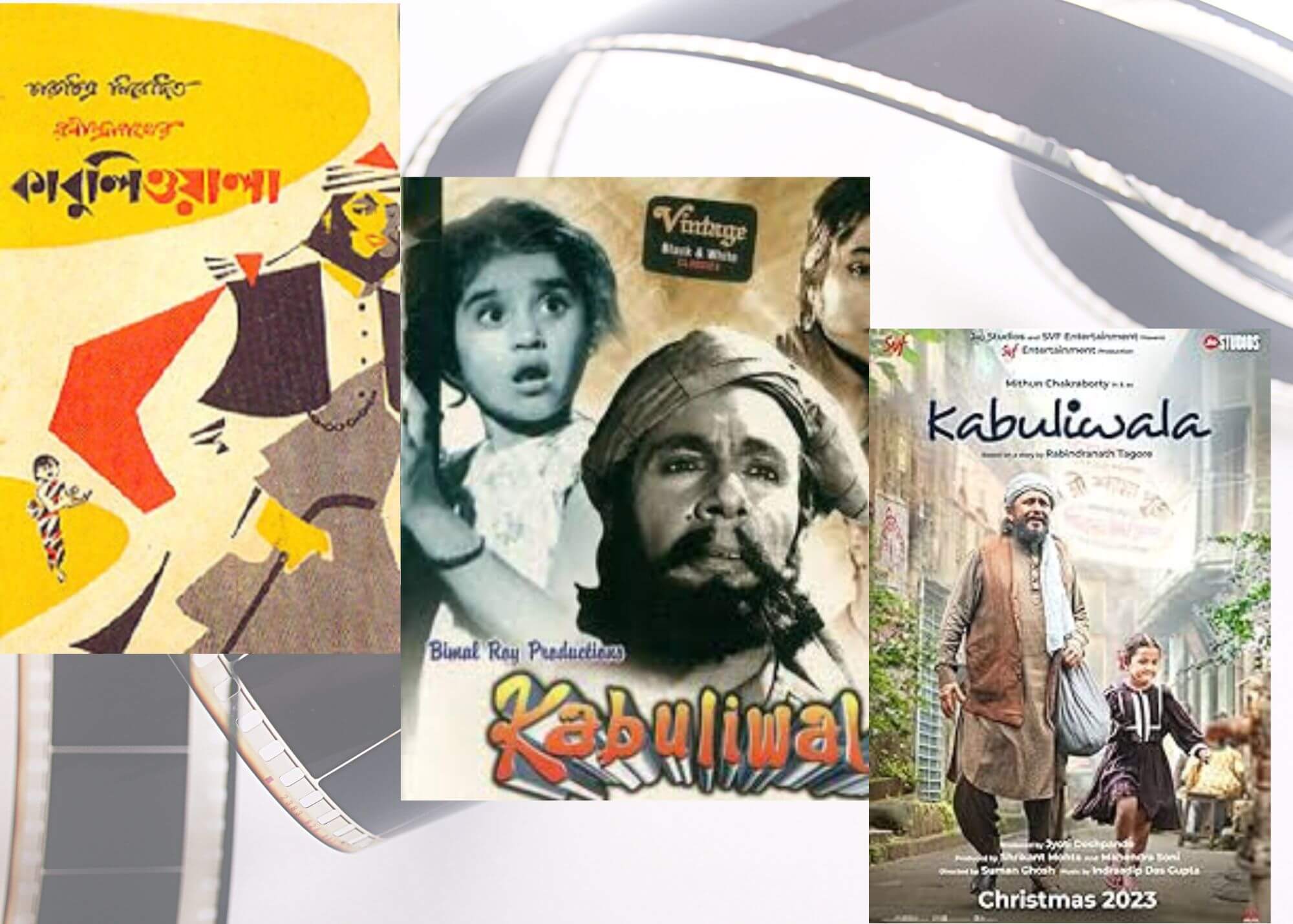

Ruchira examines Suman Ghosh’s Kabuliwala (2023) on DifferentTruths.com, blending criticism, nostalgia, and a Mithun Chakraborty tribute.
AI Summary:
·Ruchira lauds Mithun Chakraborty’s commanding performance and solid technical craft, calling the film a showcase for the actor.
· Major deviations—1965 Indo-Pak backdrop, altered character behaviour, and added courtroom climax—distort Tagore’s original emotional core.
·Earlier versions preserved timeless paternal love; this adaptation’s political overlay and communal tensions dilute Tagore’s intimacy and universality.
Yes, I am referring to the latest version of “Kabuliwala” (2023), which is based on Tagore’s timeless short story. The director, Suman Ghosh, has taken on a formidable challenge and succeeded brilliantly. This film is truly a showcase for Mithun Chakraborty, who captivates the audience in every frame. Fans of Mithun are sure to be delighted. In technical terms, the film is well-crafted.
However, I will wager you anything that Tagore would surely writhe in his grave were he asked to view the flick. To begin with, the content is tweaked beyond measure. In sharp contrast to the original story, the screenplay is set around 1965 against the backdrop of the Indo-Pak conflict. Mini’s mother, the narrator-author’s wife (Sohini Sarkar), is shown freely voicing strong prejudices against Rahmat, the Kabuliwala. Additionally, she yells at him and rudely drives him away. Much later, as the film nears its end, she is shown repenting and offering all her jewellery to Rahmat so he can raise passage money for his journey back to his native Afghanistan; this, of course, he refuses (naturally).
There is more: One day, Mini (Anumegha) is shown wandering off on her own. In that tense, communally charged milieu, the needle of suspicion points to the “alien”, quite naturally. Fortunately, Rahmat spotted her and brought her home safely; otherwise, a riot would have surely erupted. In the climactic scene, a local shopkeeper is shown mouthing profanities against Mini, following which an enraged Rahmat (his paternal instinct roused) kills the offender (in the original story, it was one of Rahmat’s creditors).
Later, the courtroom scene — trial and conviction—appears superfluous; it could jolly well have been avoided. Other sensitive points, e.g. Mini briefing her ‘Big Friend’ about the Hindu way of worship; in that politically charged atmosphere, as shown in the film, this would be irrelevant. Also, the family’s housemaid’s open animosity against the Kabuliwala—branding him as a thief, child lifter, someone whose diet comprises all obnoxious stuff — is truly irksome. That Mini’s mother gets so fiercely biased is pathetic. These features — fallacies or deliberate distortions — incorporated in the film are by no means acceptable to Tagorephiles.
I had the opportunity to watch the earlier versions many years ago. The one in Hindi stars Balraj Sahni, the other in Bengali, directed by Tapan Sinha, features the legendary Chhobi Biswas in the titular role.
What I loved about the earlier productions was the vivid depiction of eternal, undying paternal love intertwined with the relationship between parent and child. This connection transcends the barriers of time and space. To put it differently, Rahamat, the Kabuliwala’s little daughter, who lives in the hinterland of rugged Afghanistan, and Mini, scion of an affluent family and the offspring of an eminent Kolkata-based author (played by Abir Chatterji), are essentially parts of the same entity, effortlessly fusing and blending into one another.
A question arises at this point: What was the need to include the nefarious (read controversial) Indo-Pakistan 1965 conflict in such a tender, emotional, and humane story? Patriotism is a noble ideology, sans doubt, but don’t we already have a good many flicks focusing on the life-changing event? At the risk of being slammed, I would reiterate that this patriotic fervour tends to get a tad monotonous after a certain point.
Picture from IMDB

Ruchira Adhikari Ghosh brings a liberal, wide-ranging outlook shaped by extensive travel across India and abroad. Educated at Holy Child School, New Delhi, Sacred Heart Convent, Ludhiana, and Panjab University, Chandigarh, she holds a Master’s in English Literature and a postgraduate diploma in Journalism and Mass Communication. With three decades in media, she writes on travel, books, music, performing arts, women’s issues, and especially food, drawing inspiration from rich life experiences. She is our Features Editor.


 By
By
 By
By
 By
By