
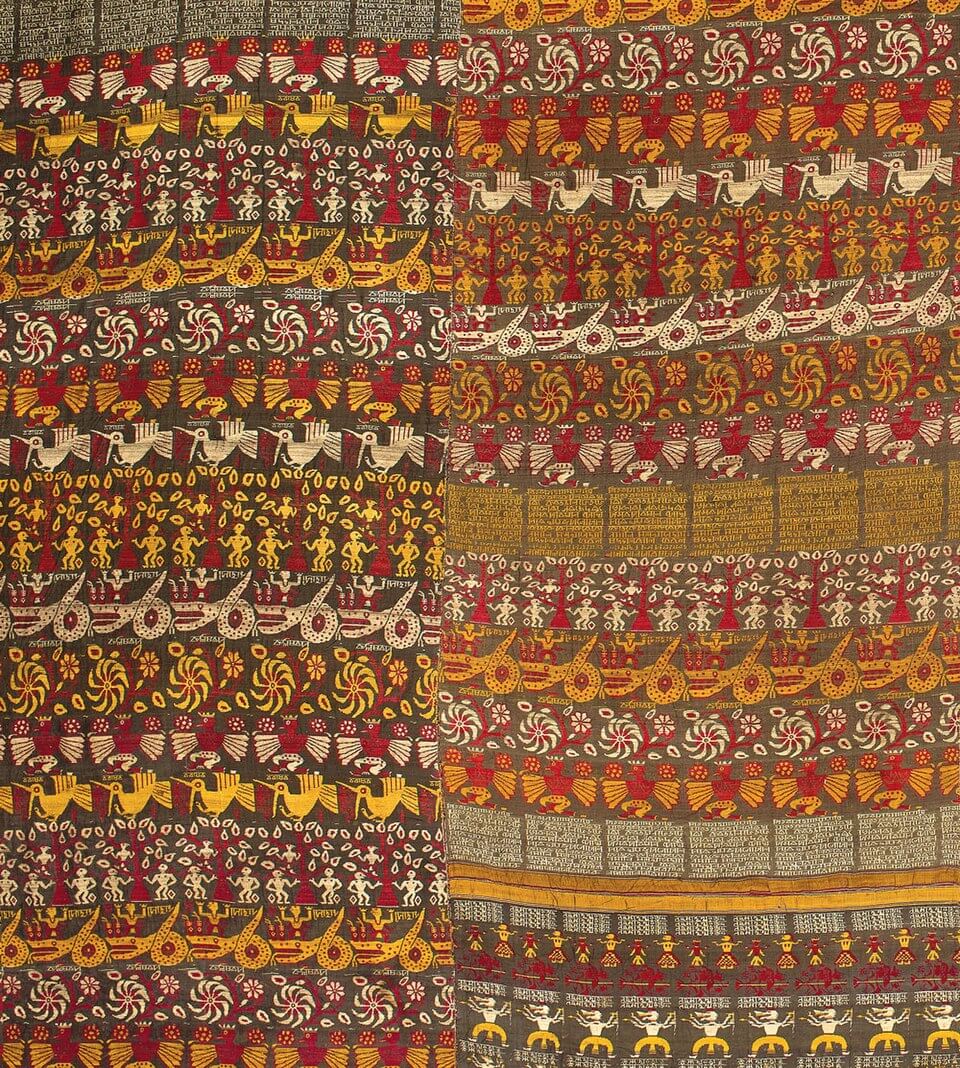
Monika spotlights Vrindavani Vastra in DifferentTruths.com: Sankardeva’s 16th-century silk epic weaving Krishna’s divine tales into Assamese civilisation.
AI Summary
- Discover Vrindavani Vastra: a 16th-century Assamese silk masterpiece weaving Krishna’s divine tales via Sankardeva’s visionary lampas technique.
- From the Koch kings’ commission to Tibetan exile and British Museum homecoming—unveiling a lost weaving art and cultural odyssey.
- Symbol of Bhakti legacy: A “civilisation in thread” poised for a 2027 Assam return, bridging faith, craft, and heritage.
Some textiles clothe a body, and then there are textiles that become civilisation itself. The ‘Vrindavani Vastra’ belongs to the latter. It is not merely a length of woven silk; it is a spiritual manuscript, a theatre of faith, and perhaps the most profound achievement of mediaeval Assamese artistry.
Created in the late sixteenth century under the visionary guidance of the saint-scholar Srimanta Sankardeva, the Vastra is among the most remarkable narrative textiles ever produced in South Asia. Stretching over nine metres in its surviving form, the fabric recreates the pastoral landscapes of Vrindavan and the divine play of Krishna. It is a work so technically sophisticated that modern historians often view its intricate weaving as a lost language, a level of craftsmanship nearly impossible to replicate today.
The Universe of Sankardeva and the Koch Kings
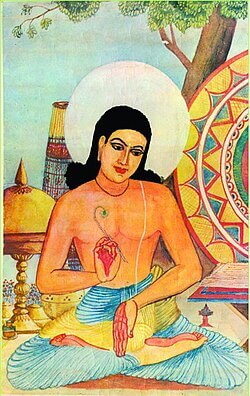
To understand the Vastra, one must first understand the intellectual and spiritual universe of its architect. Born in 1449, Sankardeva was a polymath who reshaped the cultural DNA of Assam. His Neo-Vaishnavite movement centred devotion around Krishna while creating a deeply participatory tradition through ‘Ankiya Naat’ (one-act plays), ‘Borgeet’ (devotional songs), and visual art.
Out of this renaissance grew the ‘Satras’ – monastic and cultural institutions that became centres of performance and weaving. It was here, during the sunset of his long life, that the Vastra was conceived. Commissioned by King ‘Nara Narayan’ of the Koch dynasty and his brother ‘Chilarai’, the textile was a royal devotional labour intended to bridge the gap between the court and the common devotee through visual storytelling.
The Architecture of the Loom: Before and After the Warp
The creation of the Vastra was an architectural feat of the loom. Between 1567 and 1569, lead weaver Mathuradas Burha Aata and a guild of artisans in Tatikuchi laboured over what would become a nine-metre epic.
Before the weave, the process began with the cultivation of the legendary ‘Muga and Pat silks’ of Assam. Unlike standard embroidery, where patterns are stitched onto a finished cloth, the Vastra used a complex ‘lampas technique’. This required two sets of warps and wefts to build the narrative into the structure of the fabric itself.
The result was a “theatre of the loom” organised in horizontal registers:
- Divine Landscapes: Krishna taming the serpent Kaliya, the defeat of the crane-demon Bakasura, and the intricate Ras Leela dance.
- Woven Literacy: Most astonishingly, the textile featured ‘woven calligraphic verses’ from Sankardeva’s own compositions. The weavers literally turned poetry into a structural component of the silk.
- The Functional Afterlife: In Assamese culture, visuality was inseparable from worship. The Vastra functioned as a ‘Shatarangi’ (ceremonial backdrop) for plays, effectively transforming the prayer hall into a living, breathing Vrindavan.
A Lost Language: The Silence of the Shuttle
In the context of global art history, the Vrindavani Vastra stands as a haunting chapter in the “lost art” series. The sophisticated double-weave lampas technique used by the 16th-century Assamese artisans is no longer practised in its original form. While Assam remains a powerhouse of silk, the specific mathematical precision and manual dexterity required to weave complex Sanskrit calligraphy and figurative narratives directly into the loom’s foundation have largely evaporated into history. To witness the Vastra today is to look upon a “technological fossil” – a pinnacle of human manual achievement that we can admire, analyse, and conserve, but no longer reproduce. It represents a severed link in the chain of artistic transmission, a silent shuttle that reminds us how easily a civilisation’s most complex intellectual properties can vanish if the thread of continuity is broken.
The Mystery of the High Passes and Global Exile
The biography of Vastra took a cinematic turn as it migrated from the humid plains of the Brahmaputra to the cold heights of the Himalayas. Likely moving through trade and religious networks, it entered a Tibetan monastery, where it began a second life. Monks added Chinese-style brocade borders and suspension loops, repurposing the Assamese masterpiece as a monastic wall hanging. For decades, this hybrid identity obscured its origin; early Western collectors often misidentified it as Tibetan work.
Vastra’s entry into Western consciousness began with the ‘1903–1904 Younghusband Expedition’ to Tibet. Journalist Perceval Landon encountered the textile and brought it to Britain, donating it to the British Museum in 1905. Today, the original “Great Vastra” is a diaspora of silk, with fragments dispersed across the Victoria and Albert Museum, the Musée Guimet in Paris, and the Philadelphia Museum of Art.
The Return: A Living Inheritance
For the people of Assam, the Vastra is not an “artefact” trapped in glass; it is a living ancestor. The British Museum’s 2016 exhibition, “Krishna in the Garden of Assam”, finally accorded the textile its rightful cultural context.
Recently, the conversation has shifted toward a “cultural homecoming”. The British Museum has indicated plans to loan the textile to Assam in 2027, provided that state-of-the-art preservation facilities are established in Guwahati. This would mark the first time in over a century that the Vastra returns to the air of the land where it was first dreamt into existence.
ACivilisation in Thread
The Vrindavani Vastra survives because memory endured where the silk might have failed. Within its fibres, it carries the resonance of the Bhakti movement, the sovereignty of the Koch kings, the sacred silence of Tibetan monasteries, and the peripatetic history of colonial collecting.
It remains a vibrant legacy of a time when art was not just decorative but a medium through which a people spoke to the divine. It is, quite literally, a civilisation still speaking through a thread.
References:
Feature picture : https://commons.wikimedia.org/wiki/File:Vrindavani_Vastra.jpg
In-text picture: https://en.wikipedia.org/wiki/Sankardev
Visuals sourced by the author

Born in the breathtakingly beautiful vale of Kashmir, Monika had her schooling there. A postgraduate in Business Management, an academician by profession, she is an art history enthusiast, writes poetry, short stories and paints. An avid reader, mostly biographies and autobiographies. Giving wings to her imagination through beautiful colours and words, she sings and has a following on YouTube.


 By
By
 By
By
 By
By