
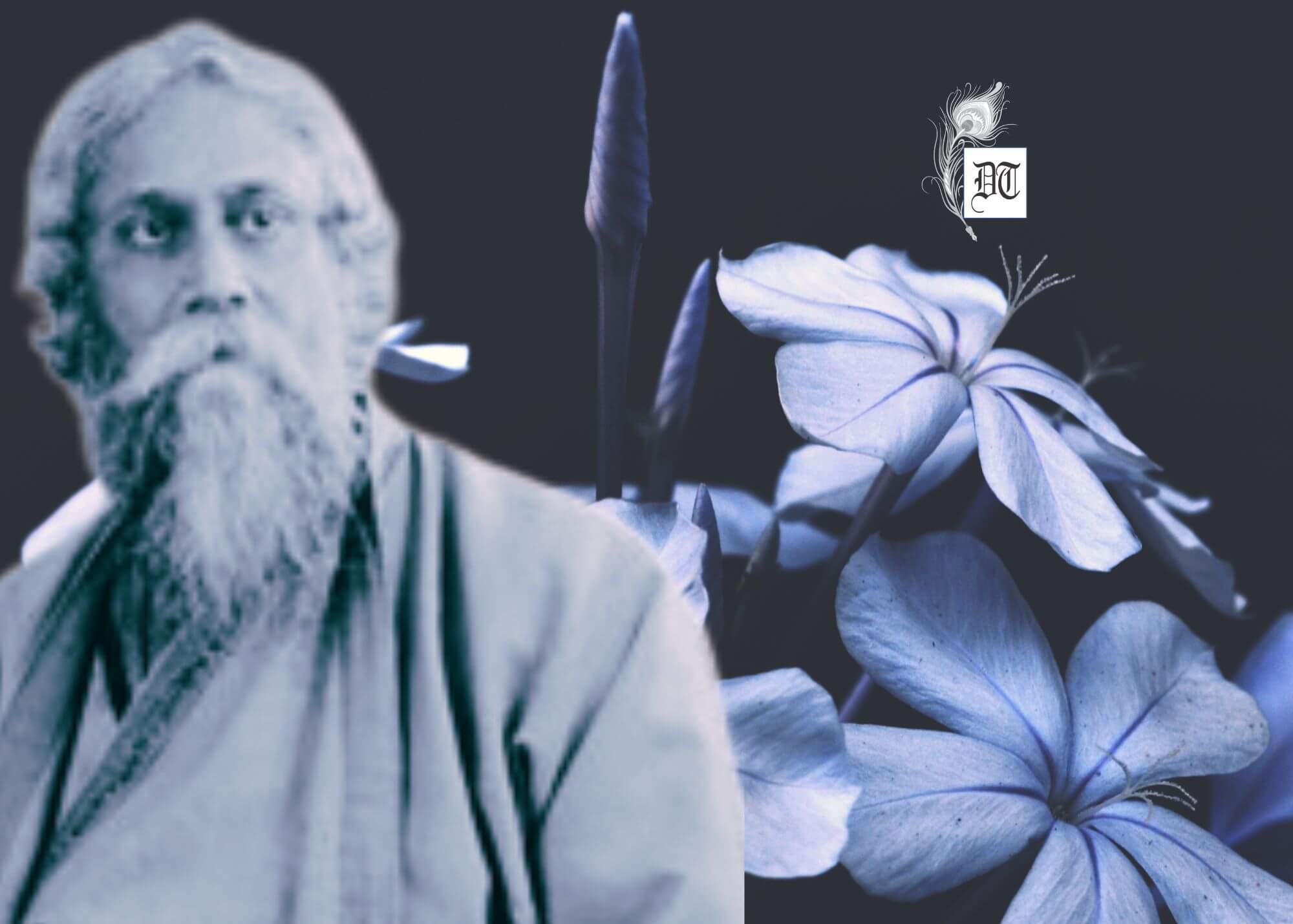

Ruchira explores Tagore’s floral imagery on DifferentTruths.com, revealing how blossoms, seasons, love, and longing shape his timeless literary imagination. A tribute on his birthday month.
The Bengali month of Baishakh (mid-April to mid-May) is familiarly hailed as Robi Mash by Tagore aficionados and literature lovers. Tagore was born on the 25th day of this Bengali month.
Speaking of Tagore, his fascination with the pristine elements – the sun, spring, monsoon, and many more – is only too well known. But how many of you know that the Bard nurtured a distinct penchant for, yes, you guessed it right, flowers?
There are innumerable references to flowers throughout his work, whether in prose poetry or lyrics. The reason behind this is not hard to decipher. Rabindranath spent a significant portion of his creative years in the expansive countryside of Bengal, surrounded by primordial nature. It would appear that not a single blossom – irrespective of its genre, hue, or shape – escaped the Bard’s notice. They ended up fascinating him, prodding him to put his emotions on paper.
To begin with, let us turn to some marvellous lines from Bhanu Singher Podaboli – an anthology of passionate romantic songs – “Mallika chameli beli kusum tulaha balika…” (O maiden, adorn yourself with a profusion of flowers, as you wait for the tryst with your loved one).
Or consider this example: “Amaar mallika bonay jokhon prothom dhorechey koli (when spring unfolded in my garden and Mallika flowers/chrysanthemums began to sprout… I yearned for Thee).” Who is unaware of “Phule phule dhole dhole” (a balmy breeze rustles over the lovely blossoms), either? Incidentally, the song is based on a Scottish ballad, Ye Banks Ye Braes. Tagore was so stunned by the haunting melody that he attempted to apply it to his own compositions.
There are so many more: “Oi phuler aagun laaglo nil digante” (the flamboyant flowers have set the azure skies ablaze).
Tagore uses floral imagery to portray myriad moods, seasons, emotions, festivals, and the like. “Badal diner prothom kadam phool korecho daan” depicts how, on a cloudy day, love blooms as the lover gifts his beloved the first Kadamba flower, typical of the monsoon season. Then we have “Chander hashi r baandh bhengeche… O Rajanigandha, tomar gondho sudha dhaalo…” On a splendid full moon night, when the earth glistens with silvery moonbeams, the poet cajoles the tuberose blossoms to exude their intoxicating fragrance, blending with the ethereal beauty that pervades everything.
There are examples galore. In a highly nostalgic song, “Purano shei diner kotha” – inspired by/based on Auld Lang Syne, a Scottish ballad by Robert Burns – the protagonist reminisces about how “Mora bhorer byalaye phul tulechi dulechi dolaye…”, narrating how every morn the little friends would pick fresh flowers and ride on swings, adding up to their overall gaiety and mirth.
In the iconic Holi song “Oray grihobashi…”, the poet depicts how the colourful Ashok and Palash blossoms smile and spread good cheer: “Ranga hashi raashi rashi ashoke polashe...”
Raktakarabi (Red Oleanders) is an allegorical and intensely musical social drama that epitomises Tagore’s love for flowers. In the play, the crimson flowers symbolise passion, love and aspiration for freedom.
It would be appropriate to conclude with reference to a significant prose poem by Tagore captioned ‘Camelia’. In this narrative, the poet-protagonist falls in love with a young woman named Kamala, who is a fellow commuter on a local bus. She suddenly becomes the centre of his universe. However, Kamala doesn’t appreciate his occasional overtures. She gets off the bus, and the poet rarely sees her again. After learning from reliable sources that Kamala’s family vacations in Darjeeling every year, he decides to go there in search of her.
Upon his arrival, he discovers that the family has skipped the vacation that year. As he plans to return, he meets an acquaintance whose sister gifts him a beautiful flowering plant with lovely camellia flowers.
The flower reminds him of his crush, prompting him to take it home, despite the challenges of carrying a potted plant in a railway carriage. Later that year, the poet follows the trail of Kamala’s relatives and finally reaches an obscure tribal village where Kamala’s engineer uncle is posted. The poet pitches a tent on the banks of a nearby river, with the potted Camellia plant keeping him company. While he waits for Kamala, the Camellias begin to bloom. One day, he spots Kamala and her family picnicking on the opposite bank of the river. He spots a dandy-looking youth sitting beside Kamala, smoking an expensive cigar. Meanwhile, Kamala appears to be lost in her own private world.
During this cataclysmic moment, the poet’s world crumbles; he realises that the aforementioned youth is possibly a family-approved suitor (read lover) who has come to vacation with them. He feels as if he doesn’t belong there at all.
Before his departure, the poet summons the tribal girl who has kept house for him. He wants the girl to carry the potted plant to Kamala as an anonymous farewell gift. When the girl arrives, he notices that she has already plucked a Camellia blossom and tucked it in her raven tresses. The vibrant flower contrasts beautifully with her dark, radiant skin, symbolising that elements of nature perfectly complement a child of nature, an epitome of innocence. Relieved, he returns to his familiar surroundings.
Picture design by Anumita Roy

Ruchira Adhikari Ghosh brings a liberal, wide-ranging outlook shaped by extensive travel across India and abroad. Educated at Holy Child School, New Delhi, Sacred Heart Convent, Ludhiana, and Panjab University, Chandigarh, she holds a Master’s in English Literature and a postgraduate diploma in Journalism and Mass Communication. With three decades in media, she writes on travel, books, music, performing arts, women’s issues, and especially food, drawing inspiration from rich life experiences. She is our Features Editor.


 By
By
Well conceived. Would have preferred other references to elaboration on Camelia. For that matter Krishnakali ( sandhyamalati) not touched. Debi babu has a book on the subject.🙏