
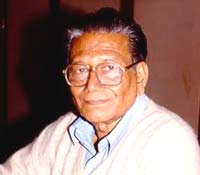
Sudipta celebrates legendary writer Manoj Das, a master of fiction whose profound storytelling captivated readers, in a DifferentTruths.com feature.
AI Summary
- Manoj Das was a revered bilingual Indian writer, blending wisdom, humour, and satire in over 70 works.
- His writings explore self-discovery, nature, and Indian culture, reflecting a unique style of magic realism.
- He garnered prestigious awards like the Padma Shri and Padma Bhushan for his literary contributions.
Manoj Das, the legendary bilingual writer from Odisha, was born in Shankari, Balasore. He stands tall in the hearts of his readers for his simplicity and the profound language he drew from the depths of silence.
A writer par excellence, he made an unparalleled mark in the world of fiction. Few writers could match his extraordinary storytelling ability. As a gifted storyteller, he had the rare talent of keeping readers captivated from beginning to end.
If one delves deep into some of his remarkable story collections—Stories of Light and Delight, The Bridge in the Moonlight and Other Stories, and Tales Told by Mystics—one can uncover intriguing characters and humorous tales, each carrying a moral for the readers. He is indeed one of the best storytellers in the world who has authored over 70 works in his lifetime. Some of his notable works in English include Temples of India, Persian Tales of Wit and Delight, Tales from Many Lands, A Bride Inside a Casket, The Escapist, My Little India, and Chasing the Rainbow.
The most promising quality of Manoj Das lies in his ability to depict the contemporary issues in a subtle yet serious tone, gently urging readers to realise the complexities of life.
Manoj Das, one of the finest literary craftsmen of the 20th century, possessed the rare skill of weaving words into gripping tales. His natural storytelling style is clearly evident in his renowned book, Legends of India’s Temples, where he meticulously portrays even the tiniest details of the Black Pagoda.
This book is a wonderful celebration of India’s temples, capturing the golden glories of sacred monuments from the north, south, east, and west. As readers delve into the mysterious tales behind each structure, they will surely develop a vivid mental image of India’s rich history. Das created harmony between life and literature by forging a profound connection with nature. His writings consistently reflect a deep bond with his homeland. The essence of Indianness permeates his works, especially in his novel A Tiger at Twilight, where he weaves together memory, myth, and tradition while creating an identity with nature. The unique characteristic of his writing is the surrender of the individual self to the vast, divine realm of the Almighty. This novel is a testament to his artistic excellence in deriving delight in the rustic glory of nature. In the rich tapestry of the rural beauty, he mastered the art of blending the tales of the past with the present.
His main characters in some stories were children. He regarded nature as a profound teacher like Rousseau and Tagore in his works.
His quest for attaining eternal truth in each of his creations elevates him in his readers’ minds. Often, he tries to unravel the mystery of nature in his notable works. As a visionary among the poets of his time, he established the immortal beauty of nature, one that transcends the fleeting moments of our existence.
For his extraordinary achievements of excelling in the skill of writing in his mother tongue and English, he was honoured with India’s highest civilian honours, the Padma Shri and the Padma Bhushan. The legendary writer, Manoj Das, who was born in pre-colonial times, began to weave his tales against the backdrop of traditional rural India, where feudalism started to decay with the rise of freedom movements in India. Most of his works were woven in the post-independence period, exploring the themes of self-discovery, freedom, spirituality, and transformation by creating oneness with his native culture.
A quest for understanding oneself and the world became his greatest strength in storytelling. He has mastered the art of creating magic realism in his novels, unlike his other contemporary English writers. Often, he delves into the psychological complexities of his protagonists to portray their inner turmoil with remarkable sensitivity. One can easily trace the charm of Indian soil in his works. In the post-World War II scenario, he never failed to mention the disillusionment of modern life, associated with a nostalgia for the nation’s glorious past. Critics often credit Das for blending the wonders of mystic power with modern ideas.
Das has stated in many interviews that he began in English to reach a broader audience. His stories, inspired by fairytales, and all the realistic stories also capture the genuine Indianness in their approach. His amazingly simple stories, suffused with humour, elevate his creations to world-class literature. Often, critics trace a tinge of satire in his works for the deceitful priests of India. He sharply criticises the pompous activities of superstition-driven Indian traditions and customs with enough wit and wisdom.
Credit is due to Manoj Das for uplifting the cultural and literary heritage of Odisha on a global scale through his incredible collection of stories, poems and novels in the Odia language. He began writing from the tender age of fourteen in his mother tongue. As an exceptionally brilliant writer from Odisha, he never looked back, and the unfailing effect of his heart-touching writings on the readers of Odisha remains intact so far.
Most of his notable creations in Odia include novels: Tandralokara Prahari (2000), Aakashra Isara (1997), Amruta Phala (1996), Prabhanjana, Godhulira Bagha, Kanaka-Upatyakara Kahani, Sesha Tantrikara Sandhanare, and others. The notable short stories are Upakatha Sataka, Abu Purusha, Sesa Basantara Chithi (1966), Manoj Dasanka Katha O Kahani (1971), Dhumabha Diganta O Anyana Kahani (1971), Samudra-kulara Eka Grama (Balya Smruti, 1996), Aranyaka (adapted to Aranyaka, 1994), Bhinna Manisha O Anyana Kahani, Abupurusha O Anyana Kahani, Lakshmira Abhisara, Abolakara Kahani, Aranya Ullāsa, etc.
His stories are so humorous that one can hardly stop laughing while reading his books. At the same time, an irony runs through his works – a medium for his rebellion against the pretentious display of empty values of modern Indians. He is actually a writer of simplicity, with a powerful voice echoing the hearts of rural India.
The common men of our nation find him to be a representative of their emotions and sentiments. It’s his timeless creations that will become a stepping stone for the next generations to learn and relearn the incredible values of India to reflect the truest values of humanity through writing.
Picture from Wikipedia

Dr Sudipta Mishra is an Indian author and poet. She is an erudite scholar of English language literature in the Puri District of Odisha. She is a source of inspiration for the young generation of this country. Her free verse in romantic and melancholic poems is appreciated around the world. She has penned more than a hundred articles.

 By
By
 By
By

 By
By