
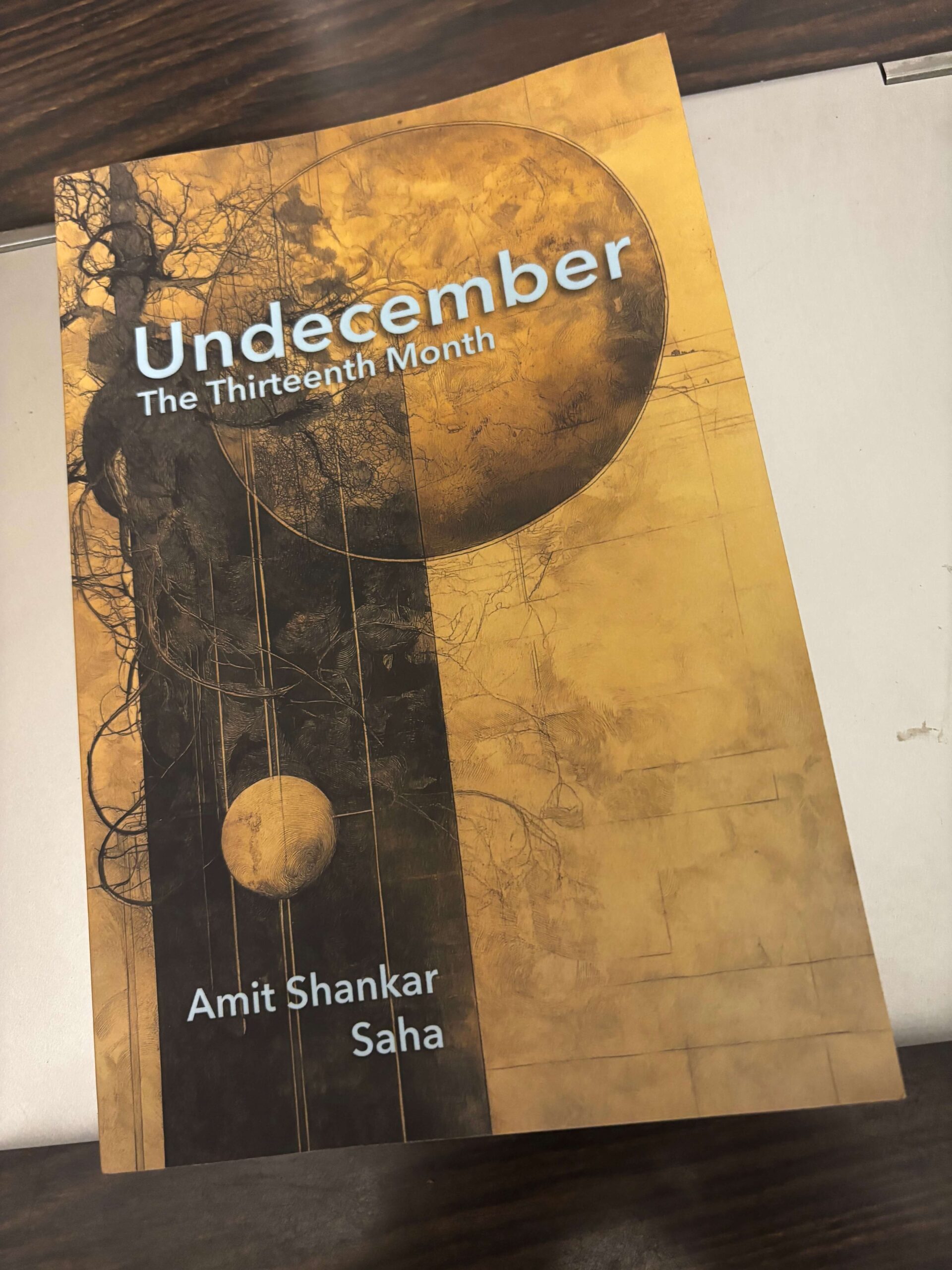
Prof Sanjukta explores Amit Shankar Saha’s Undecember in DifferentTruths.com, a profound collection navigating the timeless lunar cycles of love and longing.

AI Summary
- Thematic Depth: Analyses love poetry’s evolution from classical traditions to Saha’s contemporary focus on unrequited longing and emotional catharsis.
- Structure: Explores the collection’s unique organisation into Shukla Paksha and Krishna Paksha, mirroring the waxing and waning moon.
- Modern Voice: Highlights Saha’s use of dark humour, scientific metaphors, and direct imagery to revitalise traditional romantic tropes.
Love poetry is the most referenced sub-genre in the domain of world poetry, from Kalidas’s Meghdutam, the cloud-courier; Sangam poetry; the poems in Geet-Govinda; the bhajans of Meera Bai; the quatrains of Omar Khayyam; the poems of Mirza Galib, Amrita Pritam, and Kamala Das; to the poetry of Edmund Spenser; William Shakespeare’s sonnets; Dante’s love poems for Beatrice in the Divine Comedy; Petrarch’s love sonnets; the love poems of John Donne; poems of Lord Byron, Rabindranath Tagore, Pablo Neruda, Ted Hughes, Simon Armitage, et al. In fact, till recently, perhaps love poetry could be regarded as a male-poet-dominated arena, though this claim can be somewhat contested, as we remember the love poems of Elizabeth Barrett Browning, Emily Dickinson, Sylvia Plath, Adrienne Rich, Carol Ann Duffy and Jo Harjo, among others.
Poetry has been the time-tested enabler for catharsis, for poets overwhelmed by the emotion of love, which challenges definition. Poets have often addressed love as indestructible, as well as irrationally passionate or even self-destructive. Love poetry remains timeless, though it is also often tagged as cliched, presumably due to the use of overworked metaphors, similes and images. In Undecember, poet Amit Sankar Shah untangles the myriad strands of loving moments that have affixed themselves in the mind’s album and are viewed and reviewed by the poet in simple lines weighted with philosophic profundity, a truly commendable chemistry in terms of poetic expression that stimulates the mind and touches the heart.
In the brief Preface of Undecember, poet Amit Sankar Saha explains, “A solar year consists of twelve months. But if a lunar year has to correspond to a solar year, then an extra month is required. This leap month is ‘Undecember’.
Saha’s Undecember is a slim volume of deeply subjective poems centred around that timeless theme of love and longing, which has resonated in lines of poetry through centuries. The poet tells the reader that the 30 poems in the volume are ‘intensely personal and yet aesthetically accessible’
Focusing on the waxing and waning phases of the moon in the Hindu almanack, the poems in Undecember are arranged under two sections. The title of the first section, Shukla Paksha, is a compound Sanskrit word, implying the bright ‘first fortnight and a day’ of the waxing moon, and the section is titled Krishna Paksha, also a compound Sanskrit word that means ‘second fortnight and a day’ of the waning moon.
In the title poem, ‘Undecember’, the poet is lost in a world so ‘light’ that it is no longer discernible, as it ‘levitates out of sight’. The following poem, ‘Enigma of Silence’, loses itself in a ‘universe of expanding quietude’. The mood of the poems is of a pervasive sense of resignation of a lovelorn poetic sensibility, sorrowfully yearning for the lost beloved. The poems do not take on a posturing of victimisation due to the coldness and abandonment of the beloved. Instead, in the true spirit of the romantic lover, the poet dusts off the dust of memories, clinging to timeless moments that remain ensconced within the mind of the poet amidst the desperate hurry of the quotidian life.
Interestingly, two poems, ‘The Missing Tooth’ and ‘Denture’, break free from the well-known stereotypes of passionate and ardent exclamations of hurt and pain in such outstanding expressions of amour and inimitable dark humour: ‘Till then let us rinse our mouth verbally, for we always maintained oral hygiene’ (Denture). In the poem ‘Ecology of Love’, on the other hand, the poet refers to fossil-fuelled love and carbon dust, and in the poem ‘Flavour of Missing’, the poet even cites the Doppler effect. These are truly contemporary enunciations of unrequited love that sit like a thorn in the mind, that hurt and relentlessly remind the poet of timeless moments of love and union.
The poet seems to struggle with a sense of despair in a bid to rise out of the quagmire of erased dreams and promises. Also, we cannot help but notice the Keatsian refrain in the line ‘so happy to see you happy’ (Deep) and the lover’s clutching of the departed beloved’s side-bag, ‘sometimes I / hug it to sleep’ (Your side-bag). In a rare image, the poet declares that he would squeeze the universe in his palms as he wishes that the poems read out by the loved one will waft towards him (Wish Fulfilment). But in the poem ‘Telescope’, the poet finds out that, focused on the loved one, ‘but you don’t come any closer’, and in ‘Thereafter’, in another startling image, the poet writes, ‘One more cup of memory / I must drink / before the dawn.’
In Undecember, which can be regarded as a sequel to his previous volume of poems titled Baramasi, Indian English poet Amit Shankar Saha cherishes, celebrates and ruminates about the enigma and enchantment that enmeshes lovers, whose union can be simultaneously one of passionate intimacy and yet can exist in an intensely vulnerable microcosm that is threatened by storms of changing times. The ardent poems in Undecember underscore unequivocally that love is sustained in the lines of the poet, lines that register that perpetual quest for the elusive beloved, a lifelong, riveting hide-and-seek that spins to the crest of ecstasy and surrenders to the heart-wrenching agony of loss.
Reading Amit Shankar Saha’s Undecember will be a rewarding experience for readers of poetry, as the volume registers the impression that poetry can be deep yet direct, spinning an astonishingly nuanced web of heart-rending lines, which form the very essence of successful romantic poetry.
Cover photo sourced by the reviewer

Dr Sanjukta Dasgupta is a poet, short story writer, critic, and translator. She was a General Council of Sahitya Akademi, New Delhi, member and the Convenor English Advisory Board Sahitya Akademi, New Delhi. She is the President of the Intercultural Poetry and Performance Library, Kolkata and has twenty-six published books. Her poems have been translated into German, Serbian, Bengali, Hindi, Punjabi, Kashmiri, and Tamil.



 By
By
 By
By