
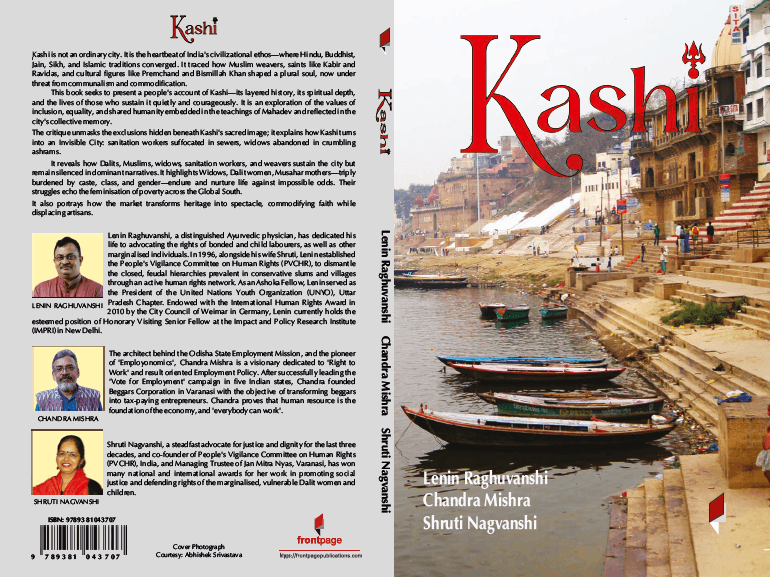
Abhishek highlights a pathbreaking new book on DifferentTruths.com, exploring the invisible voices and the spirit of resistance in modern-day Kashi.

AI Summary
- Shifting Landscapes: The book analyses how rapid modernisation and political projects are transforming Benares from a sacred, integrated space into a delineated “Kyoto-style” city.
- Voices of Resistance: It spotlights marginalised communities—Dalits, weavers, and women—reclaiming their narratives against structural invisibility and neoliberal “development” models.
- Spiritual vs. Political: The authors argue for “heritage justice,” urging a reimagining of Kashi that protects pluralist traditions while ensuring dignity for its vulnerable inhabitants.
Varanasi, i.e. Benares or Kashi, the oldest living city, has been at the helm of political and electoral affairs in India for a few years. Whatever made it ‘the oldest living city’ was visibly interfered with for the first time after 2014, as far as the notion of ‘contemporary’ holds. This project to transform Kashi into Kyoto is rapidly changing its geography, which has been the dwelling place of history entangled with mythology. Benares is one of the few cities in the world where history and geography meet [Eck, 1983]. Now it is no longer the case.
Secondly, the religiosity of Benares is peculiar in that it never distinguished between the sacred and the inhabited. The sacred was not distant from human inhabitation. It was inside it and vice versa. In that sense, Benares was a vast sacred complex [Vidyarthy, Jha and Saraswati, 1979] that equally contained the profane. The changed geographical landscape has delineated the Divine from the Social and the Sacred from the Profane.
This development is an ongoing process. It has disturbed the inherent social order, everyday lives, human activities, religious traditions, and long-established psycho-spatial and mental landscape of the locale. The people have been deliberating, discussing, retaliating, resisting and challenging this development through every means possible. But the written literature- on account of which Benares could easily boast to be the most-written about ‘maximum city’- has consistently fallen short of recording the life of city-dwellers as a variable in time. Most books written by European and Indian scholars on Benares are frozen in time and treat this city as eternal and unchanging, as people do.
There may be a valid reason for that: the landscape of Benares almost remained unchanged and sort of virgin until the eighties. The physical and social change became visible only with the turn of the century, and that was the time when the local intellect had already migrated to Delhi/Lucknow or abroad. It is pertinent to mention here that right from Tulsidas to Kabir and Namvar Singh to Uday Shankar, all great intellectuals and wise people had to leave Benares for one reason or another. So, whatever was written on Benares became a reproduction of sorts, that too by mainly by European scholars. Diana L. Eck has sincerely tried to capture Benares’ life from very close during her long stay here in two of her volumes, but other than that, scholars of Benares like Rana PB Singh or Baidyanath Saraswati kept themselves limited to profiling the Kashi, its geomancy and sacredness, but never its people.
Of late, this much-awaited scholarship is emerging with the emergence of the sacred as anti-political. In this broader context, ‘Kashi’, written jointly by Lenin Raghuvanshi, Chandra Mishra and Shruti Nagvanshi and published (in 2026) by Frontpage Publication, becomes a pathbreaking work that clearly states that to fully understand Benares, one must listen to the invisible voices of this city.
Stories, Characters and Narrative
‘Kashi’ is a modest book of around 150 pages, but it effectively captures the ethos of the city in twelve chapters. Establishing the imperative of this book in the opening chapter titled ‘Need’, the authors move on to frame the debate in terms of ‘Exclusion Vs Resistance’ in the next ten chapters that include case studies and stories from the margins. The authors acknowledge this at the outset in the first chapter. “…Kashi is a civilisational spirit. A place where spirituality has coexisted with resistance, where saints and revolutionaries have walked the same streets, and where the divine has always lived in dialogue with the people. Yet today, Kashi stands at a critical crossroads. Although global narratives often highlight Kashi’s ghats, temples, and cultural heritage, the everyday lives of marginalised communities—including Dalits, Muslims, women, weavers, sanitation workers, and informal labourers—frequently remain absent from mainstream conversations.”
This chapter thus sets the tone for a narrativisation, which is embedded in the mythological legend of Mahadev, where “he appears as a Chāndāla to reveal that every living being is a manifestation of Brahm— reject all forms of untouchability and social hierarchy.” Employing the mythological motif to build a narrative of resistance against exclusion, authors are very clear that “…bringing these spiritual values into contemporary discourse can help ensure that development honours not only Kashi’s visible grandeur but also its inclusive, compassionate essence.” Here, the occurrence of the ‘D’ word (development) not only offers a contrasting-competing narrative to the unfolding story of ‘Kashi’ but also enables and justifies the notion of resistance against exclusion.
The principal characters around which the story of Benares is narrated are Dalits, women, Muslims, weavers, widows, informal labourers, sanitation workers, and Musahars. Youth, social activists and intellectuals are also part of the story, but they always appear at the end, offering a beacon of hope for re-imagining Benares on a dual-city model: “protecting Old Banaras as a pluralist heritage city, while developing New Varanasi to meet modern needs. Only then can Kashi remain both a city of pilgrims and a city of dignity.”
This idea of re-imagining the oldest living city aspires to dismantle the “structural invisibility produced by systems of patriarchy, caste hierarchy, and economic deprivation”. This invisibility, according to authors, functions outside the sacred complex of so-called eternal Kashi and constructs another city within which is almost always silent: “Widows in crumbling ashrams, Dalit mothers in understaffed clinics, Musahar women in brick kilns or kitchen gardens: together, they expose how a city celebrated as eternal survives on the silence and survival of its women.”
While asserting and reclaiming the space for the excluded, they question the notion of ‘eternity’ too: The future of Kashi’s spirituality hinges on this tension. Will the city be remembered as a stage where rituals were choreographed for cameras, or as a living community of seekers?” The answer provided again uses a mythological source to connect: “The Mundaka Upanishad warned long ago that rituals performed for display are ‘fragile boats.’ That warning echoes today at the ghats of Kashi, where devotion risks dissolving into performance.”
The Praxis
The theoretical articulation and storytelling converge into praxis in the tenth chapter titled “Banaras Convention 2003: A Turning Point”. In 2003, the Banaras Convention, organised institutionally by Dr Lenin and Shruti, brought together activists, scholars, and citizens to demand justice, dignity, and pluralism. According to the authors (and obviously organisers too), it was a ‘turning point’ where memory, resistance, and collective imagination came together. The chapter revisits the convention as an example of how Kashi continues to inspire collective struggle and renewal.
The authors provide an overall socio-political and economic background to the event, which establishes the Banaras Convention as a conscious process, not as an accident. Globalisation was accelerating. India’s markets were opening, foreign corporations were entering villages, and the gap between rich and poor was widening (Patnaik,2003: 14). The Iraq War had revealed the violence underpinning global power, sparking solidarity among anti-war activists in India (Roy, 2004: 5). Meanwhile, the Gujarat carnage had exposed how communal hatred could tear apart India’s plural social fabric (Engineer, 2003: 11). And beneath these headlines, everyday caste violence—bonded labour, untouchability in health services, denial of education—persisted with chilling normality (Mendelsohn &Vicziany, 1998: 63).”
The chapter narrates the story of the Convention as it progresses to the People’s SAARC that was held parallel to the official South Asian Association for Regional Cooperation (SAARC) summit. Photos of the Convention that are included in the chapter include one from the 2014 event that saw Swami Avimukteshwarananda presiding on the stage. Swami now holds the seat of Shankaracharya of Jyotish Peeth. He has been in the headlines much recently and earlier too, when he initiated a movement ‘Mandir Bachao Andolanam’ against the demolition of temples in the newly built Kashi Vishwanath corridor. He is one of the few figures in Banaras who shares the ideological narrative put forward by the authors.
Authors navigate through the scholarship of Banaras in Chapter 11, highlighting the role of universities, educational institutions, poets and journalists as a building block for envisioning Kashi. They write: “As global crises multiply—authoritarianism rising, inequality deepening, climate unravelling—the quiet rhythms of Kashi’s students, poets, and journalists carry an unbroken promise: that truth will not be silenced, that memory will not be erased, and that hope, like the Ganga itself, will continue to flow.”
The last chapter sums up the story of Kashi as the story of India itself- from exclusion to resistance, from commodification to survival, and from radicalism to hope. Reaching the end of the book provides the reader with an overarching feel of the ‘eternal’ city, not only in socio-economic terms but more so in its spiritual and historical significance. Authors usefully provide a sort of snapshot of each chapter at the end to sum up their journey and trajectory of the narrative. They write: “Taken together, these threads form a single tapestry: Kashi as a city of survival, of unfinished revolutions, and of unyielding dignity.”
A City as Future
The book winds up with providing a few concrete policy recommendations for envisioning the city in terms of heritage justice for its weavers, artisans, women, Musahars, Dalits and their children. It recommends treating the city as a museum not of artefacts, but of communities. Recalling Henri Lefebvre’s idea of a democratic urban space, authors prescribe that Kashi must guarantee that ghats, lanes, and public resources are accessible to all castes, genders, and religions; and no corridor should displace the poor in the name of beautification.
So, without referring directly to any infrastructural or developmental project, or any political and administrative actor, this book essentially focuses on the communities of Kashi, stands in their favour against the onslaught of neoliberal crony capital, and proposes an alternative to the ongoing development model for Banaras.
Much aptly, and in the same spirit too, authors have dedicated ‘Kashi’ to the invisible city-dwellers who sustain this city, to the women who refuse silence, to the weavers who weave dignity into fabric, to the students who dare to dissent, to the journalists and poets who remind us that words can be weapons of truth.
Cover photo sourced by the reviewer

Abhishek Srivastava is a Delhi-based journalist with more than two decades of experience in various media outlets. He is currently the Associate Editor of India Quarterly (Hindi), a flagship peer-reviewed journal of the Indian Council of World Affairs (ICWA). He has published three original titles, including an ethnography, a travelogue, and a collection of long-form stories from conflict-ridden areas of India. He has translated over a dozen books on history, politics, and sociology.


 By
By
 By
By
 By
By