
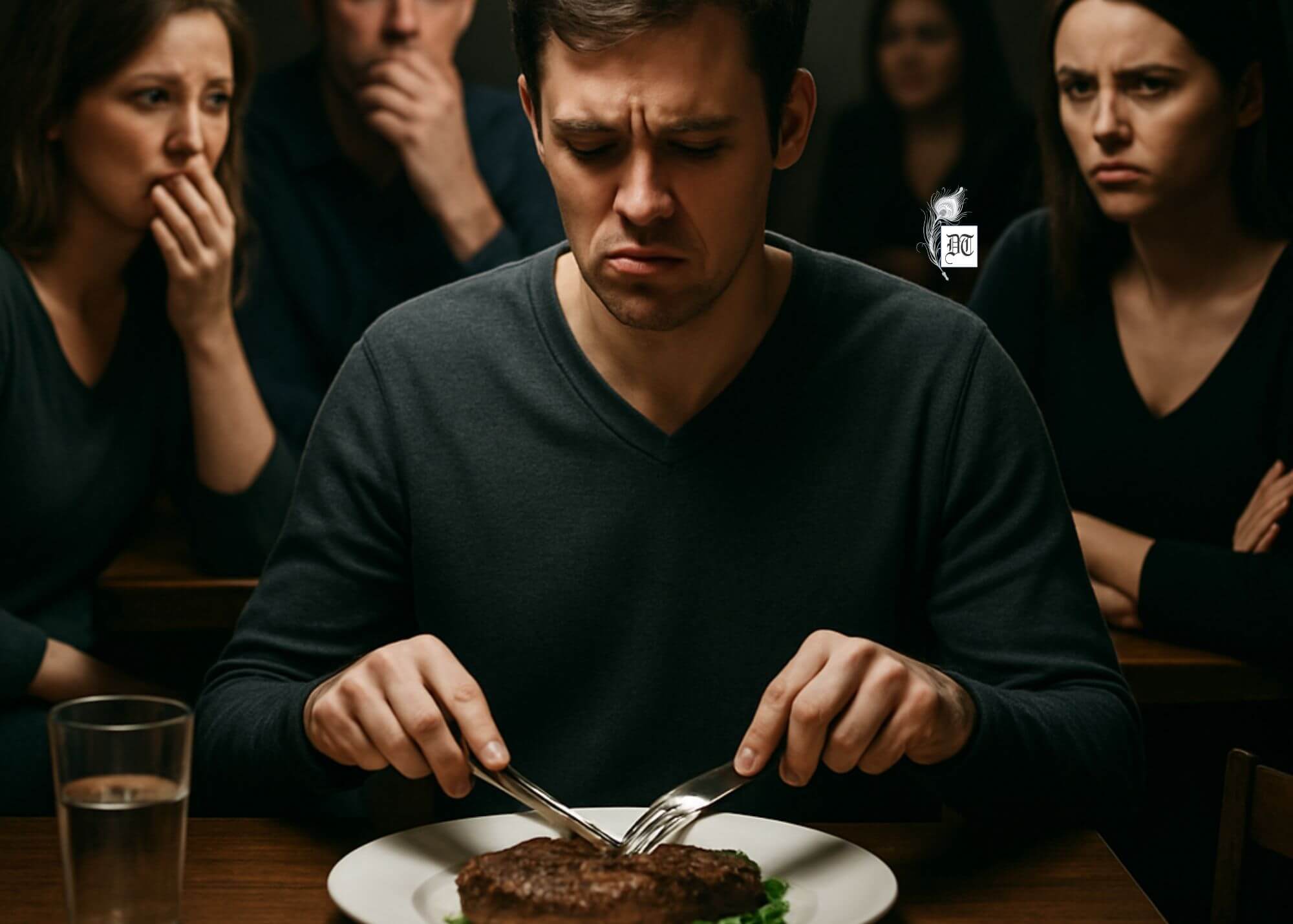
Sohini at DifferentTruths.com dissects the moral theatre of modern veganism, exposing how food choices became a battleground for virtue and judgement.
AI Summary
· Sohini critiques how diet has evolved into a public performance of ethics.
· It questions moral superiority tied to food choices and labels.
· It argues that true virtue lies in empathy, not dietary declarations.
There was a time when food was simply food. One ate what one liked, what one’s grandmother cooked, what one’s geography permitted, and what one’s conscience could comfortably ignore. Then came the modern vegan crusade, armed not with pitchforks but with quinoa bowls and a terrifying moral vocabulary.
Today, what you eat is no longer merely a culinary choice; it is a referendum on your character.
The steak eater, once simply a person who enjoyed a well-seared ribeye, has been reclassified as something between a mediaeval barbarian and an ecological terrorist. Meanwhile, the vegan—whose lunch consists of almond milk foam, ethically distressed tofu, and a salad that looks like a botanical experiment—has quietly assumed the moral altitude of a Himalayan sage.
The transformation is remarkable.
Somewhere between the rise of Instagram activism and oat-milk cappuccinos, diet became a virtue. Not private virtue, mind you, but public, performative virtue. Food is now an ethical broadcast system. Every bite announces your place on the moral ladder.
Order a steak, and you are, apparently, endorsing planetary destruction, systemic cruelty, and the emotional trauma of cows everywhere.
Order a kale bowl, and you have, by implication, solved ethics.
One might admire the efficiency.
In previous centuries, judging a person’s moral fibre required time: conversation, observation, perhaps even friendship. Now the process is gloriously streamlined. Simply glance at their plate.
Is there bacon?
Case closed.
The curious part is not the compassion. Compassion for animals is hardly a radical concept. Civilisations from India to Greece have debated the ethics of eating animals for millennia. The problem lies not in kindness but in the peculiar zeal with which modern dietary virtue is weaponised.
The contemporary vegan does not merely abstain. Abstinence would be too quiet, too modest. Instead, abstinence must be accompanied by commentary, education, and occasionally a faint air of spiritual superiority.
You are not merely eating chicken. You are participating in a moral failure.
There is, of course, a delicious irony in all this. The same civilisation that cannot agree on geopolitics, climate policy, or the definition of truth has discovered absolute certainty about lunch.
Lunch, it turns out, is where the ethical revolution will be fought.
Observe the language. A steak eater is not simply someone with a different diet. He is “violent”, “complicit”, “colonial”, and sometimes even “toxic”. One half expects a tribunal where the accused must explain, under stern lighting, why he ordered lamb chops.
Meanwhile, the vegan floats through this courtroom of cuisine, draped in a halo of moral purity. The logic is simple and comforting: if I eat the right things, I must be the right kind of person.
History suggests otherwise.
Human cruelty has never been confined to meat-eaters. Some of the most ruthless ideologues in history subsisted quite comfortably on vegetarian diets. Tyranny, alas, has never required bacon.
Conversely, a person capable of demolishing a steak might also be capable of kindness, generosity, and even the occasional act of moral courage. The world stubbornly refuses to divide itself neatly along dietary lines.
But moral simplicity is tempting.
It is much easier to believe that virtue lives in the grocery aisle. That by selecting oat milk instead of dairy and lentils instead of lamb, we have somehow purified our participation in the messy machinery of modern life.
This illusion is particularly attractive because it is measurable. Climate change is vast, politics is exhausting, and global inequality is depressing. But lunch—lunch is manageable.
You can fix lunch.
You can photograph lunch.
You can hashtag lunch.
And best of all, you can judge other people’s lunch.
Social media has elevated this habit into a minor sport. The comment section now functions as a kind of dietary confessional. Someone posts a photograph of a steak, glistening under restaurant lighting, and within minutes, the moral auditors arrive.
“How can you eat that?”
“Do you know what cows go through?”
“Educate yourself.”
The steak remains silent.
Meanwhile, the vegan bowl—composed of ingredients flown in from four continents—glows with ethical radiance.
None of this, it should be said, invalidates veganism as a personal choice. Many people adopt it thoughtfully: for health, for animals, for the environment. Those reasons are legitimate and often admirable.
But personal ethics, once converted into public moral theatre, acquire an unfortunate edge. They begin to resemble less a philosophy and more a social ranking system.
The plate becomes a passport to virtue.
And like all passports, it allows entry to some while excluding others.
The irony is that food, historically, has been one of humanity’s most generous bridges. People meet, share, exchange recipes, and laugh across cultures over a table. A Bengali fish curry, an Italian ragù, a Japanese sushi platter—these are not merely meals but civilisational stories.
Reducing this vast culinary landscape to a moral scoreboard feels oddly impoverishing.
Because the truth, inconveniently, is that goodness cannot be reliably measured by dinner.
A person may eat tofu and still be insufferable.
Another may eat steak and still be decent.
Ethics, frustratingly, demand more than menu choices. It requires humility, empathy, and the occasional reluctance to treat strangers like villains because of what they ordered.
So, by all means, eat vegan if you wish. Save the cows, the climate, and your cholesterol.
Just resist the urge to save humanity one judgemental salad at a time.
The rest of us, barbarically chewing our steaks, might yet surprise you.
Picture design by Anumita Roy

Sohini Roychowdhury is a renowned Bharatanatyam dancer, choreographer, artistic director, speaker, social activist, and professor of Natyashastra. She founded Sohinimoksha World Dance & Communications in Madrid/Berlin/Kolkata/New York. A visiting professor of dance at 17 universities worldwide, she won several awards, including the “Mahatma Gandhi Pravasi Samman” by The House of Lords, the Priyadarshini Award for Outstanding Achievement in Arts, and the Governor’s Commendation for Distinguished World Artiste. She has also authored several books, including ‘Dancing with the Gods’.

 By
By
 By
By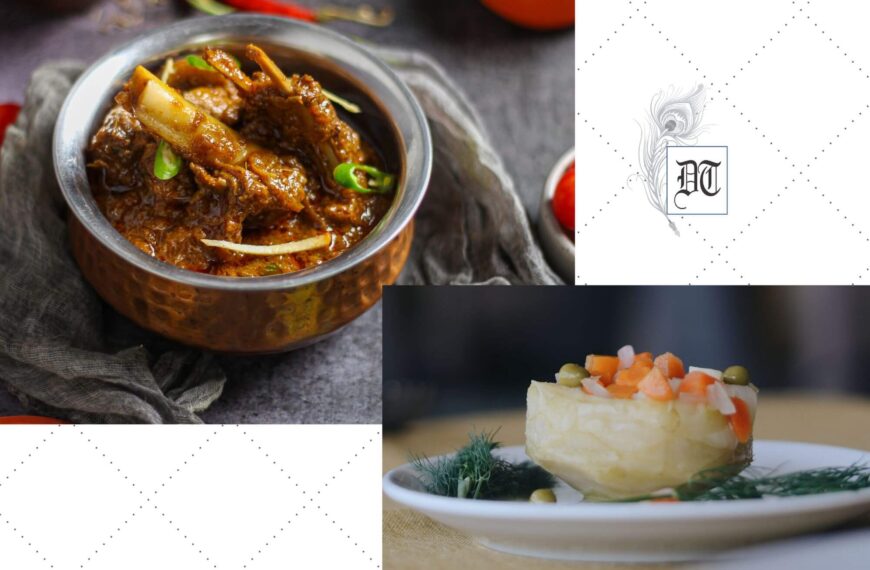
 By
By