
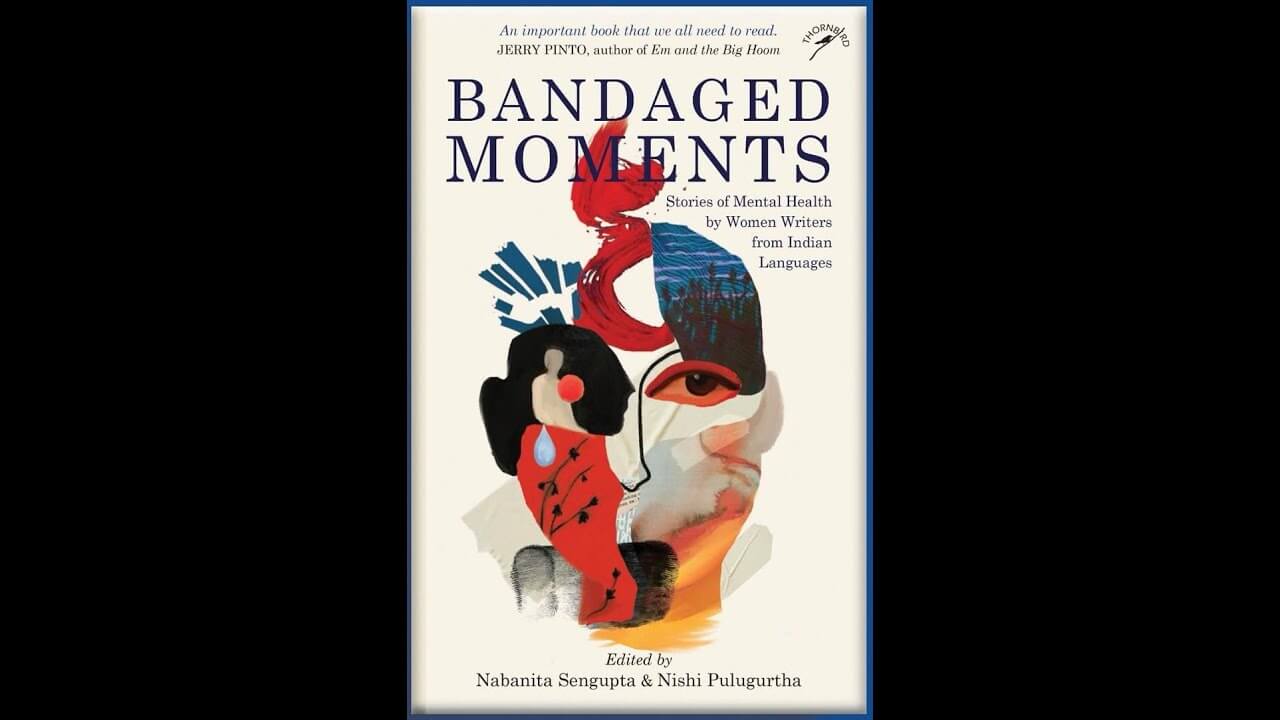
Prof Sanjukta reviews Bandaged Moments for DifferentTruths.com, exploring how Indian women writers translate domestic trauma into powerful narratives of resistance.

AI Summary
- Systemic Oppression: The anthology highlights how patriarchal structures—marriage, domestic labour, and economic deprivation—trigger profound mental health crises in women.
- Cultural Stigma: Stories contrast clinical definitions of illness with the harsh reality of “madness” as social ostracism and the medicalisation of poverty.
- Literary Liberation: Using Emily Dickinson’s metaphors, the collection tracks the transition from “bandaged” incarceration to the pursuit of absolute liberty.
Women’s unofficial histories, both globally and locally, have very often included the presence of madwomen in attics. The attic has been a symbol of incarceration and repression, and for women, life has always been governed by two signifiers, permission and control.
Bandaged Moments: Stories of Mental Health by Women Writers from Indian Languages, edited by Nabanita Sengupta and Nishi Pulugurtha. The 26 stories written by women writers that have been translated from 17 Indian languages quite unnervingly gesture towards the unhappiness of women trapped within the patriarchal structures of the domestic space, family, marriage, bearing and rearing of children, domestic labour, abusive husbands and other oppressive family members.
Interestingly, the common denominator that emerges from these stories is the systemic neglect of women linked to economic deprivation, low or no education and rarely any treatment of the mental disorders that may have affected them. It is important to keep in mind that psychiatric clinics are not common in rural India; the villagers are not aware of doctors who treat mental health issues.
Mostly, both in urban and rural areas, abnormal behaviour is instantly stamped as madness, and social ostracism is common. Mental illness includes depression, anxiety disorders, schizophrenia, eating disorders and addictive behaviours. Some of the common mental health issues that are routinely listed include inexplicable sadness, inability to concentrate, mood swings, excessive fears, panic attacks, paranoia, hallucinations, suicidal or homicidal impulses associated with manic depression. Mental health issues are different from neurodegenerative diseases such as Parkinson’s, Alzemeir’s and dementia.
Interestingly, and not without irony, one of the world’s most highly regarded medical institutions, the Mayo Clinic in the USA states, ‘There’s no sure way to prevent mental illness. However, if you have a mental illness, taking steps to control stress, to increase your resilience and to boost low self-esteem may help keep your symptoms under control”.
On the other hand, many websites issue caveats about mental health awareness campaigns being linked to global capitalism serving the needs of a profit-maximising economy, by shifting the blame for distress from systemic, socio-economic factors onto the individual, transforming mental health into a commodity.
These studies therefore conclude that, ‘Instead of addressing the root causes of distress—such as inequality, precarious labour, and lack of community—the focus is placed on fixing the individual through therapy, medication, or wellness apps, making them better “units of production”. Also, the studies observe that problems rooted in political and economic structures are often “medicalised” or “pathologised,” treating natural emotional responses to a dysfunctional, stressful, and competitive environment as individual illnesses. Moreover, it has been noticed that ‘the rise of digital mental health (apps, chatbots) has created a “behavioural futures market,” where emotional data is extracted and commodified to predict and shape user behaviour. These arguments do not derecognise mental health problems, but serve as an awareness campaign about the insidious strategies of the open market economy.
The choice of title of this fascinating book of short stories, ‘Bandaged Moments’, taken from Emily Dickinson’s poem, is absolutely brilliant. The Introduction by the editors includes an excerpt from Dickinson’s poem that was first published in 1862-
‘The Soul has Bandaged moments —
When too appalled to stir —
She feels some ghastly Fright come up
And stop to look at her —'
However, the spirited Emily Dickinson was not overwhelmed by the bandaged moments. After all, moments can be traumatic, but there are chances of moving on from the entrapment of bandages. So in the same poem, these lines of the repressed Dickinson, whose poems were published posthumously, also rejoice in bandage-free moments of absolute liberty-
The soul has moments of escape —
When bursting all the doors —
She dances like a Bomb, abroad,
…
Touch Liberty — then know no more —
The 26 translated stories in Bandaged Moments track a varied register, but the sharp difference between the advantaged and disadvantaged individuals representing diverse communities stands out with disturbing starkness.
Trishna Basak’s story, Borderline, showcases the obsessive-compulsive disorder of Jaba. From washing hands to washing rice, Jaba was unable to hold herself back, and as a result, her marital family sent her off to her parents’ home for treatment. However, instead of a fairy tale ending, the story ends with Jaba’s husband watching her, standing stark nude in the moonlight and bathing with buckets of water raised from the well in the courtyard. The English translation by the editor of the book, Nishi Pulugurtha, is admirably reader-friendly.
The Story of Laughter by Sebanti Ghosh, translated by Nabanita Sengupta, tracks the inner turmoil that perturbs observant, intelligent and disgruntled Meghna, who was unable to burst out laughing though she was aware that laughter was a therapy that would help her uncork the bottle within her, which was crammed with moments of dissatisfaction, suspicion, sadness, pain and unfulfilled sexual desire. The only time she felt like laughing was to witness her husband’s pride in parenthood. She resolved to join a laughing club.
Bleak Noon by Jhumur Pandey is a story about a mad young woman. Pagli is rather different. It emphasises unequivocally how poverty, hunger, joblessness, and lack of labour security destroy families. The story is not about mental health as a genetic or biological disorder; it is a story about the exploitation of the poor by a capitalist patriarchal ecosystem. These three stories referred to here were written by Bengali women writers. The following Bhojpuri story, Didiya, by Sandhya Sinha, is about social stigma, culture of silence and suffering that is a common feature of middle-class homes in South Asia. That Nibha was Didiya’s daughter and not her sister led to the complex networks of suffering and secrecy.
The Gujarati story, Vicious Cycle, written by Saroj Pathak, stands out from the rest of the stories in this volume. It is a very sexist story about a male tailor’s obsessive fantasy and desire for a young customer, Avanti, who grew out of frocks, transitions into a woman and eventually wears clothes designed for young, adult women. The stressed tailor Virgi eventually joins a men’s tailoring shop, as he is assailed by qualms of conscience about his obsessive male gaze.
The story, Breaking Out, by Zakia Mashhadi, is a first-person narrative of repression and anger, emanating from the utter negligence of the woman Uzma by her husband, who uses her as a service provider. The sharpening of pencils and the homicidal desires are expressed with brevity. Is Uzma pacing towards becoming a manic depressive? The story does not tell us.
The Tale of a Toilet by Sudha Adukala is a powerful story about a mental disorder rooted in poverty, deprivation, and denial of basic facilities in villages. Anusha, having a toilet of her own, changed her life. She grew up in a home without a toilet or a bathroom, bathing with her clothes on, as she had to use the open spaces for toilet purposes and public open-air facilities for bathing and was aware of the torture of compulsive voyeurism.
Mind it, Madhuriya is an interesting story of a village girl. Whenever adolescent girls seemed listless and depressed, the treatment advised was inevitably marriage, and the much-coveted prescription was that domestic labour in the marital home was the best antidote in such cases. Oh, My Benefactor is a Maithili story written by Usha Kiran Khan. The story is about abject rural poverty, cruelty, gender issues, murder, rape, violence, and a newborn being eaten by dogs. The girl Gheghoi was a dimwit, and so she was ruthlessly exploited by men. She became pregnant and was killed along with her newborn baby.
The Marathi story, Taj Mahal, is about a derelict, mentally unstable, wild woman without any address or home who receives compassion and care from a gentleman as he makes it possible for her to enter the precincts of the Taj Mahal. She eventually commits suicide, as she perceives sympathy from the privileged is momentary if not impulsive. The Marwari story, Sanjeevani, is about epistolary exchanges between two friends. The story lays bare how families and mothers, who uncritically consolidate patriarchy, destroy the self-confidence of their daughters, Sanju and Kabutari. Also, the Odia story, Shadow, is a heart-wrenching story of a mother in a poverty-stricken family who is driven to commit suicide. The Tamil story Glass Walls, by Lakshmi Kannan, translated by the author herself, stands apart as a story in which an upper-middle-class family suddenly witnesses the drifting away of their young, handsome, talented young son from his familiar environment of parents, relatives, home and office. Despite visits to celebrated temples guaranteeing solutions, despite visits to the psychiatrist’s chamber, Aditya increasingly becomes encapsulated in an interiority that distances him from existential challenges and experiential reality.
Nabanita Sengupta and Nishi Pulugurtha’s Bandaged Moments, a brilliant compilation of 26 short stories selected from 17 languages, will surely benefit students and researchers of medical humanities, apart from readers of meaningful fiction.
Cover photo sourced by the reviewer

Dr Sanjukta Dasgupta is a poet, short story writer, critic, and translator. She was a General Council of Sahitya Akademi, New Delhi, member and the Convenor English Advisory Board Sahitya Akademi, New Delhi. She is the President of the Intercultural Poetry and Performance Library, Kolkata and has twenty-six published books. Her poems have been translated into German, Serbian, Bengali, Hindi, Punjabi, Kashmiri, and Tamil.




 By
By
 By
By
 By
By