
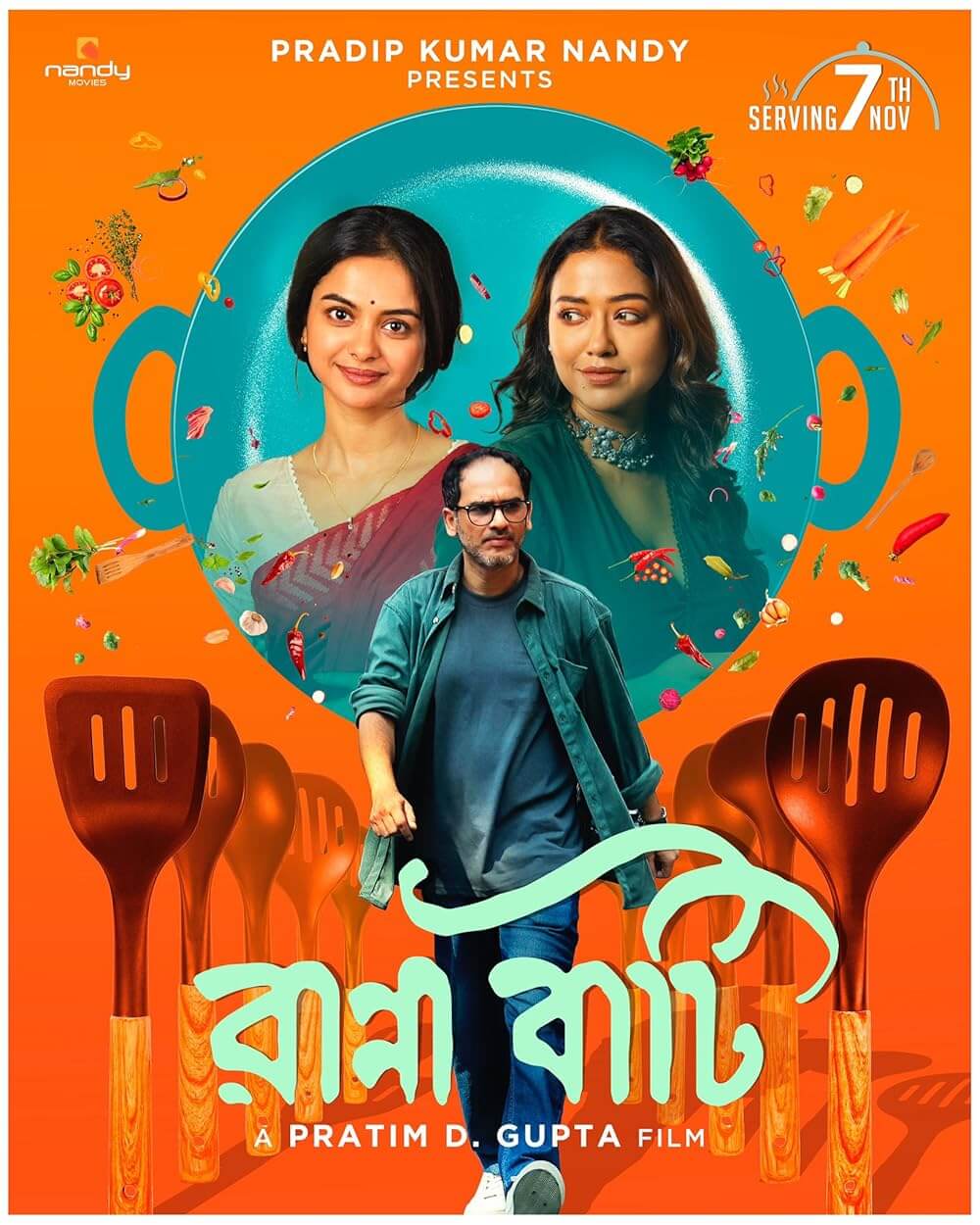

Ruchira reflects on Pratim D. Gupta’s Ranna Bati for DifferentTruths.com, exploring how culinary heritage heals a fractured father-daughter bond.
AI Summary
· Emotional Resilience: Shantanu, a widowed software engineer, navigates the turbulent grief of his teenage daughter, Mohor, through their shared loss.
· Culinary Connection: Discovering his late wife’s secret recipes, Shantanu attempts to bridge their emotional distance, eventually finding guidance from instructor Rita.
· Healing & Hope: The film masterfully portrays food as a poetic language of love, offering a second chance at happiness for two broken families.
Pratim D Gupta is a brilliant contemporary film director of Tollywood. His films consistently revolve around family life, with a primary focus on food. “Maacher Jhol” and “Ahare Mon” are a few examples of his work. Pratim’s latest film, “Ranna Bati”, in the same genre, is already garnering popularity.
The film offers a humane glimpse into human life, holding out new hopes for emotional recuperation and the quiet strength found in everyday life.
An adage says, “The way to a man’s heart is through his stomach.” In the case of “Ranna Bati”, it appears to be slightly tweaked to be read as: The way to a daughter’s heart is through her stomach…
The film revolves around the life of a 40-year-old software engineer, Shantanu Dasgupta (Ritwik Chakraborty), a widower who grapples with the challenges of single parenthood. His wife, Supriya, having succumbed to cancer, he is left alone to handle his daughter Mohor (debutante Idara Dasgupta), a wild, unruly teenager (you can’t blame her since she is unable to overcome the trauma) who is deliberately nasty, rude and snappy whenever she interacts with her surviving parent.
The silently grieving girl appears besotted with her mother’s culinary style. Her mom, Supriya (played by Solanki Roy), was apparently a passionate cook who documented her life through recipes, each reflecting her daughter’s growing tastes and her own gamut of emotions.
One day, Shantanu discovers his wife’s cookbook and, forthwith, decides to try the recipes to win back his daughter’s affection and end her caustic remarks.
His initial clumsy attempts to cook up dishes for Mohor end in a fiasco. On one occasion, he even forgot to light the gas stove! On top of it, the dishes he carefully prepares are consistently overlooked by the wily youngster.
Disheartened but unwilling to give up, Shantanu decides to join a cookery class. In this scenario, he encounters the instructor, Rita Ray (Sohini Sarkar), an attractive, sophisticated, and highly efficient young woman. Having learnt about the confused widower’s predicament, she decides to assist him and starts giving him personal attention.
Gradually, the two develop a camaraderie, and in the process, Shantanu discovers her tragic past: she lost her infant child in a kitchen accident and subsequently separated from her spouse.
The diehard moviegoers might consider Rita a modern-day Mary Poppins, lending a poetic touch to food and making it a symbol of love, care, and affection.
Meanwhile, Mohor begins to suspect that her father is having an extramarital relationship with the cookery coach. Finally, after tailing her father, she comes face-to-face with Rita. Instantly, she is bowled over by the lady’s charm and affectionate disposition. In what may be termed a change of heart, she even plans to fill the void left by her dead mother in their house by asking Rita – with whom she has already bonded – to step in. Egged on by the daughter and some of his close friends, Shantanu and Rita begin to ponder the issue.
Eventually, the two bereaved, disconsolate hearts decide to give their lives a second chance.
All said and done, “Ranna Baati” is an in-depth exploration of how food can function as a language of love as well as a bridge between hearts.
Feature picture from IMDb

Ruchira Adhikari Ghosh brings a liberal, wide-ranging outlook shaped by extensive travel across India and abroad. Educated at Holy Child School, New Delhi, Sacred Heart Convent, Ludhiana, and Panjab University, Chandigarh, she holds a Master’s in English Literature and a postgraduate diploma in Journalism and Mass Communication. With three decades in media, she writes on travel, books, music, performing arts, women’s issues, and especially food, drawing inspiration from rich life experiences. She is our Features Editor.



 By
By
 By
By

 By
By