
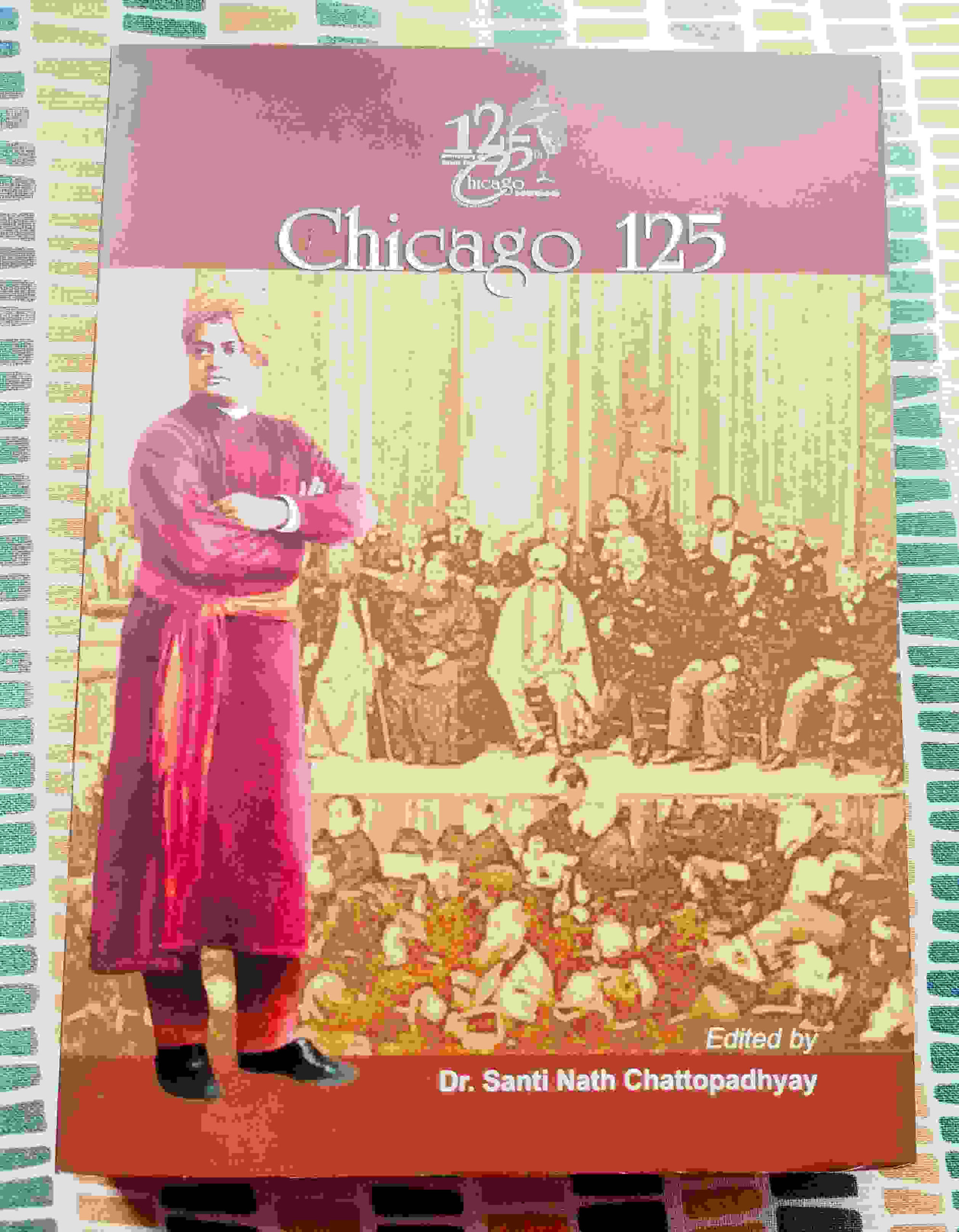
Prof Nandini reviews CHICAGO–125, that triumphantly reclaims Swami Vivekananda’s universal vision, offering a critical compass for our fractured modern world, exclusively for Different Truths.

This volume, CHICAGO–125 critically engages with the continuum of comparative philosophy, aesthetics and intercultural ethics, emphasising the editor’s accomplishment in renewing the universal and humanistic legacy of Swami Vivekananda for a fractured modern world. This book offers a critical and interpretive analysis of CHICAGO–125, an edited volume commemorating the 125th anniversary of Swami Vivekananda’s Chicago Addresses (1893).
Edited by Dr Santi Nath Chattopadhyay, the volume explores the philosophical, aesthetic, intercultural, and global significance of Vivekananda’s thought in two parts. Part I focuses on the philosophical and intercultural evaluations of the Addresses, while Part II extends their aesthetic and global resonance in the context of modern crises–war, displacement, economic instability and cultural deracination. The volume situates the lectures in contemporary humanities discourse and argues that Vivekananda’s integration of spirituality, science and culture remains crucial for the moral and intellectual renewal of modern civilisation.
CHICAGO–125 is not just a commemorative collection; it is a profound philosophical re-engagement with one of the most transformative moments in global intellectual history, the 1893 Chicago Addresses of Swami Vivekananda. Under the sensitive and rigorous editorial stewardship of Dr Santi Nath Chattopadhyay, this volume offers a series of research papers that span philosophy, aesthetics, cultural studies, theology and political reflections of Swami Vivekananda. The editor’s introduction, written with both scholarly precision and interpretive empathy, establishes the premise that Vivekananda’s addresses are not to be read as historical artefacts but as living documents that continue to speak to the ethical and existential anxieties of the twenty-first century.
The book’s structure allows readers to trace the movement of Vivekananda’s thought from metaphysical inquiry to cultural critique. The Chicago moment, as the editor and contributors suggest, was not simply an encounter between India and the West; it was a collision and convergence of civilizational epistemes. Vivekananda’s oratory becomes the site of resistance and renewal, a spiritual intervention in the politics of modernity. Dr Chattopadhyay’s critical engagement transforms the volume into a dialogue between past and present, faith and reason, East and West.
The first part of CHICAGO–125 gathers essays that interpret Vivekananda’s Chicago Addresses as philosophical meditations on human unity, religious pluralism and epistemic decolonisation. The contributors, ranging from philosophers to literary and cultural scholars, revisit his speeches as acts of intellectual subversion that challenged the moral complacency of Western modernity. For Vivekananda, the proclamation of the divinity of every soul was a rhetorical flourish and a revolutionary statement against colonial hierarchies and sectarian dogmas.
Dr Chattopadhyay’s editorial introduction situates this section in a dialogic framework, where Indian Vedantic philosophy meets Western humanism in mutual critique and enrichment. The essays reveal how Vivekananda’s Advaita Vedanta becomes a cosmopolitan ontology, a philosophy of interconnectedness that transcends the binaries of self and other, sacred and secular. His spiritual cosmopolitanism, anchored in Advaita yet open to intercultural exchange, anticipates the contemporary discourse of global ethics.
The section also offers powerful analyses of Vivekananda’s synthesis of faith and reason. In emphasising that religion must be scientific in method, and science must be spiritual in purpose, Swami Vivekananda advanced a philosophy that dissolves the false dichotomy between rationalism and spirituality. The contributors carefully trace this integration to his larger vision of modern India, where education and technology must serve the awakening of human consciousness.
One of the most engaging aspects of CHICAGO–125 lies in its attention to the aesthetic dimension of Vivekananda’s discourse. Several contributors treat his speeches as aesthetic performances that merge philosophical insight with poetic form. The editor’s commentary deftly connects Vivekananda’s oratory to the Indian aesthetic tradition of Alaṅkāra Śāstra, while also positioning it in the Western rhetorical lineage of Burke and Emerson.
The Chicago Addresses, when read through this aesthetic lens, become works of art as much as spiritual declarations. The sonorous cadence of Vivekananda’s delivery, his rhythmic invocation and his emotive appeal to humanity constitute what Dr Chattopadhyay aptly presents as the poetics of spiritual modernity. The essays here suggest that Vivekananda’s eloquence derives from literary adornment and authenticity; his words radiate conviction because they arise from lived experience and inner realisation.
The aesthetic analyses also explore Vivekananda’s use of metaphor and symbol, particularly his invocation of the motherhood of religion and the oceanic imagery of unity. These are not mere tropes; they embody his vision of the sacred as dynamic and inclusive. As the contributors note, Vivekananda’s oratory embodies the triadic Indian aesthetic ideal of Satyam-Shivam-Sundaram–truth, auspiciousness, and beauty–as the foundation of all creation. His rhetoric fuses the ethical, the spiritual and the aesthetic into an indivisible whole.
If the first part of the volume establishes the philosophical and aesthetic framework of Vivekananda’s thought, the second part powerfully situates it in the contemporary global crisis. The essays in Part II engage directly with the modern world’s suffering, the bloodiest wars, forced migrations, economic depression and the collapse of moral imagination under the weight of pseudo-Western materialism. In this context, the contributors reinterpret Vivekananda’s Chicago Addresses as a blueprint for global ethical renewal.
Dr Chattopadhyay’s editorial insight ensures that these essays avoid both idealisation and reduction. Vivekananda is treated as a saintly abstraction as well as a modern visionary, a thinker whose ideas on education, gender, science and culture remain relevant to global discourse. The contributors argue persuasively that his belief in universal brotherhood and Vasudhaiva Kutumbakam prefigures contemporary debates on multiculturalism and global human rights. His insistence that true civilisation depends upon the moral elevation of humanity stands as a prophetic warning to an age dominated by algorithmic ethics and digital alienation.
This section also highlights the global aesthetic expansion of Vivekananda’s thought. His oratory has inspired literature, theatre, music and intercultural art across continents. The contributors trace his influence on modern Indian writers and global thinkers alike, positioning him as a precursor to postcolonial and transcultural dialogues. His Chicago vision becomes an enduring metaphor for intellectual hospitality and moral courage, an antidote to the fragmentation of contemporary thought.
A significant contribution of CHICAGO–125 lies in its nuanced understanding of Vivekananda’s views on science and technology. Far from opposing scientific inquiry, Vivekananda envisioned science as the natural ally of spirituality. He believed that both sought truth through observation and introspection, and that India’s regeneration required a synthesis of scientific rationality and spiritual discipline. Several essays in the volume explore this synthesis in detail, linking it to Vivekananda’s call for a new education system grounded in holistic development. His assertion that education is the manifestation of the perfection already in man is reinterpreted as a pedagogical philosophy of integrated consciousness, one that unites intellectual, ethical and aesthetic training. The editor’s commentary underscores the continuing relevance of this vision in today’s fractured world, where technological progress outstrips moral awareness.
Vivekananda’s insistence that science and literature must grow together, each refining the other, reflects his modernist sensibility. For him, technology was not an end but a means toward human welfare; literature was not entertainment but illumination. His vision of a modern India rejuvenated by the confluence of knowledge and compassion remains one of the most enduring contributions to Indian intellectual history. This, precisely, is the thrust of the volume, Chicago-125.
In its intellectual depth and ethical urgency, CHICAGO–125 transcends the boundaries of a commemorative anthology to become a critical text of global humanism. Dr Santi Nath Chattopadhyay’s editorial brilliance lies in orchestrating a symphony of diverse voices that speak across philosophy, aesthetics and intercultural dialogue. The volume reminds readers that Vivekananda’s message is neither archaic nor utopian; it is radically contemporary, addressing the moral fractures of modern civilisation with a language of synthesis and hope.
In an era defined by technological acceleration and spiritual exhaustion, this volume reaffirms that the path forward lies in the integration of science and spirituality, of art and ethics, of East and West. The Chicago Addresses, as illuminated by this collection, continue to challenge humanity to rise above division and rediscover the divine unity that underlies existence. Dr Chattopadhyay’s CHICAGO–125 is both a scholarly landmark and a moral compass. It compels the readers and the seekers to revisit the universal vision of Swami Vivekananda as a living, evolving philosophy for a world desperately in search of balance, compassion and meaning.
I wish the book all success.
Notes
- The World’s Parliament of Religions took place in Chicago in September 1893, where Swami Vivekananda delivered six addresses that marked the beginning of a global dialogue on religious pluralism.
- Quotations from Vivekananda are taken from The Complete Works of Swami Vivekananda (Advaita Ashrama, 1989).
- Dr Chattopadhyay’s introduction to CHICAGO–125 underscores the need for a poetics of spiritual modernity, emphasising the unity of ethics and aesthetics in Vivekananda’s vision.
- For theoretical context, the review draws upon concepts of Indian poetics such as rasa, dhvani and auchitya as elaborated in classical Sanskrit aesthetics.
Works Cited
Chattopadhyay, Santi Nath, editor. CHICAGO–125
Nandy, Ashis. The Intimate Enemy: Loss and Recovery of Self under Colonialism. Oxford University Press, 1983.
Panikkar, Raimon. The Intrareligious Dialogue. Paulist Press, 1999.
Radhakrishnan, S. Eastern Religions and Western Thought. Oxford University Press, 1939.
Tagore, Rabindranath. The Religion of Man. Allen and Unwin, 1931.
Vivekananda, Swami. The Complete Works of Swami Vivekananda. 9 vols., Advaita Ashrama, 1989.
Cover image sourced by the reviewer

Prof Nandini Sahu is the Vice Chancellor of Hindi University, West Bengal, and a celebrated Indian English poet and Amazon’s Best-selling Author. Formerly a Professor and Director at IGNOU, New Delhi, she is the author/editor of 23 books. A double Gold-Medalist, her accolades include a Gold Medal from the Vice President of India for English Studies, the Michael Madhusudan Academy Award-2024, and the Tagore Samman-2025. Her expertise spans Folklore, Hindu Studies, Comparative Literature, and Critical Theory.


 By
By
 By
By
 By
By