

Dr Dhiraj states that the ancient wisdom of dignified death meets a humble bee’s procession, revealing a profound lack of love and companionship in modern life, exclusively for Different Truths.
An old Indian is saying — Fortunate is the one who gets four shoulders to carry their body to the cremation ground. It speaks of dignity in death, the importance of companionship, and the value of being remembered. In a world where loneliness is becoming more common—even in the middle of crowds—this old wisdom still holds deep meaning.
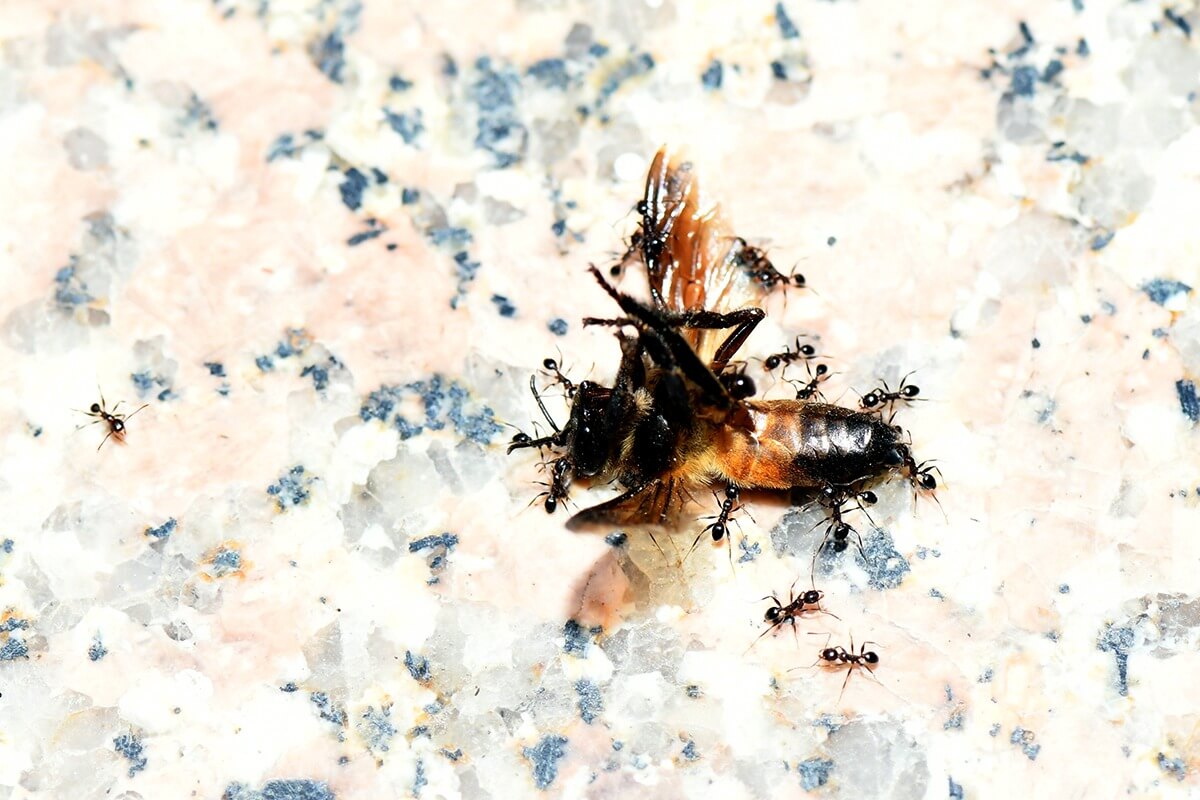
The image you see above is not just a photograph. It is a quiet lesson from nature. A honeybee has fallen — perhaps after a life of hard work, buzzing from flower to flower, collecting nectar. And now, in death, it is being respectfully carried away. Not by one, two, or four, but by a dozen black ants, who surround it like loyal pallbearers. They are not from its hive. They are not its kind. Yet, in death, they offer company, effort, and purpose.
What a contrast this is to the human world! In many cities today, people die alone in flats, discovered days later. Old parents are left in care homes, funerals are live-streamed, and often, the tradition of four people lifting the body is reduced to hired workers. The bond of community, family, or friendship seems to be thinning.
And here, in a silent corner of the floor, a group of tiny ants teaches us something profound.
They remind us that even the smallest beings in nature do not ignore the fallen. For the ants, this is perhaps instinct, or survival — the bee is food, after all. But still, there is a strange dignity in their procession. A sense of purpose. A sense of togetherness. They work as a team, respecting even a stranger’s body.
In a deeper way, this scene reflects a truth we often forget in nature: every life matters, and every death has a meaning.
There is also a metaphor here. The bee symbolises those who worked hard all their lives — tirelessly, quietly — and then suddenly fell, unnoticed. The ants, then, are those who still care, who still respect effort, who still show up even when it is not their duty. How rare are such humans today? We often talk about success, followers, social media likes, or achievements. But who will walk with us to the end? Who will carry our weight — physically, emotionally, spiritually — when we are no longer speaking?
If a bee can receive such a farewell, shouldn’t we humans try harder to give dignity, love, and support to one another — not just in life, but in death too?
This simple scene captured by a sharp eye is not morbid. It is poetic. It is a wake-up call. Nature, in its quiet wisdom, has shown us what respect, cooperation, and community truly look like. Let’s not forget these lessons. Let’s try to be the ant in someone’s story. Or better yet, let’s ensure that when our time comes, we have earned the company of at least four good souls — not out of obligation, but out of love.
Photograph by Dr Swaraj Raj

Dr Dhiraj Sharma, faculty in Management Studies at Punjabi University, Patiala, writes at the intersection of economy, finance, governance, culture, literature, and social change. His interdisciplinary work examines how individuals and institutions adapt to economic and societal shifts. Beyond academia, he pursues creative writing—fiction, non-fiction, poetry—and excels as an avid birder, nature/wildlife photographer, and painter in realistic/semi-impressionist styles. He actively supports government/NGO initiatives for bird watching, butterfly monitoring, and natural habitat conservation. He is our Associate Editor: Economy, Finance and Governance.


 By
By
 By
By
 By
By
 By
By