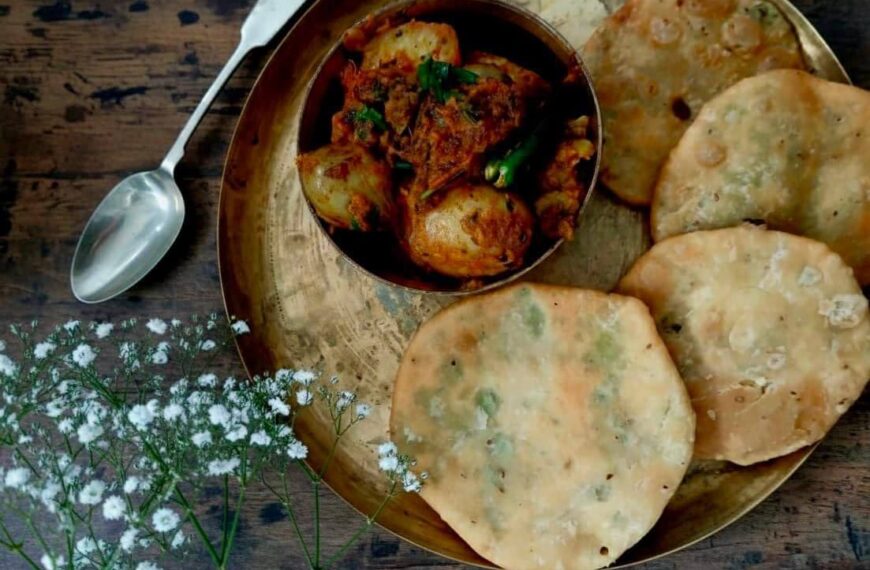

Experience authentic Bengali bliss: whip up traditional Narkel Sondesh, a fragrant coconut delight that embodies Durga Puja’s sweet farewell and festive magic, with Sarika, exclusively for Different Truths.
Life has changed so much. Another shorotkal (autumn) had arrived, and once again Maa Durga came home with all her grace and power. She left for her abode in Kailash, and it’s time for Kojaguri Lokkhi (Lakshmi) Puja today (Oct 6). Yet, amidst the festivities, the world outside feels restless.
So much is happening across the globe—geopolitics keeps shifting, nations rise and fall, and the balance of power changes hands. Some countries suffer under misguided leadership, where decisions are driven not by wisdom but by ego and frustration. And in the middle of all this, I often wonder: what are we truly passing on to the next generation? Which values will they inherit, and whom will they look up to?
It is not easy to remain calm and focused in such times. Yet, Durga Puja always reminds me of resilience. Just as Maa defeats Mahishasura, I remind myself that truth and goodness will always find their way, even in times of unrest.
As my son heads off to his desired university, I found myself telling him about our pujo in small-town Digboi—simpler, slower, and somehow more heartfelt. I still remember the air on Bijoya Dashami—soaked in both joy and sadness. The pandal would be buzzing, Kumar Sanu’s “Are Kotokal Ami Soibo” playing somewhere in the background, dhaaks rolling for the last time, women in red-bordered sarees playing Sindoor Khela, and we children running around, trying to catch one last glimpse of the goddess.
Before immersion, there was always that goosebump moment—when the priest declared “Debi boron holo” and the idol seemed almost alive, as if Maa herself had taken possession before leaving us for another year. All the idols from different pandals would gather in one place before the grand procession. One by one, they moved toward immersion, the roads alive with dancing, laughter, and music. For us children, it was pure magic.
Maa Durga’s immersion in Digboi was always near the Ramlila ground, and every year, at that exact time, the effigy of Ravana was set ablaze. Two worlds of celebration collided—Maa’s farewell and Ram’s victory. Those memories remain etched in my heart like little fragments of joy and wonder.
And then, the most comforting part awaited us at home—the Bijoya Dashami rituals. After touching the elders’ feet and saying “Shubho Bijoya”, plates of sweets appeared. At our home, it was always my mother’s Narkel Sondesh that made the evening special, along with nimki, naru, and the store-bought jalebis that we children loved.
I can still see her in our modest Digboi kitchen, scraping coconuts patiently, her hands moving in rhythm while the aroma of khowa and sugar filled the air. By the time she pressed the mixture into the wooden mould, we were already hovering nearby, waiting for that very first bite. Soft, mildly sweet, and fragrant—the sondesh was more than a sweet; it was love, tradition, and the bittersweet essence of Puja’s ending.
Even today, when I prepare Narkel Sondesh, those Bijoya evenings in Digboi, and Lokkhi pujo come rushing back —the dhaak beats fading in the distance, Maa Durga riding away on a truck toward the river, and our family sitting together, sharing sweets that tasted of both farewell and hope.
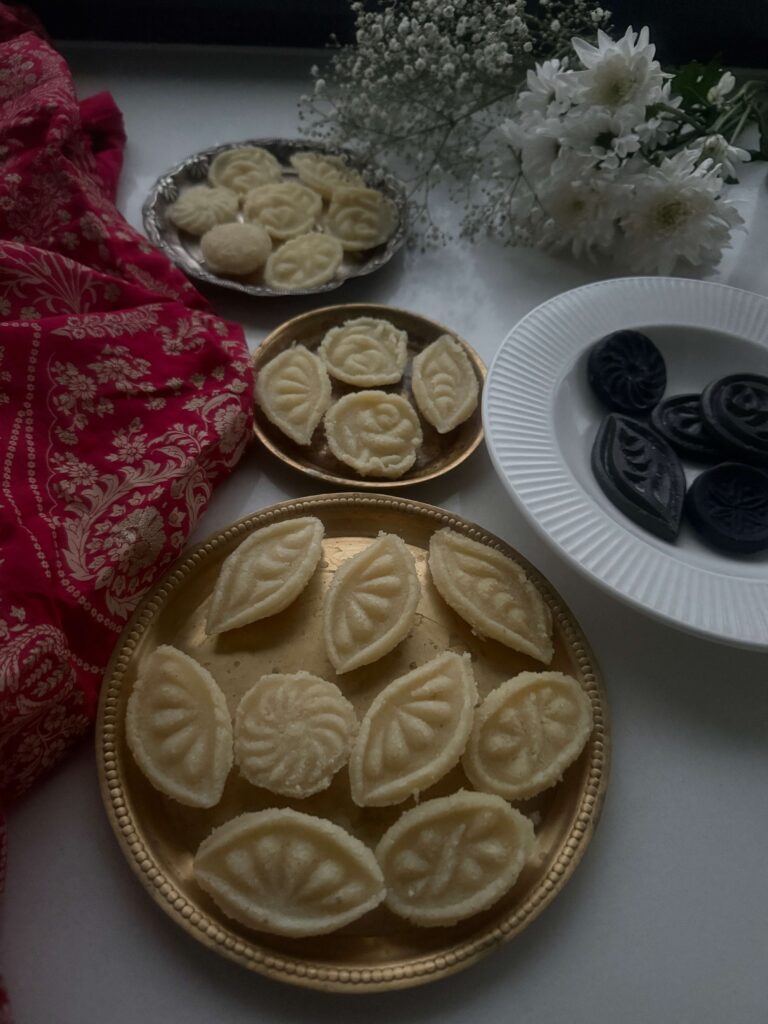
Narkel Sondesh (Bengali Coconut Sweet)
Course: Dessert
Cuisine: Bengali
Prep Time: 30 minutes
Cook Time: 30 minutes
Total Time: 1 hour
Servings: 20 pieces
About the Recipe
Traditionally made during festivals and special occasions, this classic Bengali dessert is prepared with just a handful of ingredients—fresh coconut, khowa (milk solids), sugar or jaggery, and a touch of ghee.
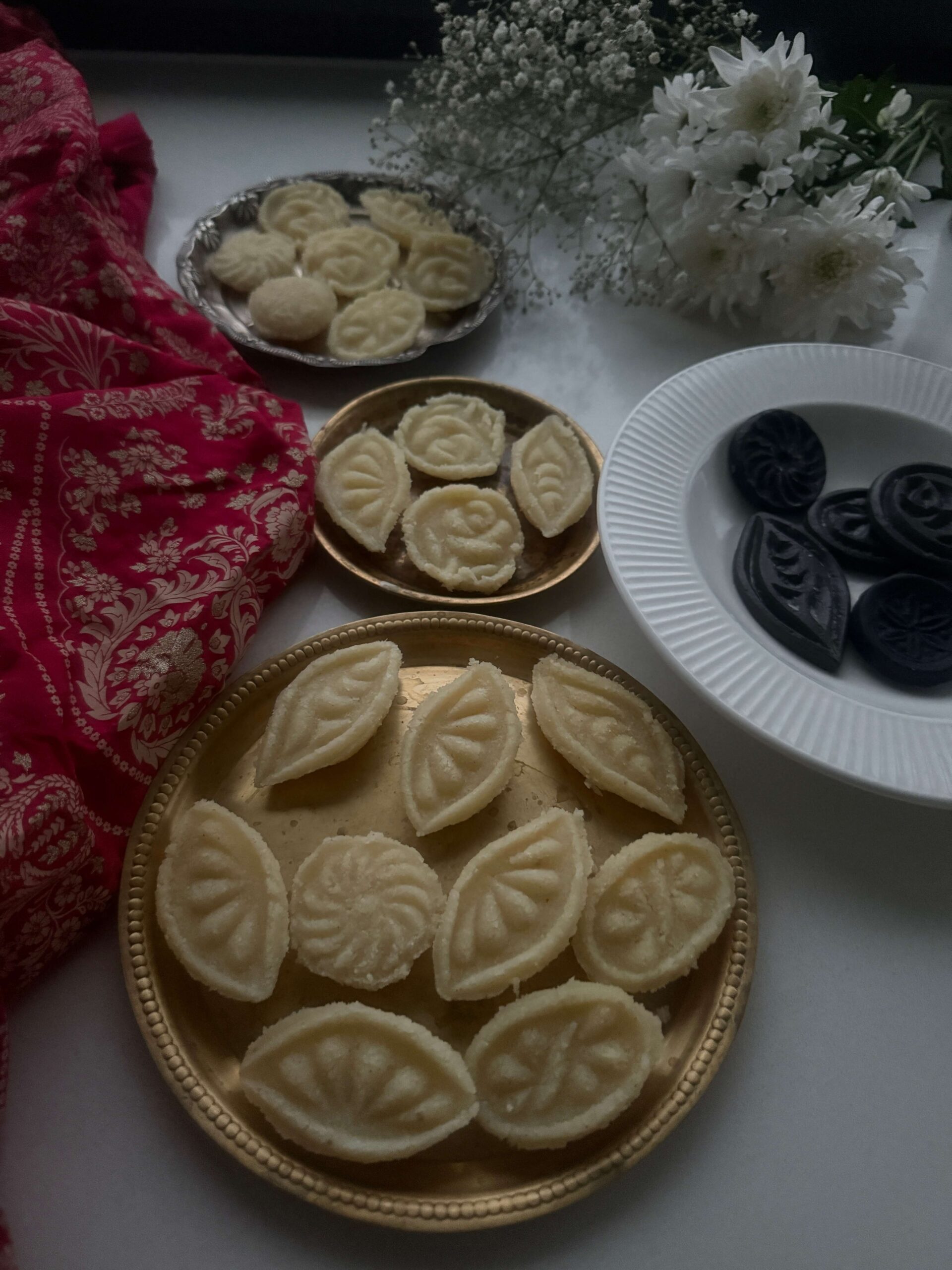
The beauty of these sweets lies in their simplicity. Each piece carries the warmth of homemade love, with a traditional impression given by wooden or terracotta moulds. Perfect to make ahead, this sweet also stores beautifully for up to a week.
Ingredients
- 2 fresh coconuts
- 100 g sugar (or substitute with jaggery)
- 75 g khowa (mawa/milk solids)
- A pinch of edible camphor (optional – adds a distinct festive aroma, the way maa does)
- ¼ tsp ghee (to grease the mould)
Instructions
- Break the coconuts and scrape the flesh using a coconut scraper.
- You should get about 1.5 cups of grated coconut from each.
- Transfer the grated coconut to a food processor (or use a traditional shil batta) and grind into a smoother paste.
Cook the Mixture:
In a heavy-bottomed pan, roast the coconut paste on a low flame for four minutes until aromatic.
Add sugar and stir continuously until it dissolves. The mixture will turn slightly soft and sticky.
Mix in the crumbled khowa and cook for another three minutes, until the mixture leaves the sides of the pan.
Finally, add a pinch of edible camphor (optional) and mix well.
- Now, grease your traditional mould lightly with ghee.
- Take a small portion of the mixture, roll it into a ball, and press gently into the mould.
- Unmold carefully to reveal the intricate pattern of the Narkel Chapa.
- Repeat with the remaining mixture.
Now leave the sondesh at room temperature for 30 minutes to firm up.
Store in an airtight container. Stays fresh for 7–10 days.
Use only a tiny pinch of edible camphor—overuse can make the sweet bitter.
Freshly prepared khowa enhances the taste, but store-bought works too.
Photos by the author

A teacher, day dreamer, random experimental cook and some hit and miss photography, and at last love to call myself a full time mother.


 By
By