
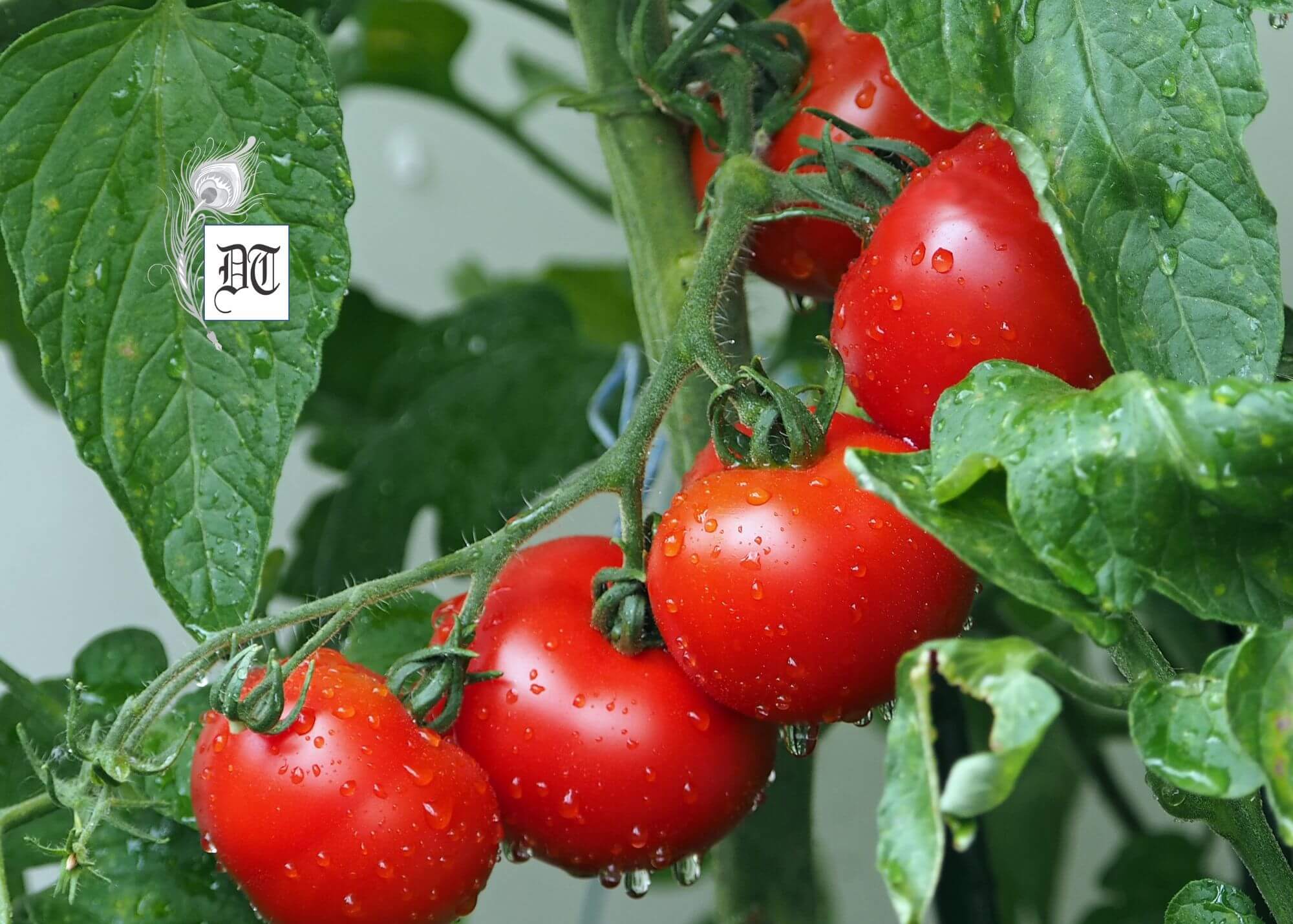

Ruchira traces the journey of the humble tomato, a staple in our kitchens. It has a fascinating journey from the Andes to our plates. An exclusive for Different Truths.

The popular and familiar tomato is part and parcel of our daily meals. However, seldom do we pause for a moment to wonder how this South American fruit traversed across the globe to land in your vegetable basket. It has been an eventful journey. Read on.
According to historians, tomatoes were first cultivated by the mighty Incas in the Andes region of South America (modern-day Peru and Ecuador). These indigenous people who gradually migrated north carried them to Central and North America, including Mexico. The (Mexican) Aztecs are recorded to have consumed tomatoes around 700. AD. How many of us know the word tomato comes from the Spanish tomate, derived from xitomat, an Aztec word?
The Aztecs went a step further to improve the taste and appearance of wild tomatoes, developing larger varieties. The Portuguese and Spanish explorers and conquistadors introduced tomatoes to Europe.
By the 17th century, tomatoes gained popularity in Spain, moving on to neighbouring Portugal and Italy. Since the Mediterranean climate was conducive to its growth, it soon evolved as a staple food.
La Tomatina Festival
Can anyone imagine a pizza without tomatoes? All of us, I am sure, know about the La Tomatinafestival held annually on the last Wednesday of August near Valencia in Spain. Hordes of revellers converge there to hit and splash overripe tomatoes at each other. At the end of the day, the entire area presents a riot of colours.
In the British Isles, for a long time, folks harboured doubts regarding tomato consumption because wild tomatoes resembled fruits of the poisonous Belladonna and Mandrake plants. Later the fear was dispelled and by the 18th century, they found their way into fresh salads, stews soups, etc.
Tomatoes came to India in a roundabout way: the Portuguese took them to southern Europe and later to their colonies on the Subcontinent. The British who followed and eventually gained a firm foothold popularised it further.
Anglo-Indian Cookbooks
Anglo-Indian cookbooks in vogue during those times would refer to tomatoes as one among ‘English vegetables grown in India’; alongside these advised desi cooks regarding their utilization in sauces, soups, dips, etc. Gradually, recipe books in Persian and their English translations made their debut. In one of those early texts, a recipe for tomato soup (aka shorba) defines tomatoes as ‘vilayeti baingan’ (foreign eggplant), possibly because Indian readers were already familiar with the indigenous eggplant, a close relative of the tomato.
Down the centuries, so powerful has been the influence of the tomato that it has largely overshadowed the traditional souring agents viz tamarind, kokum, anaardana (dried pomegranate seeds), curd, amchur (dried mango powder) and raw mango. Though these ingredients are still widely employed yet tomato has emerged as a handy alternative.
Studies reveal tomatoes are low in calories but enriched with vitamins A and C, potassium, and (an antioxidant) lycopene.
Talking of tomatoes, it has been my favourite vegetable after, yes, you heard it right, potatoes. From early childhood through my school days…I remember how my mother would pack fresh, ripe tomato sandwiches into my tiffin box. The characteristic aroma of butter, fresh tomatoes, and freshly ground pepper is still vivid in my memory. I used to be, and still am, particular about tomatoes in my omelettes whenever I choose to eat one.
Tomato Chutney
A very familiar and popular dish in our community (Bongs) is tomato chutney that you may relish for lunch and dinner. On important socio-religious occasions, tomato chutney dominates the menu, though it may be occasionally replaced with chutneys made with papaya among many. You can enjoy plain variety. Or enrich with khejur/dates or aam shotto/aam papad/dried mango pulp. It tastes heavenly!!
Lately, browsing through YouTube I picked up an Islamic style (as opposed to saatvik/onion- garlic free) recipe, which is quite a rage in neighbouring Bangladesh. The process is simple: take a heavy-bottomed pan. Pour mustard oil into it. Heat. Take four to six ripe, juicy tomatoes, cut them into half, and place these in the pan face down. Alongside, place in a few large cloves of garlic. Add salt. Put the lid on, let it sizzle, and then steam. When they are cool, remove from the pan onto a plate. Remove the tomato skin. Mash the stuff. Next, add salt, chopped onion, green chilies, and parsley leaves. Mix well. Serve. It pairs rather well with rotis or parathas.
Punjabi Bharta
This appears to be a cousin of the Punjabi bharta, which permeated into northwestern India from Afghanistan. In almost every household in North India (Punjabis in particular), a ubiquitous spice is a paste of tomato, onion, ginger, and garlic that goes into every dish (well, almost)!
While still on the topic of tomatoes, the partner has a penchant for green/raw tomato curry, a simple dish with diced cubed potatoes, with salt, turmeric, cumin, and coriander powders as spices.
Even as I write this, there is a chill in the air… so I’m going to grab a cup of piping hot tomato soup…
Picture design by Anumita Roy

Ruchira Adhikari Ghosh brings a liberal, wide-ranging outlook shaped by extensive travel across India and abroad. Educated at Holy Child School, New Delhi, Sacred Heart Convent, Ludhiana, and Panjab University, Chandigarh, she holds a Master’s in English Literature and a postgraduate diploma in Journalism and Mass Communication. With three decades in media, she writes on travel, books, music, performing arts, women’s issues, and especially food, drawing inspiration from rich life experiences. She is our Features Editor.


 By
By
 By
By
 By
By
 By
By