
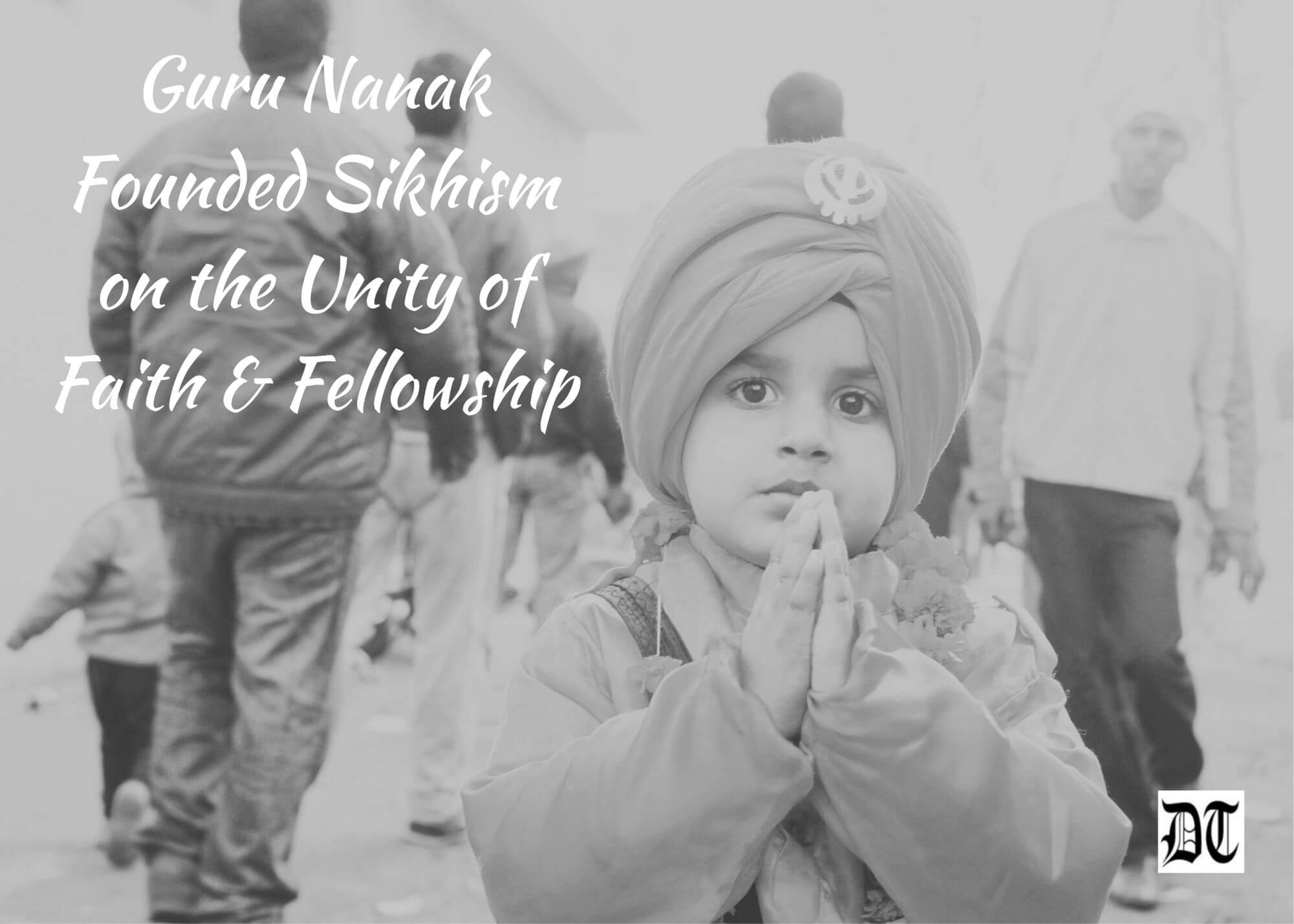

Ruchira profiles Guru Nanak on his 552nd birth anniversary on Friday (Nov 19). He founded the youngest religion, Sikhism, based of the unity of faith and fellowship, shredding divisiveness, and discrimination. A tribute, exclusively for Different Truths.

Five hundred and fifty-two years ago, Guru Nanak, a noble soul was born upon this subcontinent. When India was being torn asunder by casteism, religious malpractices, communal hatred and more, he strode the land like a Colossus, spreading the sublime message of peace, universal brotherhood, and secularism in the truest sense of the term.
From his childhood through adolescence and youth, he preached Divine Love via music, poetry, and personal interactions. The obnoxious aspects of the Hindu society viz., casteism, meaningless rituals and dogmas, left him deeply saddened. Likewise, he was distressed by the prevalent socio-political milieu, particularly by atrocities unleashed on the masses by the then Mughal regime.
… Guru Nanak undertook long extensive journeys across India, often foraying beyond its frontiers into neighbouring countries.
Born in village Talwandi (presently Nankana Sahib), near Lahore, in medieval undivided Punjab, during his lifetime, Guru Nanak undertook long extensive journeys across India, often foraying beyond its frontiers into neighbouring countries. Accompanied by his closest associates, Bala and Mardana, he engaged in lengthy dialogues with practitioners of multiple faiths, which helped him to place religion and spirituality in its proper perspective. Eventually, he arrived at the conclusion that God was One, Formless, Intangible, beyond comprehension by the senses, Omnipresent and Omnipotent (uncanny similarity with Christianity).
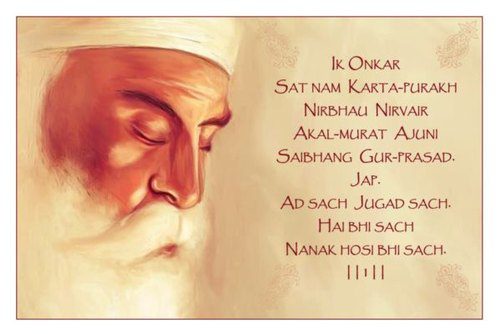
All are Equal
All humans were equal, irrespective of their rank, caste, creed, race, faith, and gender. For instance, Nanak’s companions Bala and Mardana were referred to as Bhai (brother/ Sir). Their social antecedents were immaterial. He blatantly refused to subscribe to rituals. There is this famous anecdote of how he avoided doing arati at a shrine pointing out to the bystanders as to how the sky above was a sacred thaali/ tray holding the dazzling Sun and shimmering Moon (lamps of worship), flowers, foliage, and herbs (votives and fragrance). Since Nature itself bowed in reverence to the magnificent Almighty (Ikk Onkaar) the activities of mortals were insignificant. He also had reportedly discarded the sacred thread worn by high caste Hindus (he is being one) fearing it would create a chasm between him and his friends. Nanak firmly believed (like other Bhakti saints of India) that divergent faiths were merely pathways leading to the one and only Supreme Being.
… Sikhism is a mundane, pragmatic religion with a strong earthy touch.
I lived in Punjab for a good number of years, which provided an insight into the fundamentals of Sikhism. A comparative study of major global faiths (now this is purely personal) gives me the feeling that Sikhism is a mundane, pragmatic religion with a strong earthy touch. Its table of values are straightforward rather than verbose, utterly devoid of frills and fuss. The lingua franca appeals spontaneously to the masses. Consequently, Guru Nanak’s earliest disciples comprised Muslims and Hindus of all hues. Rather than focusing on ceremonies, Guru Nanak laid out certain basic principles which the commoners could easily imbibe.
Vand Chako: Sharing food, wealth, and resources with people around us, particularly the needy.
Kirat Karo: Earning one’s livelihood with truth, honesty, hard work and dedication
Naam Japo: Chanting God’s name at all times. God being the supreme entity will help humans overcome fear, doubt, trials and tribulations.
Hukum Razayee Chalna, Nanak Lihkiya Naal: Accepting God’s will with unwavering faith. Everything happens by the grace of God.
Is ḏėhī anḏar pancẖ cẖor vaseh kām kroḏẖ lobẖ moh ahaʼnkārā: Purging our inner selves of five formidable foes — sexual passion, wrath, greed, worldly desires, and arrogance
Nanak Naam Chardi Kala, Tere Bhane Sarbat Da Bhala: Nanak appeals to the Eternal One to bestow prosperity, health, happiness on everyone and everything.
Community Living
In the penultimate years of his life Guru Nanak laid the foundation for a wholesome harmonious community living — langar(community kitchen & meals) pangat (partaking food without social discriminations) and sangat(collective decision making).
Interestingly, Guru Nanak comes across as an ardent champion of women empowerment. He candidly airs his views thus:
In a woman, man is conceived,

From a woman he is born,

With a woman he is betrothed and married,

With a woman he contracts friendship.

Why denounce her, the one from whom even kings are born?

From a woman a woman is born,

None may exist without a woman.”
During Guru Nanak’s time, women were devoid of economic freedom, education, and independence.
During Guru Nanak’s time, women were devoid of economic freedom, education, and independence. They were expected to solely serve their menfolk and run the household. However, after the birth of Sikhism life was never the same again. Guru Nanak spoke vociferously against rampant subjugation and oppression of myriads of nameless faceless womenfolk. The venerable Guru’s message of dignity and equality dispelled darkness from their sordid lives forever.
Visuals sourced by the author and by Different Truths

Ruchira Adhikari Ghosh brings a liberal, wide-ranging outlook shaped by extensive travel across India and abroad. Educated at Holy Child School, New Delhi, Sacred Heart Convent, Ludhiana, and Panjab University, Chandigarh, she holds a Master’s in English Literature and a postgraduate diploma in Journalism and Mass Communication. With three decades in media, she writes on travel, books, music, performing arts, women’s issues, and especially food, drawing inspiration from rich life experiences. She is our Features Editor.



 By
By
 By
By
 By
By
 By
By