
Radhika reveals an amazing secret of Nature, exclusively for Different Truths.
 The next time you see a sunflower, here is what you must do! Take a magnifying glass or even just look with your naked eye at the pattern of seeds held within the center of these special flowers. The seed pattern of a sunflower follows the Fibonacci sequence, or 1, 2, 3, 5, 8, 13, 21, 34, 55, 89, and so on.
The theory of the divine proportion is definitely most fascinating and one of the most astonishing discovery made.
In the Fibonacci series, each number in the sequence is the sum of the previous two numbers. Mathematical biologists love sunflowers.
They say nature is math, let me take you back to math class. In the Fibonacci series, each number in the sequence is the sum of the previous two numbers. 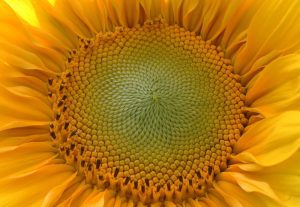 Mathematical biologists love sunflowers. Sun flowers are one of the most obvious and also one of the most beautiful examples. The spiraling patterns you see in the center are generated from this sequence – there are two series of curves winding in opposite directions, starting at the center and stretching out to the petals.
The vast majority of flower petals follow the Fibonacci sequence – the lily has three petals, buttercups five, delphiniums eight, corn marigold 13, chicory 21, the daisy 34. Phi appears in petals on account of the ideal packing arrangement as selected by Darwinian processes; each petal is placed at 0.618034 per turn (out of a 360° circle) allowing for the best possible exposure to sunlight and other factors
Fibonacci sequence has captivated mathematicians, artists, designers, and scientists for centuries.
The famous Fibonacci sequence has captivated mathematicians, artists, 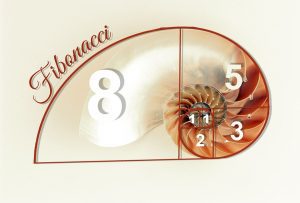 designers, and scientists for centuries. Also known as the Golden Ratio, its ubiquity and astounding functionality in nature suggests its importance as a fundamental characteristic of the Universe.
In mathematics, two quantities are in the golden ratio if their ratio is the same as the ratio of their sum to the larger of the two quantities.
If you divide the number of female bees by the number of male bees in a hive it produces the ratio 1.61.
DNA, too, follows the Fibonacci sequence. Each molecule is 34 angstroms long by 21 angstroms wide – both numbers in the Fibonacci series – and their ratio is 1.61.
Even our bodies exhibit proportions… the measurement from the navel to the floor and the top of the head to the navel is the golden ratio.
Even our bodies exhibit proportions that are consistent with Fibonacci numbers. For example, the measurement from the navel to the floor and the top of the head to the navel is the golden ratio.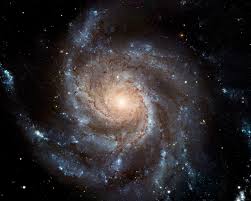
Phi appears in the Solar System and The Universe as well. From the distances between the planets, to the structure of Saturn’s rings to the shape of the Universe itself, phi is found again and again in different manifestations.
This is what makes a single number so captivating that it has persisted in our imaginations thousands of years. When we examine the nature and cosmos around us with this new understanding, we step from the world of the absolute accuracy and confirmable proofs of mathematics and geometry into the more subjective world of wonder, beauty and interconnectedness of all things. Thus, venturing into a domain where our heart tells us what logic cannot. Follow your heart for a bit more and you will find yourself in deep amazement of the cosmos we are a part of.
©Radhika Bhagat
Photos sourced by the author from the Internet

Radhika Bhagat is a Wildlife Conservationist based in India. She has been working since several years to protect wildlife and habitats across India and other South Asian countries. She is also formally trained in Yogic sciences and is exploring the subject of spiritual reverence towards nature as the basis for balance for our individual selves and also for our planet.She loves the sea and believes all answers lie in our inherent wildness.

 By
By
 By
By
 By
By
 By
By