

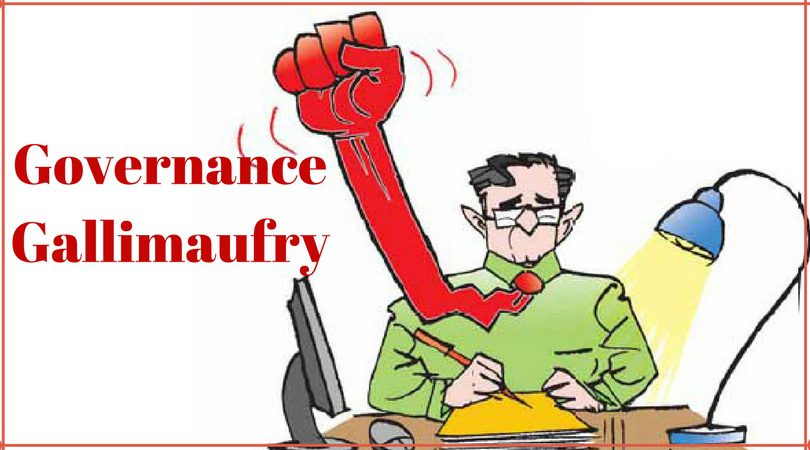
The state administrative service is rife with arbitrariness and discrimination. Hemashri recounts how her study-leave prayer for higher studies at JNU, New Delhi, was denied, while two other batchmates were granted a relaxation of the rules. It will soon be 20 years; departmental proceedings, the old provision, and the administrative process have yet to dispose of her prayer. Read more in the weekly column, exclusively for Different Truths.
It was the erstwhile foreign rulers who laid the foundation of our administration when the East India Company became ambitious beyond mere trade. Those rulers eventually left, but their systems persisted, whether in our education or in our administration. The First Administrative Reforms Commission of India was set up on 5th January 1966 under the chairmanship of Morarji Desai. However, the second such commission was set up only on 31st August 2005, after a gap of 39 years. Why it took almost four decades to follow up on the initiative is a question that only experts can answer.
As an experimental bureaucrat, I have been a keen observer of the delivery mechanism of the institution called ‘government’, which is a vast setup. Pundits hold extreme views about the scope of a government’s operations. The motto with which Henry David Thoreau opened his pamphlet ‘Civil Disobedience’ was, “That government is the best which governs the least.” Countries like India, afflicted with mass poverty and illiteracy, would be a utopian concept and far from reality. The government here is a welfare-oriented institution that works in a responsive manner for the masses, with the avowed goal of equality.
Within a year in the Civil Service, I grew restlessly disillusioned. A series of incidents and a loud scolding from a brown sahib made me rebellious and seek an escape route. In my desperation, I began reading the Employment News. I found a notice inviting applications for a national entrance to an M.Phil./Ph.D. programme at Jawaharlal Nehru University (JNU), New Delhi. I obtained permission from the authorities to appear, cleared the written entrance exam, and then had a heated debate with the parents. Finally, I boarded the Rajdhani Express to appear for an interview on leave. When the results came out, it was a surprise to see my name as serial number one in the selected list for the August 1998 batch of MPhil/PhD students in the Centre for Social & Regional Development in the School of Social Sciences, JNU.
I drafted a study leave prayer as a novice and called on the head of the department, who appeared sympathetic and assured me of all help. Since 14th August 1998 was the last date of admission, I proceeded to join during the pendency of the prayer. I arranged tickets for all family members. Our brother was posted in Gujarat, and he was supposed to join us in Delhi.
The Rajdhani Express we boarded was stuck near Alipur Duwar for nearly eight hours, which delayed our arrival. I was restless, so I called another selected candidate I had met only during the JNU interview: Bashistha Banerjee from Patna. I narrated the situation to her and asked her to book a flight ticket for me from Patna. She assured me she would arrange it for me. In utter disappointment, I walked into the nearby compartment. I saw the local MP, Smt Bijoya Chakrabarty, and approached her for help. I requested her to write a letter to the JNU authority to consider my case, as she is also travelling on the same train. She was very kind to me and gave me a letter.
As we reached the Patna Railway Station, it was already 12.10 pm, and the Sahara flight was scheduled at 12.20 pm. I was anxious. I bade goodbye to my parents and, with full confidence in my new friend, got down from the train. Bashistha, with her uncle, was waiting for me. She told me Aunty had prepared a sumptuous lunch for me, but there is now no time to go to the Rajendra Nagar apartment. So we dashed off to the airport. A handsome Sahara Airlines manager welcomed me and said the flight was on hold for 15 minutes due to a technical snag. It was unbelievable! With a warm hug for my angelic friend, I boarded my epic first flight. From the airport, I headed straight to the JNU campus and took admission. I had already contacted the office bearers of the JNU Students’ Union to inform them of my predicament, and they helped me a lot. After admission, I went to Hotel Assam Mayur in Paharganj and booked a room for my parents. On the eve of 15th August, security was tight. I produced my identity card and admission documents. At midnight, our family members arrived.
A new chapter of my life began in the Ganga Hostel room number 150, where my soul sister, Bashistha, joined me a few days later. As I walked along the street, lined with greenery on both sides, I felt like a bird released from its cage, and everything seemed perfect. A lavish lunch in the department canteen would cost only Rs 15, and Archie’s birthday card with the printed price of Rs 10 would cost only Rs 8. Very often, there would be a post-dinner talk by distinguished guests whom I only saw on TV or in newspapers.
The first blow came after three months when my father told me that my study leave request had been rejected without any reason. I immediately sent another prayer for extraordinary leave without pay. My parents panicked, and my mother became inconsolably tearful. All day, I would be busy roaming around and attending classes, but only at night would the gloomy picture unfold with an unpredictable outcome. One day, I decided to discuss the matter with my course director, as the first-semester examinations were due by the end of the semester. He told me to apply for a zero semester, go back home to settle the matter, and then come back with a clear mind. He also added, “If you are not allowed permission, then do not resign from your job. You can come for your PhD anytime.”
After the examination, I returned home during the break and visited the office. I was told that my second leave prayer has already been rejected. A prestigious fellowship and a seat at a renowned university were considered unjustifiable grounds for granting my study leave. After a few days, one of my well-wishers informed me that a batchmate of mine has been allowed to proceed on quasi-lien, in violation of existing government rules and office memoranda, to work in a private-sector organisation. He advised that I may approach the court with this order. This batchmate was from a politically influential family. Another well-wisher informed me that another officer from such an influential family had proceeded to a foreign embassy without formal government permission. Still, her case has been considered for regularisation. I was confused and was utterly directionless. I decided to follow my parents’ and the course director’s guidance and applied for a zero semester.
I received a notice to vacate my hostel seat. When I brought back my luggage, I felt as if I had left behind on that campus a fragrant dream of mine – to hone my wings to fly. The UPSC aspirant I had met in JNU turned out to be my Knight in Armour in real life – engagement and marriage followed.
I submitted several prayers for the regularisation of my five months’ leave, but I received no reply. In 2012, during an imposed sabbatical, I was assigned by the Assam Civil Service Officers Association, along with a few colleagues, to study the stagnation in the service. After several sittings, when there was no concrete outcome to start the project, I felt very motivated to take the call and start the study. The situation I was enduring at that time, along with the resultant agony, perhaps acted as a catalytic agent. Friends, well-wishers, and seniors helped and guided me. We placed a research paper as our document. Meanwhile, I received a show-cause notice in July 2015 asking me why I had submitted a PhD application in 1998 and why a departmental proceeding should not be initiated against me. I was asked to submit a reply within three days. I wrote that, since the matter is 17 years old, I will have to search my old files and that two additional days should be given. I submitted a six-page reply, citing the precedent of generous relaxation for two persons.
It was a dream come true that the government accepted all our study’s suggestions and notified the Assam Civil Service Amendment Rules 2015. The government had launched two new services to support the Premier Service and had created 157 new higher-level posts in ACS. It was a fruitful result of grand teamwork. It was a dream fulfilled. After a week, I went to the left to enquire about the status of my prayer. The gentleman officer was very annoyed and told me, “I would not have stated those precedents years ago, precedents, if I were in your position, because those were special cases.” I pulled up a chair to sit near him and told him, “Sir, I was under the impression that, as per the provisions of the constitution, similarly situated people must be treated similarly. So I would like to know on what ground those were special cases.” He was very visibly irritated and told me, “I know your husband. He is a very amiable person, unlike you.” I told him, “Thanks, Sir, I will convey your compliment to him, but I will come again.” I went again after about two weeks. He told me, “You may go and meet senior people.” I told him, “Sir, you are sufficiently senior for me.” I never went again. The prayer is still pending.
I believe in destiny, destiny, and I have not really pursued destiny, destiny, destiny, destiny, or the disposal of the prayer. It is not my prayer anymore. It is a case study. Without any intervention, I am curious to see what happens when this process concludes.
In August 2018, I would complete twenty years since the initiation of this prayer. I am planning to celebrate the 20th birthday of a project which is now a dead dream. How to celebrate it? it? I have no clue. Let August arrive; we will find a way to celebrate. This project may have failed, but it gave birth to another, which, to date, looks like a yet-to-be-born baby – administrative reforms – where every case shall be treated on its merits and not on family linkages.
©Hemashri Hazarika
Photo from the Internet
#IASExams #PHD #IndianCivilService #AdministrativeReform #GovernmentOfIndia #GovernanceGallimaufry #DifferentTruths

Hemashri Hazarika is an Officer of the Assam Civil Service since 1997. Her research on Assam Civil Service brought reforms in 2015. A first-class Postgraduate in Economics from Gauhati University, she was awarded JRF/NET by UGC in 1997. Her experience as a bureaucrat has sensitised her to human sufferings. A solutionist by passion, she takes an active interest in issues related to Governance, Development, Women, Children, etc. Reading, Writing, Speaking and Painting are her hobbies.
 By
By
 By
By
 By
By
 By
By