


Hemashri talks about the Holy Book, the Gita, a maid (read: casual worker) named after the Sacred Book, and the kingdom of wisdom that awaits. Read more in the weekly column, exclusively for Different Truths.
After his retirement, I saw my father getting totally immersed in reading the holy books, especially the Gita. He would often lament some wrong decisions in life. He regretted not reading these scriptures in his early life. From his experience, I decided to study the Holy Book early in life to become wiser. But I have been just collecting various versions of the Gita over the last twenty years. A good bibliophile is often not a good bibliomaniac. All these years, I have been gathering like a honeybee.
The Holy Book, the Gita, has always been awe-inspiring. Though my learning of the Sacred Book is yet to begin, I met a real-life Gita, who taught me to survive in rough weather. This real-life Gita left me speechless. Here’s a slice of her life story.
Gita was an older woman in my office. She was our cleaner and made tea for us. One of my predecessors had arranged a gas connection and a stove for making tea in our office for the staff members on the 5th floor. Gita Didi was in her 50s and had a lean build. As the only woman on staff, I sometimes struck up small talk with her.
She told me I resembled her daughter.
One day, on my arrival, I found a young, healthy girl cleaning up my room. When I asked who she was, she told me she was Didi’s daughter. Didi was unwell, so her daughter had come to do her duty instead. Didi’s dedication impressed me. I was curious to know more about her.
Gita had lost her husband when her daughter was barely three months old. Her father was a gardener and had purchased a plot of land with his hard-earned savings. The father married her off to a man once again and gave away the plot of land as a dowry. Until the birth of her son, things were normal. However, after his birth, her husband started drinking, and he became abusive.
Her second husband used to beat her up and snatch away all her money. When her son became a teenager, his father brainwashed him, and that created a rift between mother and son. He was so notorious that he wanted to marry his stepdaughter. A helpless Gita found a suitable boy and married her off to save her daughter’s honour. After her daughter’s marriage, she was thrown out of her home. She constructed a small hut within the same compound, on the plot of land that her father had given as Gita’s marriage dowry.
Though she was a casual worker, a mere cleaner, she would be sent to other offices to deliver letters and run errands. I had found that my staff used to engage her beyond the realm of her work. In the scorching heat, when the sun was blazing brutally, she was sent to the other offices. I called my staff members and asked them to stop this practice immediately. I issued an office order to this effect.
On a rainy day, I found Gita coming to the office barefoot. When I enquired, she said that  her chappal was broken and that she could not afford another pair. She asked me for a pair of used sandals. I gave her two hundred rupees to buy a new pair.
After two to three days, when I enquired from her whether she had bought a pair of sandals, she told me, “With fifty rupees I bought a pair of sandals; another fifty were spent on firewood; a third fifty rupees were spent on rice; and with the balance, fifty rupees, I bought vegetables.” I felt very guilty. I felt like a heartless, rich merchant. Our children sometimes eat chocolates that cost rupees two hundred or more.
Gita was a casual worker. She requested that I regularise her services. I tried to find out the details. Tracing old references, I located her file in a place that showed it had been lying on a table, gathering dust, for four years. I discussed her case with a lawyer friend. We were told that if her case had been placed at the right time, her services could have been regularised. After a recent order from the Honourable Supreme Court on the regularisation of services for casual workers, there was no scope for the regularisation of her services.
I felt sad, but there was little I could do. False promises hurt, so I explained to her that it was now too late to try for her regularisation. She appeared to understand, but she still insisted that I do something for her. I felt terrible and wished someone would take the initiative when the time was right.
God only knows how many such unfortunate souls are still working with utmost sincerity, hoping that their services will be regularised someday. And that they would get the benefits of pensions, etc. She kept in touch with me even after I moved out of that office. Her high expectations of me made me sad, as her problem, which could have been solved long ago if people had been somewhat more sensitive, had no remedy.
The Holy Book, the Gita, is considered a panacea for life management. 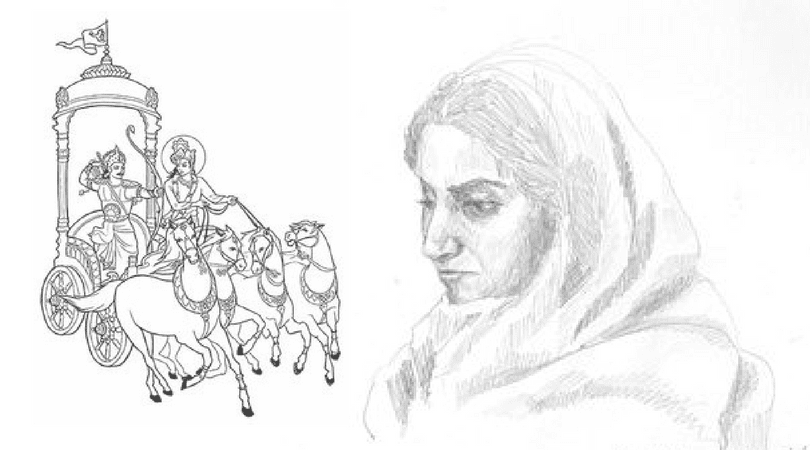 This ever-cheerful, optimistic Gita left a deep impression that tough situations toughen people up. They can survive difficult situations.
A real-life Gita was perhaps forced to master the art of survival without ever having read the Holy Book after which she was named.
However, my hunger and quest for the wisdom of life management continue. Gita, the Holy Book – like the person – is still a pending project. Gita, the person, was destined (read doomed) to follow the essential principle of the Holy Book – Nishkaam Karma – duty without the desire for its fruits!
I feel that I have reached the middle of my life’s journey. Much water has flowed down the Brahmaputra. I toss on its mighty waves, like a small boat amidst boatmen’s songs, aware that the journey is more important, far more beautiful, than the final destination.
The Kingdom of Wisdom awaits me…
©Hemashri Hazarika
Photos from the Internet
#Life #Gita #WomanNamedGita #Loneliness #FinalJourney #BareFoot #GovernanceGallimaufry #DifferentTruths

Hemashri Hazarika is an Officer of the Assam Civil Service since 1997. Her research on Assam Civil Service brought reforms in 2015. A first-class Postgraduate in Economics from Gauhati University, she was awarded JRF/NET by UGC in 1997. Her experience as a bureaucrat has sensitised her to human sufferings. A solutionist by passion, she takes an active interest in issues related to Governance, Development, Women, Children, etc. Reading, Writing, Speaking and Painting are her hobbies.
 By
By
 By
By
 By
By
 By
By
We must have come across many such Gitas in our journey in life leaving no lasting impression but for Hemashri’s superb narration this Gita left an indelible mark of a woman in my mind.
Eye opener. Very interesting…