
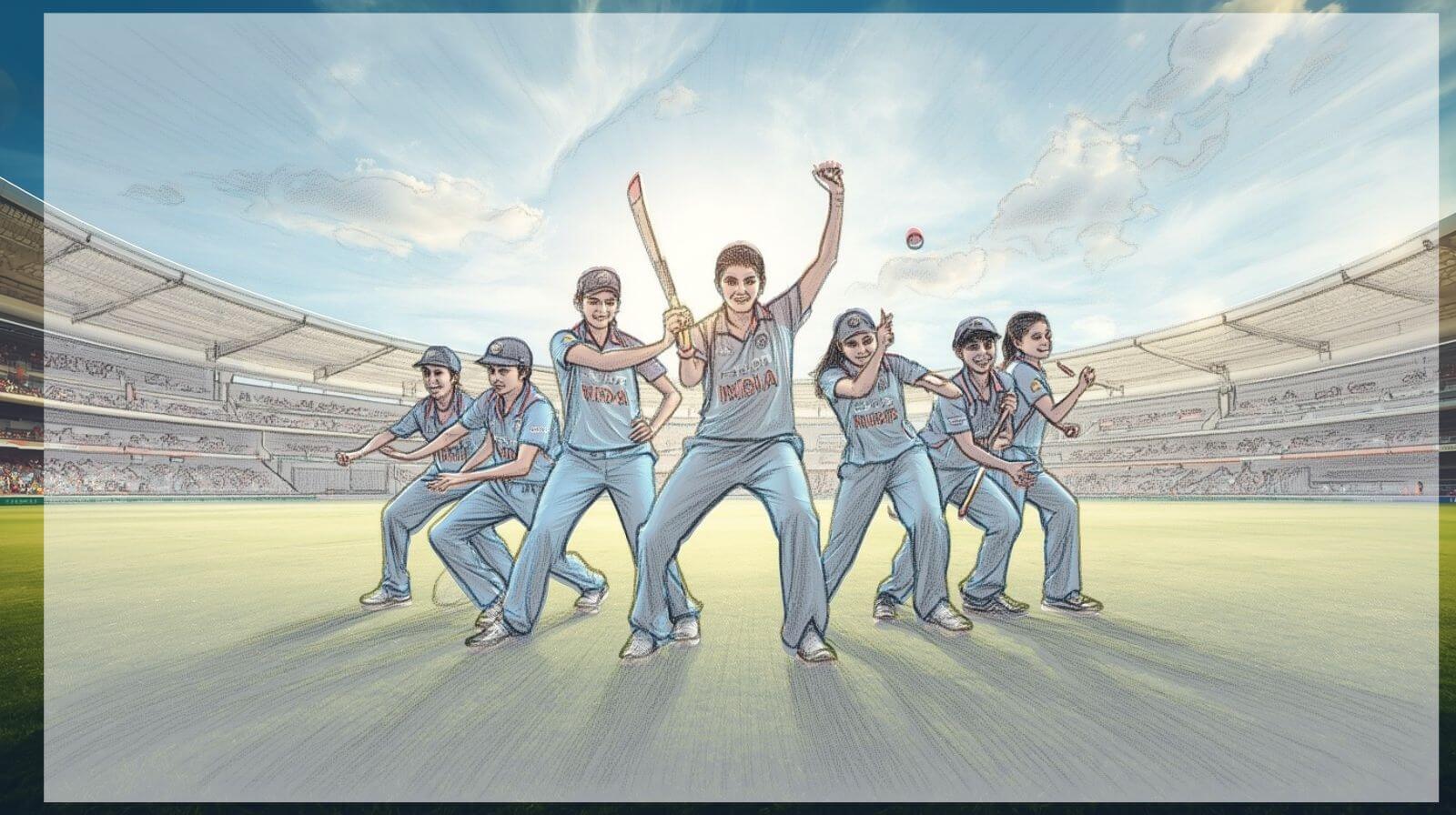
India’s Women’s World Cup 2025 victory culminated in a triumphant homecoming for the Girls in Blue, celebrating their historic final win over South Africa. An exclusive report by Mowmita, for Different Truths.

Richa Ghosh proudly returned to Kolkata as a World Cup champion, and the atmosphere at Eden Gardens radiated the warmth of a triumphant homecoming for a remarkable athlete—someone the city had eagerly awaited the chance to celebrate. As she stepped onto the field, the floodlights shone brightly upon her, and the crowd erupted into a wave of genuine affection; this was more than just a celebration of cricket. It was Bengal taking a young woman in its arms.
She stood there, just 22, slightly overwhelmed but trying to hide it, while the ‘Banga Bhushan’ Award was draped around her. A gold-plated bat and ball followed, then a gold chain, and finally a cheque of ₹34 lakh, rupee for every run she scored in the final. Even then, the loudest reaction came when Mamata Banerjee announced her appointment as a Deputy Superintendent of Police.
Her parents were sitting in the front row—eyes shining, shoulders tightening, the kind of pride that arrives only after years of small sacrifices no one else sees.
Sourav Ganguly: Richa Ghosh, India’s Future Captain
Sourav Ganguly, former skipper, was there too, and if anyone can tilt an atmosphere in Bengal with just a sentence, it’s him. He didn’t go overboard; he just spoke in that quiet, persuasive way he has. He called Richa a future India captain, something he rarely says so openly about anyone. And he explained what her position really demands.
Batting at number six, he reminded everyone, is not for the timid—it’s where matches wobble, tilt, and sometimes collapse. In the final game, Richa truly stood out as a key player for India. She delivered a remarkable performance, scoring 34 runs off just 24 balls, which included two sixes and three fours. Her efforts gave the Indian team a boost, helping them reach a total of 298 for the seventh consecutive week.
As South Africa started their chase, it was evident they were having a tough time, and in the end, they could only manage 246 runs. It was a memorable sight to see Richa leave the field, her bat resting against her shoulder and her chin held high, as she showcased her confidence and determination. Her innings truly embodied India’s victory.
A Roaring Revolution as India’s Women’s Cricket Team Shatters the Glass Ceiling
India’s women shattered the glass ceiling, answering years of doubt with a World Cup triumph, sparking a roaring revolution.
“Tumne kya kar liya?” (What have you done?)
“Kabhi kuch jeeta hai?” (Ever won anything?)
“Ladkiyan cricket khel sakti hain kya?” (Can girls play cricket?)
India’s women didn’t just win a World Cup. They tore down a wall. Smashed the glass ceiling to smithereens.
Every girl who ever picked up a bat in this country has heard some version of this. Sometimes whispered, shouted, sometimes laughed in her face. For years, this was the soundtrack to women’s cricket — doubt disguised as wisdom, mockery packaged as advice.
On a thunderous night at DY Patil Stadium, India’s women finally answered. Not with anger. Not with arguments. But with a World Cup.
This victory wasn’t a sporting achievement. It was an emotional explosion — years of disrespect, invisibility, and underestimation collapsing in one unforgettable, history-shaking moment.
One strike-through that hit like a roar. Harmanpreet Kaur’s post-win picture said it all. The trophy glittered, yes, but her T-shirt burned brighter: “Cricket is a gentleman’s everyone’s game.”
That strike-through wasn’t ink. It was justice. It was closure. It was every girl’s clenched fist finally opening — not in surrender, but in triumph.
For Punam Raut, it was personal. Punam Raut felt that line like a punch and a hug at once. She lived through the heartbreak of 2017 — the nine-run loss that stole India’s dream. She gave everything that day: a courageous 86 runs, grit, poise, fire. And what did she get?
Criticism. Judgment. Questions she never deserved. She remembers boys mocking her when she started playing: “Ladkiyan cricket khelti hain kya?”
She couldn’t answer then. She doesn’t need to anymore.
When India lifted the cup on Sunday, Raut says she broke. She cried. She shook. “The answer has been conveyed,” she said. “The wound of 2017… It’s finally healed.”
A win nine years in the making.
Only three players from 2017 remained in the 2025 squad — Harmanpreet, Smriti Mandhana, and Deepti Sharma. They carried the memory of those nine missing runs like a stone in their chest. For nine years, it haunted them. On Sunday, they turned that pain into power. This was not redemption. This was a revolution.
The girls they mocked are the women who rule. For decades, India told its daughters to dream softly. To stay in their lane. To know their limits.
But on that day, under deafening cheers and blinding lights, a simple truth stood tall: Girls don’t just play cricket. They own it.
The old proverb said: “The hand that rocks the cradle rules the world.”
But India’s women just updated it. “The hand that grips the bat can rule a stadium, a nation, a narrative, a future.”
This win wasn’t for the world. It was for the little girl hiding her cricket kit so no one would laugh. For the daughter begging for one more hour in the nets. For the mother who defended her dreams. For the father who didn’t say no.
And now, if anyone still asks, “Tumne kya kar liya?”
India’s women can lift the World Cup and say — with tears, with pride, with fire — “Sab kuch!”
—Mowmita Sur
Jhulan: Richa’s Mentor
Somewhere on the side, watching the celebration with a small smile, Jhulan Goswami stood, probably not realising she was wearing what she was wearing. She had been the one who spotted Richa’s spar, the kind of early that later becomes myth when the player succeeds. For her, the evening carried a quieter satisfaction.
She spoke briefly, in that soft but sharp way she has, encouraging Bengal cricket to use this moment, to build something substantial, to create a few more girls who dared to hit the ball as hard as Richa. Now heading into her phase as a mentor with the state team, Jhulan looked like someone who had finally learned to enjoy the shift from the centre of the field to its edges.
Richa Time her Sixes
Richa herself spoke with a disarming straightforwardness. She talked about pressure as if it were a familiar companion—she sets targets for herself, she works on timing her sixes, she learns which ball to chase and which one to leave alone. She said it the way athletes do when they’re not self-indulgent. And then, suddenly, she wasn’t talking.
A group of young girls in matching No. 13 jerseys charged toward the stage, their cheers filling the air as they called out her name. The joy on their faces was infectious, like they were greeting a long-awaited hero.
For a moment, Richa wasn’t caught by the scene before her, but then a big smile spread across her face as she took it all in. In that moment, she transformed from a world champion who hit two sixes in the final match into a powerful symbol, showing that a girl from Siliguri could inspire an entire generation to chase their dreams.
Jhulan’s Indian cricket is like a majestic tree standing silently in the background. The significance of this often goes unrecognised until one day, everyone comes to appreciate the comfort and strength it offers. Growing up in Chakdaha, she was pretty detached from the idea of making a career in cricket. There were no fancy training facilities or professional pitches around her, just the environment that shaped her formative years.
Long Train Rides and Borrowed Shoes
What Jhulan had were long train rides into the city, a borrowed pair of shoes, and an obsession with fast bowling that most people around her didn’t know how to do. She took all of that and turned it into a 20-year career that brought her over 350 international wickets—the most by any woman in the sport. But her numbers are Bengal’s. It’s the image of a girl running in perfection day after day, simply because something inside her refused to quiet down.
Now she’s prepared to mentor Bengal’s women’s team, and for the first time in years, she won’t be the one sprinting in with the new ball. Her mentorship is already making a difference, shaping the next generation of cricketers.
Anushka Portrays Jhulan in a Biopic
And her story, full of humility and stubbornness, is heading to the big screen, with Anushka Sharma portraying her in a biopic that promises to dig deeper than surface-level sports storytelling. The film doesn’t want to trivialise the records; it wants to show the lonely mornings, the heartbreak, the laughter in cricket moments, and the courage it took for a woman from a small town in Bengal to step into stadiums that never expected her. Anushka Sharma understands that this isn’t just a film; it’s a story that could inspire a woman from a small place to believe she can strive a little harder toward her dream.
Mithali Raj, former Skipper, led from the Front.
And then there is Mithali Raj—steady, composed, almost serene in the way she carried Indian women’s cricket decades. If Jhulan was all fire and energy, and Richa is electricity, Mithali is the glowing lamp that never flickers. She made her international debut at sixteen and, without making a fuss about it, scored a century. She kept going for more than two decades, accumulating over 10,000 international runs. More than 7,000 of those came in ODIs, making her the leading run-scorer in the format. Her format is India’s first to score a double century in Tests, having achieved the feat back in 2002 with a score of 214.
She captained India in four World Cups and led them to two finals, with the 2017 edition becoming a part of India’s cricket folklore. Her journey was not without its challenges, from gender biases to personal sacrifices, but she persevered, becoming a role model for many aspiring cricketers.
Her consistency was truly impressive—she scored seven consecutive ODI fifties in 2017, setting a world record. Even in T20 Internationals, few would have doubted her ability; she managed to score over 2,300 runs and became the first Indian woman to reach the 2,000-run milestone.
By the time Mithali retired, she had played over 200 ODIs, being the first woman to achieve that feat. However, numbers alone can’t capture the impact she had on the game. On the field, she had a quiet authority that didn’t seek the spotlight, yet it found her.
Mithali’s biopic, “Shabaash Mithu,” by Taapsee Pannu, aimed to showcase that essence, highlighting her grace, calm presence, and steadfast belief in women’s cricket.
Jemimah Rodrigues Jams with Sunil Gavaskar
Women’s generation feels different, lighter, more playful—and Jemimah Rodrigues embodies that shift perfectly. When India won the Women’s World Cup 2025, this year, there was confetti in the air, cheers still echoing in the stadium, and Jemimah, buzzing with adrenaline, decided it was the perfect “moment to remind Sunil Gavaskar about the promise he had made.
After she hit an unbeaten 127 in the semifinal against Australia, Gavaskar had said on live TV that if India won the trophy, he and Jemimah would sit together—her with the guitar, him with “whatever voice I have.” Most people laughed it off.
But then India won. Harmanpreet Kaur’s team pulled “Kaur’s something spectacular “, spectacular in the final, beating South Africa. “I’m holding up the trophy, and you’re Gavaskar’s pride.” Jemimah put up a video almost immediately: guitar slung across her shoulder, smile dancing on her face,” she said, barely holding back her grin. “I’m ready with the guitar.” Hope you’re ready with yours.”
It wasn’t cocky; it was pure joy. The kind of joy that cuts through weeks of pressure, months of hard work, and years of proving that women’s cricket deserves attention. She even posted a throwback clip of the two of them from a past BCCI event where they had performed spontaneously together.
Sunil Gavaskar took it all in stride; affectionately referred to as India’s “old man,” he was willing and eager to keep his word. Now, amidst the victory parades and interviews, the cricketing world waits for this unlikely duo— a small moment of music within the larger spectrum of Jemimah’s accomplishments.
Jemimah’s remark, suggesting that girls aren’t as tough, resilient, strong, or capable, seemed out of touch. Watching Richa hit those sixes, feeling Jhulan’s legacy resonate through the cheering crowd, and witnessing Mithali’s calm authority in every memory brought a sense of unity. Jemimah’s laughter echoed into millions of homes, and in that moment, you realised that something significant had shifted. It wasn’t loud or dramatic; it was steady, robust, and irresistible.
Women as Shakti
Women, epitomised as Shakti, have always carried a strength that the world has routinely underestimated. They bring life into the world, then fight through battles no one notices. India’s steel, which was intended for them, they make their own. The Women’s World Cup 2025 wasn’t just a win; it wasn’t a message—a line drawn firmly across anyone still doubting whether girls can do what boys do.
When these women walk onto the field wearing India’s colours, they’re game. They’re walking into. They’re still being written, one that they now control entirely. Every stroke, every sprint, every celebration becomes a reminder to young girls everywhere that there is no space, no dream, no ambition they cannot claim.
More power to every woman who rises, every girl who dreams, every team that refuses to step aside quietly.
Chak de phatte!
Picture design by Anumita Roy

Mowmita Sur is an educationist, author, poet, and content writer. She has received many accolades for her writings at both the national and international levels. She was awarded as one of the best 50 poets of India. Many of her published book gets effusive praise and good reviews. Her books are captivating, incredibly well-researched and evoke strong emotions. She writes witty fiction, non-fiction, horror and mysteries. Her characters are clever and fearless like her.



 By
By
 By
By
 By
By
 By
By