
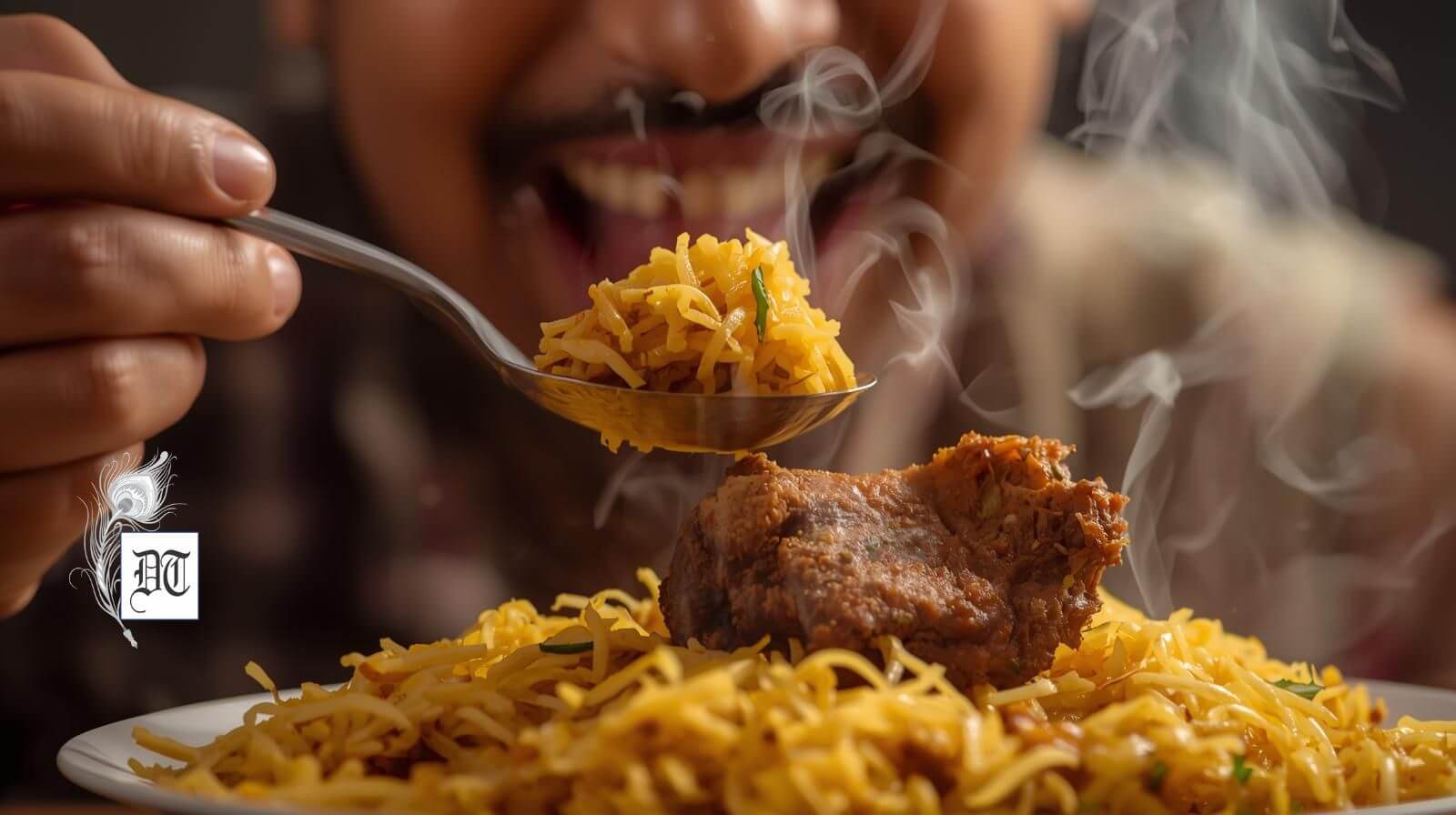
Sohini’s tongue-in-cheek take on biryani, for Bengalis, isn’t food—it’s emotion. Replacing mutton with paneer is not fusion; it’s love lost and culinary betrayal, for Different Truths.
Let’s not mince words (that’s for the biryani). For Bengalis, the phrase “vegetarian biryani” is not merely wrong — it’s sacrilegious. It’s the culinary equivalent of playing Rabindra Sangeet on auto-tune or serving rosogolla with ketchup.
Because here’s the truth: the Bengali soul runs on literature, politics, and mutton fat.
Thou Shalt Not Desecrate the Holy Grain
Biryani, to a Bengali, is not just food — it’s sacred geometry. Perfectly aligned rice, tender mutton, the humble potato (yes, it belongs there, calm down, Lucknow), all layered in divine harmony.
You open the lid, and angels sing in Awadhi accents.
But swap the meat for paneer or peas? Congratulations, you’ve just created a rice-based insult. The average Bengali’s blood pressure spikes faster than the oil temperature in Arsalan’s kitchen.
In the Beginning, There Was Mutton (and Then There Was the Potato)
When the exiled Nawab Wajid Ali Shah brought biryani to Calcutta, he didn’t realise he was founding a cult. The Bengalis took that royal dish, added a potato — because starch is our birthright — and turned it into edible poetry.
That potato isn’t a sidekick; it’s the Shakespearean fool — wise, comforting, full of soul.
But — and this is crucial — it plays best opposite mutton. Without it, the poor aloo is just… existentially confused.
Vegetarian Biryani = Rice with Delusions of Grandeur
Let’s face it: calling rice with veggies “biryani” is like calling Park Street’s Christmas lights “fireflies.”
It’s like saying “I’m having sushi” and then pulling out a sabudana khichdi.
The words vegetarian and biryani together are a grammatical error of the gastronomic kind.
You can’t just sprinkle some fried onions on rice, hum “Mere Mehboob Qayamat Hogi”, and call it a day.
That’s not biryani.
That’s pulao with a god complex.
The Bengali’s Emotional Support Mutton
Ask any Bengali about biryani, and their eyes glaze over in spiritual rapture. You can almost hear the faint echo of “Aaah, Arsalan-er mutton ta ki je bhalo chhilo…”
You see, Bengalis don’t eat biryani. They feel it.
It’s not lunch — it’s therapy.
It’s heartbreak food, celebration food, even “my-boss-is-a-monster” food.
So, when you say, “vegetarian biryani,” what the Bengali hears is: “I’ve replaced your therapist with a motivational podcast.”
Scenes From a Bengali Home
Picture this:
You bring a pot of “vegetarian biryani” to a family gathering.
- The grandmother gasps like you’ve dropped the Shankhachur.
- The uncle mutters, “Eta abar ki notun bipod elo?”
- The mother quietly brings out khichuri, because at least that has integrity.
- The father looks betrayed, muttering Tagore quotes about “truth” and “purity,” but you know he’s thinking about goat fat.
You might as well have declared you’re giving up rice for keto.
In the Court of the People vs Paneer
In Bengal, culinary justice is swift.
Paneer in biryani? Life imprisonment (with no parole).
Soya chunks? That’s terrorism.
Tofu? Now you’re just asking for exile.
The Verdict
Vegetarian biryani is not biryani.
It’s rice cosplay.
It’s biryani’s distant cousin from Noida who claims to be “spiritual, not religious.”
In Bengal, we believe in equality — but also in accuracy. And if it doesn’t have meat, it’s pulao. End of discussion.
In Essence
In the great ledger of Bengali crimes against culture — from mispronouncing Tagore to skipping the last stanza of Aguner Poroshmoni — serving vegetarian biryani ranks at the top.
So, here’s the rule:
- If it once had a heartbeat, it’s biryani.
- If it didn’t, it’s carbs.
And in this city of fish, festivals, and fierce opinions, that’s the only truth worth simmering over.
Picture design by Anumita Roy

Sohini Roychowdhury is a renowned Bharatanatyam dancer, choreographer, artistic director, speaker, social activist, and professor of Natyashastra. She founded Sohinimoksha World Dance & Communications in Madrid/Berlin/Kolkata/New York. A visiting professor of dance at 17 universities worldwide, she won several awards, including the “Mahatma Gandhi Pravasi Samman” by The House of Lords, the Priyadarshini Award for Outstanding Achievement in Arts, and the Governor’s Commendation for Distinguished World Artiste. She has also authored several books, including ‘Dancing with the Gods’.



 By
By
 By
By
 By
By
 By
By
Now that is something: I’ll forward it to my kids, one of who is vegan, and one vegetarian! On top of it, a delightful read in itself!
That said, how about leaving out the paneer and using chickpeas instead?