
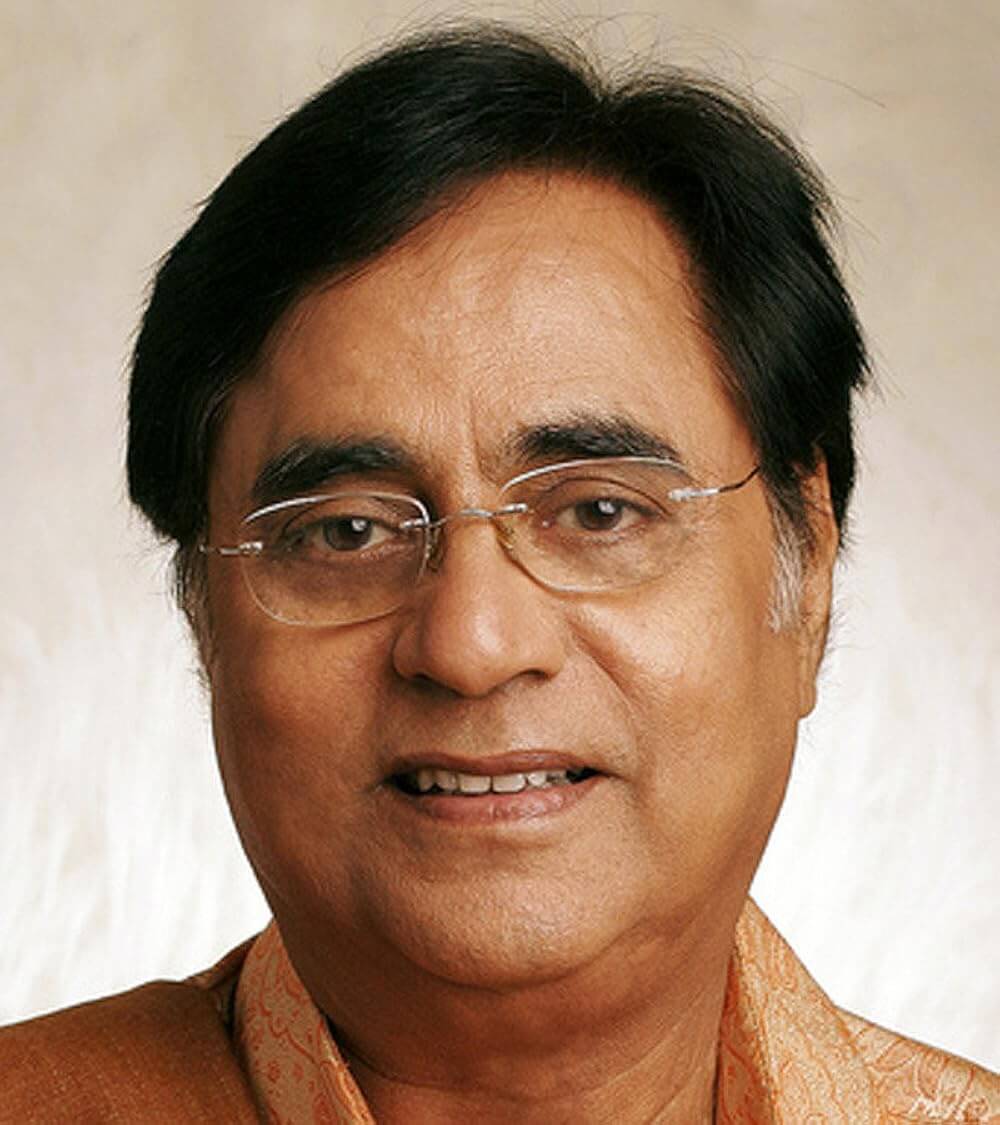

Dr Dhiraj’s tribute to Jagjit Singh, the Ghazal King, whose timeless voice still heals countless hearts, on his 14th death anniversary, exclusively for Different Truths.
October 10, 2025, marks the 14th death anniversary of the great Indian composer, singer, and musician Jagjit Singh—the day when his velvet voice fell silent, yet his legacy continues to resonate as the loudest, clearest note in the modern history of the ghazal. His life, shaped by both innovation and tragedy, secured his place as the undisputed Ghazal King of all time. I still remember my summer vacations as a Class 7 schoolboy at my maternal uncle’s house. He proudly showed off his newly bought cassette player, and when he played a tape, a deep, soothing voice filled the room: “Tum ko dekha to yeh khayal aaya.” I was instantly captivated, falling in love with that soul-stirring sound, unaware then that this voice would go on to transform an entire genre and touch millions of hearts, not only in India but across the world.
Jagjit Singh, born Jagmohan Singh Dhiman on February 8, 1941, in Sri Ganganagar, Rajasthan, into a Punjabi family, came from humble beginnings, far removed from the glitz of the music world he would eventually conquer. His father, a government employee, envisioned a career in engineering or bureaucracy for his son, yet the boy was captivated by music from an early age. He received his early education in Sri Ganganagar and Jalandhar, followed by his post-graduation in History from Kurukshetra University.
Alongside formal academics, he pursued rigorous musical training, studying under Pandit Chhaganlal Sharma and later dedicating six years to mastering classical forms such as Khayal, Thumri, and Dhrupad with Ustad Jamaal Khan of the Sainia Gharana. This classical foundation became the steel core upon which he built his radically modern style. In 1965, drawn by the lure of Bombay (now Mumbai), he arrived to stake his claim in the fiercely competitive world of Indian music. Over a career spanning more than five decades, Jagjit Singh’s voice graced compositions in Hindi-Urdu, Punjabi, Bengali, Nepali, Gujarati, and Sindhi, leaving an indelible mark across genres and audiences.
Jagjit Singh’s revolution began in the mid-1970s. He made a conscious decision to adopt Bol Pradhan Gayaki—a style that foregrounded lyrics over musical ornamentation. By emphasising emotional clarity in words, setting poetry to simpler but deeply melodic tunes, and introducing modern instruments like the guitar, violin, and synthesiser, he opened the ghazal to a vast new audience.
Jagjit Singh was not just a singer; he was the bridge between classical finesse and everyday life. Until he came along, ghazals were bound to classical taans and difficult Urdu, confined to elite mehfils and admired only from a distance by connoisseurs. Jagjit Singh brought them home—into our drawing rooms, our car stereos, even our study tables while preparing for exams. He simplified the orchestration, gave the ghazal a modern melodic frame, and yet retained its soul. Suddenly, the ghazal was not intimidating. It was relatable, hummable, even romantic in its everydayness.
His first major album with his wife, Chitra Singh, The Unforgettables (1977), was a breakthrough. The husband-wife duo became the first commercially successful pair in Indian non-film music. Their later albums, Ecstasies, A Milestone and many more, broke sales records and proved that non-film music could command mass popularity, creating a parallel industry outside cinema. In an age when playback singing was the only marker of fame, he proved that albums—independent, personal, direct—could create their own universe of listeners.
Jagjit Singh’s contribution to films and television was equally profound. His music for films such as Arth and Saath Saath in the early 1980s became cultural milestones, resonating with audiences far beyond the cinema hall. Yet his magnum opus was undoubtedly the score for the TV serial Mirza Ghalib (1988), which not only brought Ghalib’s verses alive for a new generation but also earned him the Sahitya Akademi Award in 1998 for popularising Urdu poetry. What set him apart was not just the richness of his voice, but the vision behind it. Long before “mass appeal” became a buzzword, he understood the potential of technology, embracing cassettes when many classical purists dismissed them as mere gadgets. In 1987, he became the first Indian musician to record a purely digital CD album, Beyond Time, demonstrating his commitment to innovation and the highest standards of sound quality. Recognition followed. In 2003, the Government of India awarded him the Padma Bhushan for his transformative contribution to Indian music.
There is a less spoken side of Jagjit Singh: his ability to balance profound melancholy with warmth. His ghazals often spoke of pain, longing, and unfulfilled desires. Yet the voice never weighed you down—it healed. Even in songs steeped in sadness, like “Koi fariyaad” or “Jhuki jhuki si nazar,” there was always an aftertaste of hope. That is rare. Most singers make you feel their sorrow; Jagjit Singh made you reconcile with your own.
Behind the public brilliance, though, lay deep personal sorrow. In 1990, he lost his 20-year-old son, Vivek, in a car accident. This wound, by all accounts, never healed, and yet it profoundly shaped his later music. The unimaginable loss was a profound shock. The couple withdrew from music completely for over a year, and Chitra Singh, unable to cope, announced her retirement from singing permanently.
For Jagjit Singh, the return to music was a gradual, painful, yet ultimately redemptive journey, as his anguish and sorrow found their way into his art, giving his later work an even deeper, more resonant pathos. In his album Hope (1991), he brought to life Nidha Fazli’s poignant words: “Tanha tanha hum ro lenge, Mehfil mehfil gayenge; Jab taq aansu sath rahenge, Tab taq geet sunaayenge,” transforming personal grief into a universal expression of loss.
Perhaps the most heart-wrenching testament to this was the song “Chitthi Na Koi Sandesh” from the film Dushman (1998), where his voice, once smooth and velvety, now carried the profound weight of human suffering, adding unforgettable depth and soulfulness to every rendition. This remarkable ability to turn pain into power defined his final decades, revealing a human spirit that refused to be crushed by fate, and reminding the world that beauty, hope, and honesty in expression can coexist with grief, touching countless hearts along the way.
Today, as we remember Jagjit Singh on his death anniversary, we do not merely mourn a loss but celebrate his everlasting presence. His ghazals continue to drift through radio waves, playlists, and quiet evenings, reminding us of the timeless magic of his voice. Jagjit Singh gave ordinary people the courage to hum poetry, to find dignity in sorrow, and to discover joy in reflection. He showed that sometimes the simplest words, when sung with honesty and depth, carry the most profound meanings. The silence he left behind is eloquent, yet Jagjit Singh never truly fell silent. Each note lingers, every couplet resonates, and in the hearts of millions, his voice lives on—forever.
Feature Picture from IMDb

Dr Dhiraj Sharma is a faculty member in the Department of Management Studies at Punjabi University, Patiala. He has authored fourteen books and published over a hundred research papers, articles, and book-chapters in reputed national and international journals, books, magazines, and web portals. Beyond academia, he is a nature and wildlife photographer and a realistic and semi-impressionist painter.



 By
By
 By
By
 By
By
The ultimate soul stirring composer, singer with sharp eye on quality life-long lyrics.
He even gave a new life to Mirza Ghalib.
Matched Gulzar’s depth.
Begining Unforgettables he will remain unforgettable.
A fitting tribute to the great singer.
Excellent write up, Dr. Sahab. A befitting tribute to the maestro who rules over our hearts with his melodious and silken baritone.