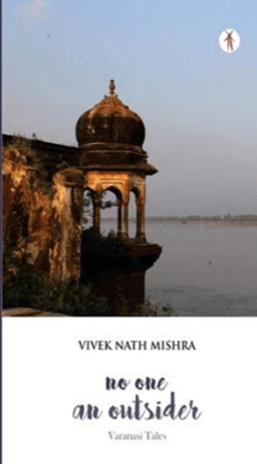
Dr. Sutanuka reviews, No One an Outsider: Varanasi Tales, by Vivek Nath Mishra. An exclusive for Different Truths.

No One an Outsider is Vivek Nath Mishra’s second collection of short stories, the first being Birdsongs of Love and Despair. In the present collection, Mishra attempts to piece together narratives where silence speaks louder than words. No One an Outsider comprises ten short stories. In the opening story, “Flood of Silence” solitude and silence of a different kind pervade.
Mishra reflects on interiority, the passage of time, and the fragile equilibrium we anchor ourselves to: “the look in the eyes of both the woman and the little boy was the same: the questioning look, the pleading look. Those were the eyes of distrust and hopeless anger. It was a look of a terrifying future as if immersed in the horror of the upcoming morning. As if they, there, would not be together again” (13).
Mishra’s Varanasi
Mishra lives in Varanasi and carts the old city in his heart. The dingy lanes and by-lanes of Varanasi, the cows, rivers, and the many ghats – are synonymous with Mishra’s writings. What is interesting is that these narrative designs move further from the geography that resides in Mishra’s memory, although that continues to be the primary impetus of the stories.
The undulant waves of Ganges turn into a flurry of human emotions.
The undulant waves of Ganges turn into a flurry of human emotions. In “It’s time” the protagonist Krish, a “Frenchman, aged around sixty-two to sixty-five” has been living” in Varanasi for about fifteen years” (26). Besides choosing the road not taken and touching a few raw nerves in the process leaves the narrator and the readers flabbergasted when he does not wake up one morning. Was it suicide? The man who would paint, sip tea in an earthen cup, and walk the lanes and by-lanes of Varanasi suddenly evaporates like thin air.
Mishra allows his readers to exercise their imagination and explores various shades of darkness in Krish’s life punctuated by sudden illuminations: “The world is a shadow. It has no shape. Nothing. It looks like a real thing, but has anything ever come into your hands? Stay free from it, untouched like you truly are. We are only smoke rising from pyre” (38).
Disparate Individuals
Mishra’s amused squint at society as a collective of disparate individuals holds the eye in “A Less Painful End” as does the vegetable vendor Ghure’s daughter Anju. Beauty was her burden. Her life was encircled by the leer, sneer, and gossip. Her neighbours always criticised her illicit ways to support her family, but nobody gave them a morsel when they needed it badly. A sudden twist at the end of the story leaves a bitter taste in the mouth when the narrator discovers the secretive life of his father.
In another story “The Culprit” , Mishra reinforces the quantum of human tragedy in today’s world.
In other stories like “Bloodline,” Mishra infuses dynamism into the narration.
In other stories like “Bloodline,” Mishra infuses dynamism into the narration. He devises an uncharacteristically low-key background to complement the solemnness. In “Smell of Leather” Subba’s (a butcher by profession) life-canvas convulses in bottled rage and angst when he finds his son Kooku butchered at the hands of the miscreants, a visceral scream freezes in his throat.
However, it is the felicity of his characters in conveying the kernel of the matter that makes No One an Outsider a compelling read.Itis marked by an undeniable flavour of Varanasi that goes beyond placing the city in the backdrop of the tale. The collection never compromises on the pace of the plotline. It rings on various registers – narratives that speak about the frailty and fragility of human emotions. This book has accolades coming its way.
Cover Photo sourced by the reviewer

Dr. Sutanuka Ghosh Roy is an Associate Professor in the Department of English at Tarakeswar Degree College, The University of Burdwan, India. She is a reviewer, a critic, and a poet. The titles of her books are Critical Inquiry: Text, Context, and Perspectives and Commentaries: Elucidating Poetry, Rassundari Dasi’s Amar Jiban: A Comprehensive Study, Asprishya (The
Untouchables, a novel by Sharan Kumar Limbale translated into Bengali). Opera is her debutant collection of poetry.


 By
By
 By
By
 By
By