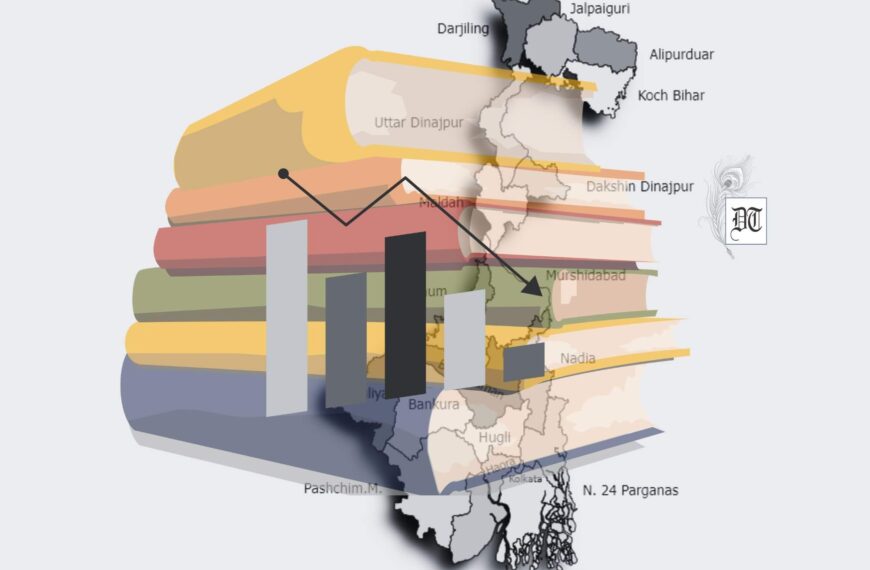
Prof Bhaskar asserts that the West Bengal teacher recruitment scam reveals a deeper moral crisis, undermining education, dignity, and the nation’s future, exclusively for Different Truths.
The beginning of what follows is a confusing condition of ‘cash for job’ as a schoolteacher in West Bengal, or a scam, among many others. However, a scam in education that involves the present and the future of children is much different from a scam in road construction or river dredging. As reported in print and electronic media, around 26,000 teachers who had been engaged as teachers in schools of West Bengal through the examination conducted by the School Service Commission (SSC) in 2016 lost their jobs in April 2025 based on the Supreme Court judgement. The sacked teachers protested on the road and in front of Vikas Bhavan, which is the authorised office to deal with the issue. They were kicked by police and lathi-charged, and, as alleged, a First Information Report (FIR) was lodged against some sacked teachers for disturbing officials on duty. This then becomes a moral question.
To add salt to the injury, the head of the government of West Bengal proposed to pay some allowance to these teachers sacked by Court order. The teachers rejected the proposal. This involves another moral question – if sacked teachers are paid unemployment allowance, why not all the unemployed job-searching youth be paid the same. Not surprisingly, the government of West Bengal is beyond the frontier of moral questions, or it defines its morality.
Teachers and Other Workers
Some years ago, while working for the evaluation of MNREGA works in six major states of India that included Uttar Pradesh, Bihar, Maharashtra, Madhya Pradesh, Rajasthan, and Odisha, sponsored by the Government of India, I was told by the non-working youth people in the heartland, ‘sab, ekbar shir par mitti uthau to phir teacher kabhi nehi ban paunga’ (If I carry dug soil on my head once, I shall never be able to work as a teacher). This tells a story bigger than this statement – that teaching is different from many types of work that include both manual and non-manual.
One major issue is the dignity of a teacher that stands out much differently from the dignity of many other types of workers since the time of Kautilya. In my understanding, a teacher is respected no less than the parents at home. ‘swadeshe pujjyate raja, vidyan sarbatra pujjyate’. So let me now come to the core point.
Cultural Retardation
I understand the society has degraded enormously over past few decades when I find a superannuated headmaster of a higher secondary school in a sub-urban area of West Bengal gets more pleasure in being identified as a counsellor of a municipality, and a teacher of a higher secondary school likes to be known more as a FIFA referee than the identity of a teacher. I find retardation when a teacher compares himself with the money that a banker earns. There is nothing wrong if the teacher is well compensated by the state, but the teacher himself is not supposed to be in that comparative-competitive mode by the indicator of money.
There was a time when teachers had unfathomable respect in society, despite some loose comments from some quarters about the paltry salary of teachers. Most of those who came to be teachers came to be engaged with children and adolescents, to make the future dependable citizens of the state and to make ‘maanush’ (man with a sense of humanity). It was not directly about converting the children into saleable goods in the labour market and marriage market. There was a time in undivided Bengal when teachers were offered a room by the zamindar in his own house to teach his children. Even during the period of political turmoil in West Bengal, teachers had a blessed relationship with the students and guardians of the students. That era probably ended, though it is not possible to pinpoint the year and date.
Very recently, because of a court case where a lady moved the Court of Justice that the cat is out of the bag. The judgement of the court went against all the teachers recruited because it was not possible to isolate in the absence of documents those who paid cash for the job and those who did not. The system was nicely built by the core state of West Bengal, mixing both types – joggo (qualified) and ajoggo (non-qualified) – one section will be ‘true’ teachers, the other section will carry forward the state agenda. It was, however, not transparent who paid cash for the job and who did not, due to the absence of any evidence. Hence, the esteemed Court thought it prudent to sack all teachers.
Education that rests on ‘question everything’ is different from a state agenda that rests on ‘accept everything’. In a ‘political collusive duopoly’, polluting education by hook or by crook seems no surprise.
The point probably is not that technology by smartphone, iPad, internet is responsible for degradation of teaching by contact hours. One point of course I found during past few decades is the less compatibility of teachers and students – lessening role of chalk and boards, parents less informed about teachers, lessening glorification of teachers and so on. Teachers ceased to be a model for the students to follow in life.
Privatisation
The mushroom growth of private-run schools at every nook and corner is based on the circulated belief that public or government schools are not worth admission. Gossip is in circulation that most of these private-run schools take donations from the students to be admitted and from teachers to be recruited. In my understanding, in all such money transactions, quality is compromised, other than the fact that it becomes discriminatory against children from poor families. The recent ‘cash for job’ scam is, however, not linked with private-run schools; it is around public schools, with money transferred from aspirant teachers is privatised, as a ‘conspiracy theory’ goes, in the pocket of a minister who is allegedly in jail.
New Normal
Many of the teachers seem now at par with rickshaw pullers-vendors-domestic assistants in language and body language. Often, the teachers’ faces are not seen in the public domain – maybe they are busy studying at home and in libraries. Some of them demand social respect but do not deserve it. They cannot assimilate with the rest of society, keeping their identity unblemished.
The core state is at an advantage – it has nothing to do with the dignity of teachers or anybody. It is only for votes in electoral politics where teachers do not matter much. The education minister or the police minister does not care if the protesting teachers are caned or kicked. I fail to understand how that teacher goes back to teach in the school, facing the students once the students saw him being kicked by police on a public road – if the picture that is displayed in print media is not fake.
National Failure
A nation is doomed to failure if it fails its teachers. The simple reason is that teachers are the nation builders – the cause of the wealth of a nation. Teachers are not supposed to echo the voice of political masters or dance to the tune of the core state or be routine conformists.
West Bengal
The state of West Bengal had pride in producing such teachers in its era of renaissance. Even post-renaissance most of the educated Bengali had the aim to be teachers. That history is to be brought back – not through kicking the teachers on public road but through recognizing their services.
The ‘cash for job’ scam in West Bengal surfaced very recently in the public domain; the major responsibility rests on the core state to rectify itself, not to drag the potential teachers into such diabolic exchange. Some youth might have thought of earning through salary in two years what money they paid on demand to the agents of the minister, that is, of course, ethically wrong, though economically well-calculated. Teaching is more than and different from economic calculations.
Teaching
I have reasons to believe that people engaged as teachers had years of education and moral training about what to do and what not. Still then, based on my personal experience of nearly half a century in teaching and research in different universities in India, may I mention that the task of the teacher is to open up questions even if all the questions cannot be answered immediately, to let the students know their country-civilization, to learn to come out from arrogance-ego, apart from adequate learning of given texts to get the degree. Getting the degree is not, however, education – it might lead to miseducation also. The teacher has to show the way to develop a scientific outlook. If education means self-enlightenment for social commitment, then the teachers need to be the first to carry society forward.
Dignity
The ‘cash for job’ scam has exposed both the government of West Bengal and a section of the people employed as teachers in schools. Teachers were made to understand the utility of corrupt practices in education – that cash payment to the political master was a necessary condition to get the job of a teacher. That the perceived private utility was a social disutility was not understood. All were sailing smoothly until one lady candidate moved to the court of law after being rejected in getting the job. The scam got exposed.
Concluding Comments
Teachers are not supposed to beg the political masters. If society cannot select teachers, it is a social failure. If institutions cannot select teachers, it is institutional failure. If an era fails to appreciate teaching, it is a demonic era. Teaching is not to be understood by labour hours; it is a 24-hour engagement. If a potential teacher does not realise it, he must not aspire to be a teacher.
Picture design by Anumita Roy
Prof. Bhaskar Majumder, an eminent economist, is the Professor of Economics at GB Pant Social Science Institute, Allahabad. He was the Professor and Head of the Centre for Development Studies, Central University of Bihar, Patna. He has published nine books, 69 research papers, 32 chapters,15 review articles and was invited to lectures at premier institutes and universities over 50 times. He has 85 papers published in various seminars and conferences.
He also worked in research projects for Planning Commission (India), World Bank, ICSSR (GoI), NTPC, etc. A meritorious student, Bhaskar was the Visiting Scholar in MSH, Paris under Indo-French Cultural Exchange Programme. He loves speed, football and radical ideology.



 By
By
 By
By
 By
By