Monika revisits Vincent van Gogh’s The Starry Night, which transforms global pigments into a swirling cosmos of emotion, hope, and inner turmoil that still burns today, for Different Truths.
Vincent van Gogh’s The Starry Night is more than a night sky. It is a landscape of emotion, a map of longing, and a story told through pigments that travelled across continents long before they reached his brush. Its swirling heavens, tremulous light, and kinetic stillness have enthralled viewers for over a century. At the core of its magnetism lies its colour palette. A daring combination of blues, yellows, and deep shadows that reflect not only Van Gogh’s technique but also his fractured brilliance, his relentless search for meaning, and the global histories of the pigments he adored.
A Sky Built from Blues and Turmoil
“The sight of the stars always makes me dream,” Van Gogh wrote to his brother Theo… perhaps the most intimate doorway into understanding The Starry Night.
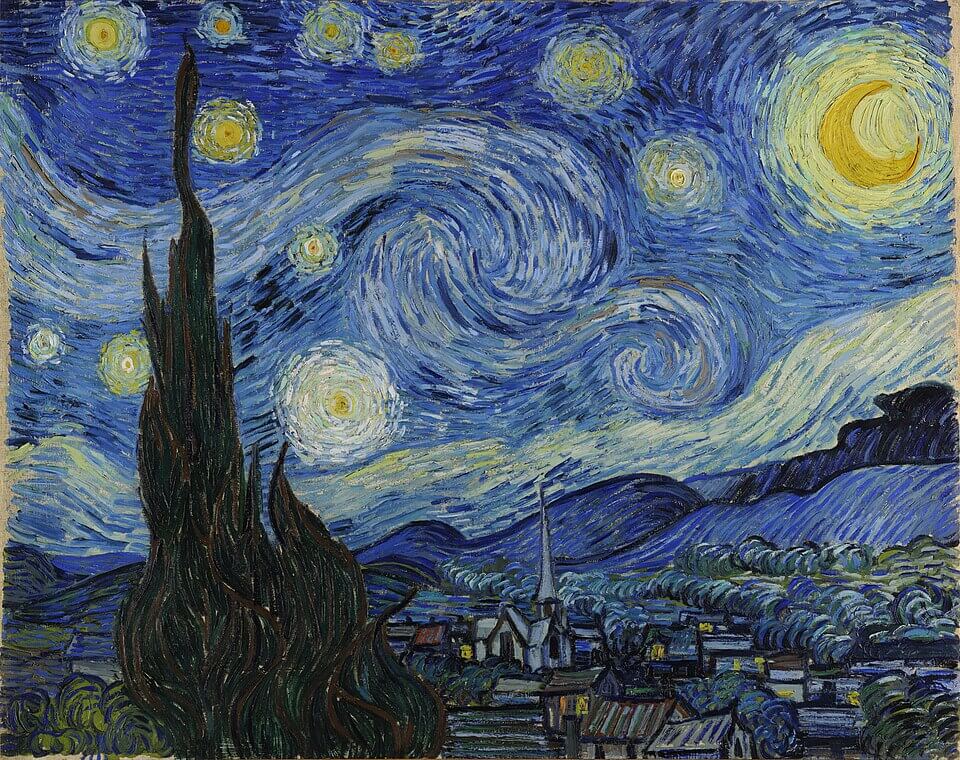
Blue dominates the painting in broad, storm-like swirls, from ultramarine depths to softer cobalt arcs that mimic wind, movement, and the mind in motion. To Van Gogh, blue was not passive. It was the colour of thought and yearning…“a colour of peace, but also the infinite,” he once hinted in his letters.
These blues were not merely aesthetic decisions. Ultramarine, once so rare that it was used sparingly in medieval manuscripts, came originally from Afghan lapis lazuli. By Van Gogh’s time, synthetic ultramarine made in France allowed him to use it lavishly, almost obsessively. Cobalt blue, developed in the early 19th century, carried a sense of modern discovery. Together, they brought celestial depth to his personal turbulence.
The swirling sky is as psychological as it is painterly. It is both movement and confinement, a cosmos bursting outward while folding back into itself… much like Van Gogh, who once confessed: “I put my heart and soul into my work, and I have lost my mind in the process.”
Yellow: His Hope, His Light, His Fragile Joy
If blue embodies his turmoil, yellow captures his reaching for hope. “There is no blue without yellow,” he declared, and The Starry Night proves the sentiment.
The stars and crescent moon radiate with cadmium and chrome yellow. Bold, warm, almost alive. These pigments themselves carried layered histories. Chrome yellow, derived from lead chromate, had entered Europe through expanding trade networks and scientific discoveries. Some of which traced their material origins back to India and its rich traditions of dyeing. Even synthetic versions carried the aura of that exotic lineage.
Van Gogh gravitated toward yellow as if it were a lifeline. In Arles, he painted sunflowers in feverish repetition, writing: “Ah! Yellow – the colour of light, of love. How I long for it.”
Yet chrome yellow was notoriously unstable, prone to darkening with time. The choice was accidentally symbolic—his hope always threatened by shadow.
Pigments of a Global World
Van Gogh’s palette was a product of a rapidly globalising 19th century
Ultramarine, once mined in Afghanistan, is now synthesised in France.
Cobalt was discovered through European industrial chemistry.
Chrome yellow, linked to trade routes and dye traditions in India.
Lead white, a pigment with roots in ancient Greece, is still made widely in Europe.
Emerald green, toxic yet vivid, was born in 19th-century German laboratories.
In painting a small Dutch church and the hills of Saint-Rémy, Van Gogh unknowingly captured the world, its minerals, industries, and cultures distilled into colour.
A Psychological Geography
The Starry Night is often read as the mind of the painter laid bare.
Painted during his stay at the Saint-Paul-de-Mausole asylum, the work emerged not from hallucination, but from memory, imagination, and longing. He wrote:
“Look at the stars and the infinity above. It makes life seem almost magical.”
Yet he painted this magic through a window of confinement. His nights are punctuated by insomnia, his days are shadowed by self-doubt. The tension between blue and yellow, between despair and aspiration, mirrors the tension within him. His world oscillated between clarity and rupture, devotion and exhaustion.
Still, there is harmony in the storm. A rhythm. A sense that chaos can organise itself into something almost tender.
He once wrote: “I am seeking, I am striving, I am in it with all my heart.”
That striving breathes in every stroke.
Influences: Japan, Paris, and the Light That Changed Him
Van Gogh’s fascination with Japanese art shaped the clarity and boldness of his palette. He admired the ukiyo-e prints for their flat planes of colour, stylised clouds, and wide horizons. “All my work is founded on Japanese art,” he wrote, and The Starry Night carries that DNA… simplified forms, expressive lines, colours chosen to express emotion.
Impressionism, too, taught him the power of complementary colours. Blue and yellow, opposites on the colour wheel, intensify one another when placed side by side. In The Starry Night, this creates the electric pulse that makes the stars appear to throb, the sky to breathe.
A Scene Local to Saint-Rémy, A Palette Borrowed from the World
Though the landscape is rooted in Provence, the colours come from centuries and continents wide. Van Gogh transformed these worldly elements into something purely his.
A swirl of Afghan blue.
A blaze of Indian yellow.
A wash of European white.
A zest of toxic Emerald green.
Together they formed a night that has outlived him, speaking in his voice long after he could.
Endnote: Colour as the Language of a Soul
Van Gogh’s palette in The Starry Night is not merely technical brilliance; it is biography.
It is a record of his restlessness, his hope, his fragility, and his continued belief in beauty despite despair.
His colours survived where he could not.
His yellows still burn.
His blues still tremble.
His stars still dream.
And perhaps, as he once wrote, that is enough: “What is done in love is done well.”
Painting image sourced by the author
The Starry Night (1889) – MoMA, New York (Credit – Wikipedia)

Born in the breathtakingly beautiful vale of Kashmir, Monika had her schooling there. A postgraduate in Business Management, an academician by profession, she is an art history enthusiast, writes poetry, short stories and paints. An avid reader, mostly biographies and autobiographies. Giving wings to her imagination through beautiful colours and words, she sings and has a following on YouTube.

 By
By
 By
By
 By
By