
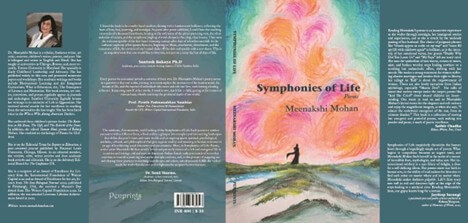

In an exclusive conversation for Different Truths, Lopamudra candidly interviews Meenakshi Mohan of ‘Symphonies of Life’ , discussing life’s non-linearity, her book’s themes, and her writing journey.
The mystic Sufi poet Rumi had famously quoted: ‘Only from the heart can you touch the sky.’ The heart is the abode of our boundless possibilities, I strongly believe, and it is in the heart that poetry resides and takes shape in various manifestations. Every poet that I have known through my soul connection with them in poetry and words has made me reiterate the message behind this quote of Rumi.
Having read the soul-nourishing poems of poet and author Meenakshi Mohan in her debut poetry collection ‘Symphonies of Life’, I can vouch for the aptness of the title, as it reflects the various tunes and melodies, the diverse trajectories of her mindscape, all converging to form a symphony, an orchestra of her artistic, poetic sensibilities. The more I delved into the poems, the more the various facets of her mindscapes came alive to me, making me believe in Rumi’s thoughts about the heart touching the sky, the horizon all over again, through the garb of poetry.
The title and cover came alive to me in the brilliant strokes of colour, very symbolic with an esoteric touch, which again reminds me of Rumi’s deep, unfathomable words. On the other hand, the range and themes of the poems appeared to me as vast and quite an ‘immersive experience’, as poet and author Satbir Chadha writes in her blurb. They range from her nostalgic self with a quest of the mystic to the immigrant woman’s words and cadence with myriad hues and sensibilities, to the ‘mosaic of incredible lives’, as Jaydeep Sarangi, poet and academician, puts it in his blurb, deeply rooted in the treasures of mythology.
Lopamudra Banerjee: Meenakshi di, welcome! Congratulations on your debut poetry collection, ‘Symphonies of Life.’ That’s a beautiful title. What was the very first thought that led you to it? And could you also tell us about the journey of bringing this book to life?

Meenakshi Mohan: Dearest Lopa, first, thank you for inviting me here and writing such an incisive introduction to the book. In the gist of Rumi’s quote, “The heart is the abode of our boundless possibilities,” you have said it all.
The book’s title, Symphonies of Life, came naturally to me. This book is my story—it is all about my emotional journey. Life is not linear—it moves in a curve. There are ups and downs and highs and lows like musical notes in symphonies. Nature and nurture play a role in a person’s life journey and emotional mindset. I grew up in a small town near Calcutta (as it was known then). Our house faced the Hooghly River with its calm and serenity, intertwined with the fisherman’s songs. In the evening, the sky and the water melted into each other, connoting the ephemerality of life and with a hope for a new day. At the back of the house, a jute factory thumped, and the sweaty-faced workers toiled away, worried about meeting the two ends of their lives. Since childhood, I had been quite sensitive to complacency and chaos in nature and life. As you read my poems in this book, you will find them spread out in my verses.
You will glimpse the book’s gist behind the opening poem, “Life is like symphonies, with haunting melodies of sadness and despair, with echoes of love and delight. Between tears and laughter, they weave a story…And we wait, for the symphonies of life to go on with an unrelenting crescendo.”
LB: Dr. Sunil Sharma’s blurb points to the diverse nature of your poems, from “rainbows” to “Zen moments.” Given that ‘Symphonies of Life’ also delves into complex life paths, mythology, and spiritual/cultural aesthetics, what would you say is the unifying central vision of your book?
MM: Considering the vast trajectories in my poems, the central vision that binds them together is exploring the tapestries of human experiences through personal reflection and empathetic observation, revealing the interconnectedness of human emotions through diverse lives and cultural landscapes.
Mythology and spirituality often explore fundamental human emotions like love, loss, hope, and fear. They are both deeply embedded in cultural traditions and aesthetics. The central vision of the book bridges human experiences through poetic reflection.
LB: ‘Symphonies of Life’ encompasses intensely personal poems dedicated to your husband, nostalgic reflections, and poems capturing diverse universal lives. As a poet, you navigate the pull of personal emotion (‘Maya’) and the need for an observer’s detachment. How did you manage this interplay between the personal and the universal in your mindscape to achieve this balance?
MM: Emancipation, “Your words bring some smiles and some tears”, suggests personal experiences, feelings, and healing themes. At the same time, Dreams of Rickshawala is based on exploring empathy and connecting diverse human emotions.
A poet also keenly observes events, nature, emotional experiences, etc. William Wordsworth said, “A poet does not see or hear or feel things that others do not see, hear or feel …” but the gist of his quote explains that a poet connects that experience to emotional and sensory perspectives. He also said that poetry is the spontaneous overflow of powerful feelings. In the Maya poem, I acknowledge, “Where his glory once ruled the domain, today, it is barren, like a desert,” as an observer, the tangible reality connects to the intangible past with the flute music as a bridge.
LB: You introduce your collection by comparing your life’s journey to a symphony, noting its various movements. As a reader, I connected with the autobiographical depth in your family poems, while your diaspora poems evoked different nuances inherent in the immigrant experience. How do you see these multilayered emotions fitting within the overall symphony of your poetry?
MM: Lopa, here I would like to quote Gopal Lahiri ji from the Foreword he wrote for the book, “Symphonies of Life, is introspective and personal in tone but wide-ranging in topic…The poet turns loose of her emotions in her poetry, yet her poetry does not always involve grief and pain, as she sometimes explores the uniqueness and undulations of life. Some of her poems are based on personal experiences yet reach the universal.” The reservoir of memory has been a valuable source for my writing, and often the mood shifted from the nostalgic elements to more contemplative emotional scenes. As for the diasporic reflections in my poems, I would like to quote Anita Nahal’s review (Bangalore Review 2025), which I find pretty accurate, “Bonding with one’s birth country and the people left behind is an intrinsic part of diaspora literature, which one finds in abundance in Mohan’s collection. V.S. Naipaul, Salman Rushdie, Jhumpa Lahiri, and Shashi Tharoor, among others, are diaspora writers who express themselves as such.”
Emotions are dynamic and not one-layered. Different moments evolve into feelings, causing them to interplay. There are indeed autobiographical elements in my poems — Deepa Agarwal in her review of this book, titled it as Autobiographical in Verse (Durgapur Review: Annual Issue, 2024) and Debasish Lahiri wrote in his review (Indian Literature, January 2025), “I have never come across a collection of verse which is not, in some suggestive way, a memoir,” but, there are different themes very close to my heart such as on migration, mythological stories mainly depicting that feminism is not a modern phenomenon, but is centuries old, as described in my poems, Shanta Devi, Medusa, and a few others. I have also touched on political issues, such as Gandhi, while some humorous poems are in Chat Masala and What Color is My Neuron.
LB: Your poem ‘Dawn’ uses Emerson’s quote about nature mirroring the spirit and creates a mystical visual. This resonates with the mystic human voice in ‘Dusk’ and the moon imagery in ‘My Own Moon.’ The lines in ‘Dusk’ about an “enchanted boat” floating on melodic winds are striking. Considering the traditional view of women as deeply connected to nature, do you feel this natural energy intertwines with your feminine energy?
MM: Dawn and Dusk were inspired by my Grandson Anant’s paintings. He portrayed himself sitting on a cliff with his guitar, playing. My Own Moon is nostalgic, as I remember my mother and childhood days. In some ways, you can say that there is a natural connection between Mother Nature and feminine energy, especially when we connect nature to nurturing and caring, creativity and beauty, connection and harmony, and resilience. Maybe in some subtle ways, you find that connection in these three poems, or my other poems. However, intentionally, I had no such thoughts when I wrote these poems.
LB: Women from mythology, like Kali, and those in Indian epics are significant in ‘Symphonies of Life.’ You reimagine the Mother Goddess in today’s women through poems like ‘Kali is Born.’ You also shed light on minor Indian epic figures and draw connections between figures like Medusa and Nefertiti from Greek mythology and modern women. How did this broad range of female narratives, spanning cultures and time, fuel your inspiration to write poetry?
MM: In all my mythological women stories, with various examples — She, Kali is Born, I am Kali, Medusa, Nefertiti, and Shanta Devi, my goal has been to awaken the women’s energy, so there are no Abhayas.
LB: You also curated and edited ‘Tapestry of Women in Indian Mythology,’ a distinct collection of poems centred on the representation of women in Indian epics and mythology, a theme not often foregrounded in mainstream Indian literature. What was your underlying ethos in compiling such a comprehensive anthology? And in your opinion, have women characters been historically marginalised or underrepresented in Indian mythology?
MM: Yes, the stories of women’s marginalisation are centuries old. The aim of bringing out that epic book, Tapestry of Women in Indian Mythology, was to prove to the world that women and men are two parts of the same coin created by God. The first word of my Preface is “God resides where women are respected.” I grew up listening to Mahalaya, an invocation to Durga, “Jago Tumi Jago Ma” – it was to inspire and encourage women to stand up for themselves. The core of this research was that, in which 80 poets contributed, women were celebrated as powerful, empowering souls.
LB: Your forthcoming ‘The Relic Anthology,’ co-edited with Dr. Santosh Bakaya, centres on human nostalgia and our connections to the past. What is your vision for this collection, and what inspired you to delve into this theme?
MM: This project aimed to emphasise the importance of artefacts that lie as forgotten history, to bring them out with their stories, nostalgia, history, and culture, and to make them pieces to be remembered by future generations. This anthology is a perfect storehouse of the memories our contributors have poured their hearts into. It is about rediscovering the gems from the spider-webbed garrets and dust-covered alleys. The idea came when Santosh and I were chatting on the phone one day about the treasured pieces we have at home, e.g., pens, kalamdans, old books, and so many other forgotten items. Santosh shared her father’s old house in Kashmir with a tethered wooden piece on the door of that house, which said, “Relic,” and thus our anthology The Relic was born.
LB: I extend my best wishes for your remarkable literary and academic pursuits, which prompt us to consider life’s various turns with a discerning eye. Thank you for providing us readers with this insightful look into your world.
MM: Thank you so much, Lopa, for doing an excellent in-depth interview about my books. I truly enjoyed our conversation and appreciated your insightful questions.
Photos sourced by the interviewer

Lopamudra Banerjee is a multi-talented author, poet, translator, and editor with eight published books and six anthologies in fiction, nonfiction, and poetry. She has been a featured poet at Rice University, Houston (2019), ‘Life in Quarantine’, the Digital Humanities Archive of Stanford University, USA. Her recent translations include ‘Bakul Katha: Tale of the Emancipated Woman’ and ‘The Bard and his Sister-in-law’.


 By
By
 By
By
 By
By
 By
By