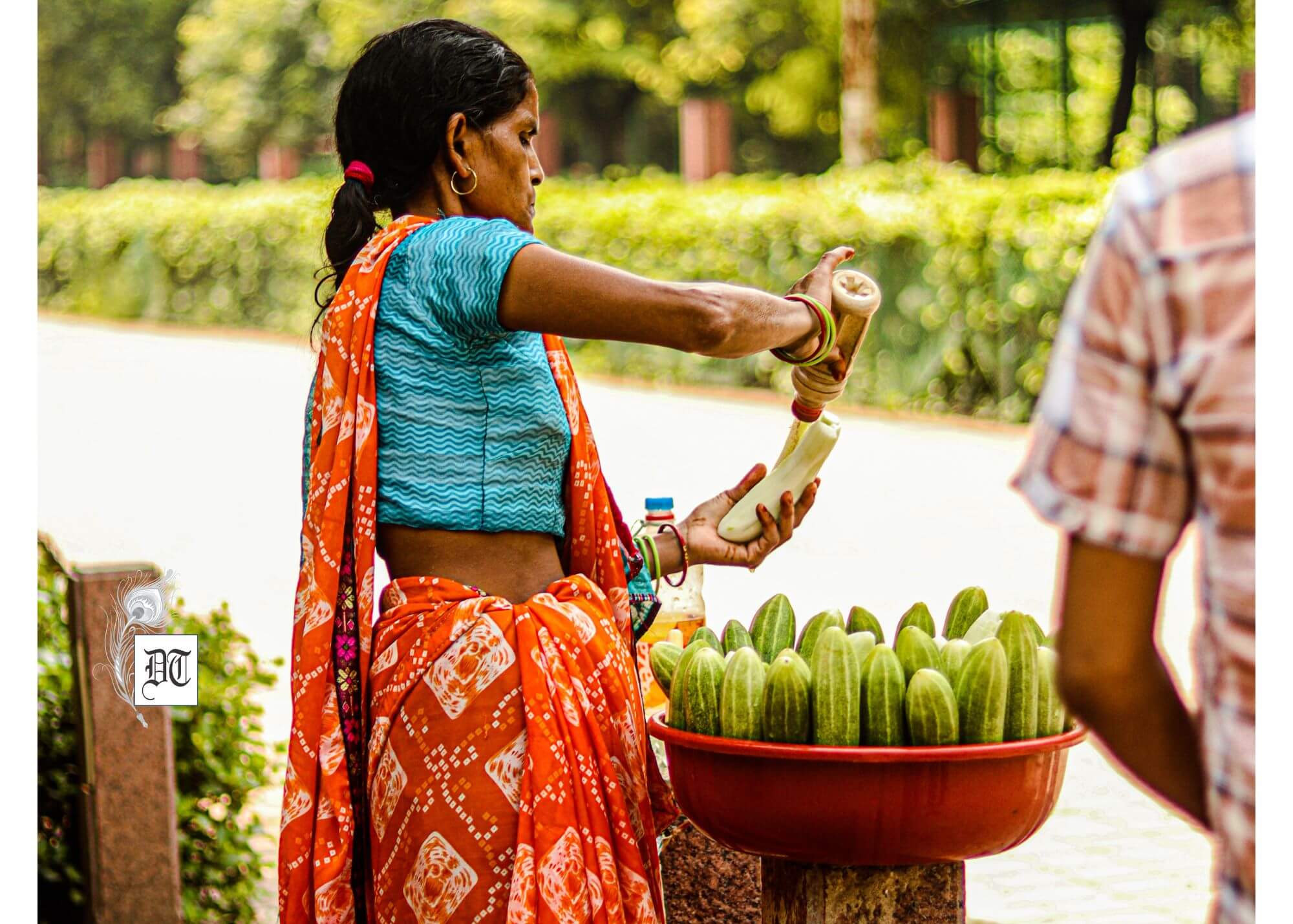
Prof Bhaskar opines that disguised poverty in West Bengal’s urban outskirts, often unnoticed, reveals women’s economic struggles through a traveller’s survey, challenging conventional metrics, exclusively for Different Truths.
Contrary to conventional ideas on poverty in India and, as a part of it, in West Bengal, poverty often remains disguised. Many times, income may not be disclosed, particularly by the lower-middle section and the marginalised population. The purpose here is to open the issue and not provide a made-easy solution.
Conventional wisdom estimates monthly per capita consumption expenditure (MPCE) at the level of the household and brackets households by MPCE to provide data. Head count is the estimate that shows households living below or above the poverty line, somehow drawn. I propose here a ‘traveller’s survey’ to find out who is engaged in what economic activities, to understand process-poverty and not poverty as an outcome. Of course, consequential poverty may be of immense importance.
Methodology
The travel zone was urban West Bengal, particularly the outskirts of Kolkata. The survey year was the first half of 2025. The travel time was from morning to evening on days not fixed a priori. The method of observation was both participatory and disguised.
Three tiny service providers were selected from three different wards under the jurisdiction of Panihati municipality, which mainly encompassed two towns, one developed, namely, Sodepur, and the other less developed, namely, Agarpara. The less developed zone was selected purposively. Three wards were selected from a total of 35 wards of the municipality. The service providers were all women of different age brackets. The shops or service centres were equidistant from one another – approximately one km – one of which was located on the west side of Agarpara railway station and the other two were on the east side.
No structured schedule or questionnaire was administered on the sample. The unstructured conversations occurred at the service-providing points.
Some Observations
In the processes, what was observed was the following:
1. A middle-aged woman in a shabby dress running an unnamed food stall in a dirty area adjoining Agarpara railway station, where the main customers were the bus drivers, bus conductors, drivers of auto rickshaws and occasional travellers. The kitchen-cum-dining room was a single dilapidated 8 ft by 6 ft semi-pucca room. The food meal was cheap, absolutely – vegetable thali Rs. 35, egg thali Rs. 50, and fish thali Rs. 60. Thus, meals taken twice a day with variations came in the range of Rs. 2000 to Rs. 3000 for an individual based on the assumption of two square meals a day. The income per month of the seller, who was a cook-cleaner-distributor, was around Rs 12,000, as reported.
2. All the raw materials, like vegetables, eggs, and fish, were bought from the nearby local bazaar at the cheapest price. The food was offered on disposable leaf plates – leaf plates bought from the local bazaar. It did not make much sense to pinpoint who lived in BPL or who lived in APL for one major reason: income was stable at a low level but uncertain; uncertainty was because of ‘day-labour, day-income’ for both the food shop owners and the drivers of auto rickshaws. The shop itself seemed transitory, having two wooden benches and one wooden table that could accommodate four people at a time. All the inputs and final output were perishable, so the meal prepared early in the morning had to be consumed at the end of the day. The shop had no consumer durable goods, like a fridge to preserve food and raw materials.
3. Two girls in their mid-twenties had to open a handmade tawa roti-making food stall and complementary sabji for buyers on the roadside of an auto rickshaw and e-rickshaw stand at Agarpara under Panihati municipality in 2024 after their income-earning father left the physical world at an early age. Even if they had ambition for further studies, the survival instinct worked. They were the workers-cum-owners of the tiny shop that had a regular sale. The buyers were more from the people around and fewer drivers of auto rickshaws and e-rickshaws. Though income per month was not reported, they could sustain their household of three members, which included their mother. Estimation of MPCE to understand poverty had not yet arrived for this household.
4. Marginalisation forced one girl in her late twenties to open one tiny shop adjoining Ushumpur bazaar at Agarpara that prepared and sold only tawa roti and aloo bhaja (potato fry) in an indigenous way. The target buyers were the vendors of the locality and random people. The shop was unnamed. The display board showed the availability of the items in the shop at specified prices. The shop was too small to provide space for customers to sit to consume. Per day’s income from this sale did not exceed Rs. 300, as reported; based on this, per month income for the girl did not exceed Rs. 10,000. She used to buy major raw materials, namely, atta, potatoes, and edible oil, from the local bazaar. Her parents depended on her for survival. Estimating poverty seems irrelevant here.
The above examples showed very few of the unending works where women were engaged in distress to keep households surviving, as opposed to the conventional notion that they were primarily engaged as unpaid workers intra-family. The engagement of such women on the plains is different from the regular, routinised self-employment of the women on the hills in the Himalayan region.
Gender Division of Labour
On the plane, land in the small towns with budding bazaars; women come on the road as the sellers, which seems the last resort for the families to survive. Otherwise, it had been the male members of the families who used to be visible in the bazaar – women were mostly homemakers. This increasing engagement of women as vendors and tiny shop owners implies disguised urban poverty that is not often noticed by mainstream economists, and their income is not estimated. Surely it remains an unfinished agenda for the economists because the beginning itself is not much understood so far.
The examples cited by no elasticity of imagination imply gender-specificity of poverty. It surely implies, given the cultural background of West Bengal, that women are the last economic weapon to sell labour power on the public road. Hence, self-engagement of women of any age for the family’s economic protection implies family poverty – the process shows the initial condition.
Priorities and Poverty
In all the examples cited, higher education and preventive health care were not on the priority list of individuals and families. Poverty loses its meaning by the human factor if these two indicators are absent or if only food security is the goal. Of course, marginalised families cannot be advised what their frontier of choice should be. Choice is income-constrained; income is irregular and uncertain. Thus, choice, if it exists, remains a dream.
Social Economy
Essentially, the marginalised people in urban areas, as maybe in villages also, live somehow based on the strength of the functioning social economy that is post-barter and based on economically supporting each other. It operates at a level below the life expectancy of high-income households. ‘ Non-rich support is manifested here. The role of polity in this domain is not readily visible.
Some Comments
· Poverty is not to be confined to a line to bracket people below it or above it, particularly in the cases of disguised poverty of the urban middle-section marginalised families.
· None of the women vendors said that they were poor; their mouths were shut on this question, but their faces revealed it. The economy is not readily visible in the processes.
· Disguised poverty generally escapes the attention of the government.
In place of a Conclusion
Unending inter-generational disguised poverty in urban West Bengal, as it may be in some other states of India, requires different types of estimates for the identification of the income-poor. The first task is to get rid of a single jacket called ‘poverty line’. The phrase made-easy conclusion seems redundant.
Picture design by Anumita Roy

Prof. Bhaskar Majumder, an eminent economist, is the Professor of Economics at GB Pant Social Science Institute, Allahabad. He was the Professor and Head of the Centre for Development Studies, Central University of Bihar, Patna. He has published nine books, 69 research papers, 32 chapters,15 review articles and was invited to lectures at premier institutes and universities over 50 times. He has 85 papers published in various seminars and conferences.
He also worked in research projects for Planning Commission (India), World Bank, ICSSR (GoI), NTPC, etc. A meritorious student, Bhaskar was the Visiting Scholar in MSH, Paris under Indo-French Cultural Exchange Programme. He loves speed, football and radical ideology.

 By
By
 By
By
 By
By