
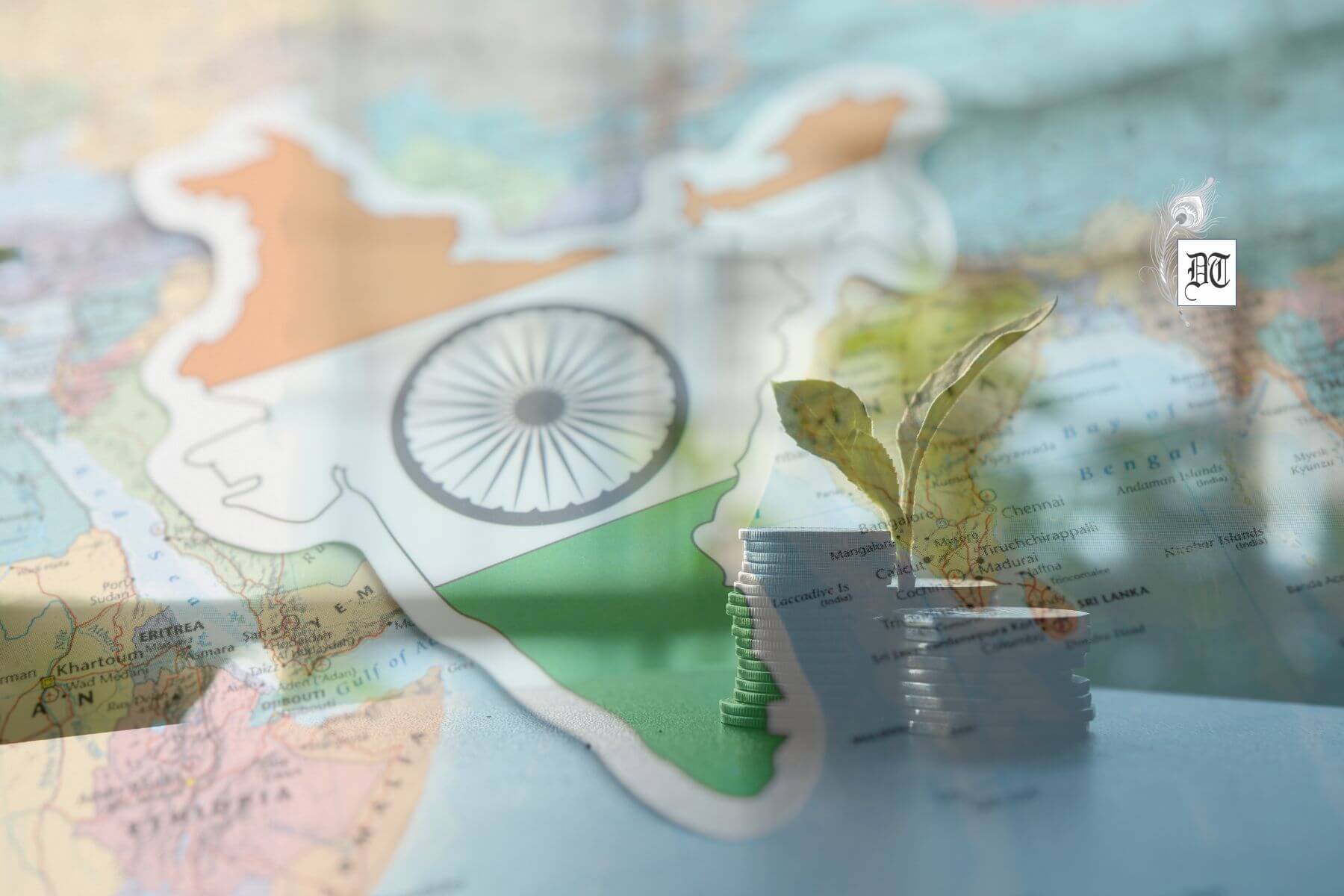
Prof Bhaskar opines that “Viksit Bharat, 2047” focuses on the economy, overlooking that India’s prehistoric civilisation and society are the true, eternal foundation, exclusively for Different Truths.
The number of ways Bharat is being perceived is uncountable because Bharat is a civilisation. Documenting this civilisation is a herculean task, if possible, for its prehistoric nature. The way Viksit is pledged has its major connotations in an economy and not in civilisation. Though the economy takes birth in the womb of the society and though the diversified society is an integral component of India’s civilisation, human tendency is to focus on the immediate past, that is, the economy, rather than searching for the society-civilisation in which the economy took birth.
While Bharat refers to time immemorial, Viksit stands on a specific time horizon. The pledge, ‘Viksit Bharat, 2047’, carries meaning for 2047 completes a century since India’s independence, 1947. Of course, India’s history did not start in 1947. ‘Viksit Bharat’ means developed India. Probably, Viksit is understood as economic development.
Success and Failure, 1947-2014
The thinkers under the political leadership of India’s first Prime Minister introduced the first five-year plan in India in 1951; in parallel, the first general election was held in 1952 – economics and politics moved in parallel for probably political consensus. The major problems then were the Partition of Bengal and Punjab on the east and west of British India. This showed an influx of population, as refugees who could not be readily absorbed into the job market. Despite the able leadership of Dr Bidhan Chandra Roy as chief minister of West Bengal till 1962 at a stretch, the crises culminated to reach their peak in the mid-1960s. The unwelcome partition of the land also brought about a major chunk of development fund oriented to military expenses for perceived hostility on both the east and west of post-independent India.
The steadiness and stability of India’s economy till mid-1960s stood on committed political leadership, the first three five-year plans, import-substituting industrialisation that got shocks since the Indo-Pak war of 1965, drought 1966-67, and consequent food insecurity. The immediate result was the end of the uninterrupted ‘planning era’ and the advent of ‘Plan Holiday’. The shocks multiplied for the 1971 Bangladesh war that saw the entry of more population from the newly formed politically sovereign Bangladesh.
The Fourth Five-Year Plan (1969 – 1974) talked about decentralised planning, but it was too late to capture either inclusive development or ensure poverty eradication. The then Prime Minister announced ‘Garibi Hatao’ in 1972, which was incorporated in the Fifth Five-Year Plan (1974-1979). The whole of the 1980s was a decade of crisis management.
The ‘Vikas Path’ was unambiguous since 1991 through the announcement of the New Economic Policy (NEP) that opened the gateway of India for trade and investment. It was aimed at reducing state control over industries in favour of privatisation. Already, the idea that ‘there is no alternative’ (TINA) was floated for policy acceptance of globalisation that stood on privatisation-liberalisation. Under the political adverse conditions, ultimately, the 11th Five-Year Plan (2007-2012) announced ‘inclusive development’ as the major objective that was repeated in the 12th Five-Year Plan (2012-2017) through the pledge of ‘more inclusive development’. The 12th Plan was terminated in 2014.
Post-2014 Decade
Some of the problems that remained concealed during the pre-2014 era were revealed during the post-2014 era. Non-Performing Assets (NPAs) increased by leaps and bounds, unclaimed deposits in the banking system became robust, and some crooks siphoned off or looted bank money. The economy of India was enormously drained. An effort was made in the very recent past to dig out black money through the declaration of ‘Demonetisation’. In parallel, it was an era of de-unionisation based on scattered-fractured labour employment based on wages per day that maintained a large chunk of youth at the margin of the economy. The phenomenon of demographic disaster was concealed in an ‘adverse inclusion’ trap. The basic structure of the economy remained mixed, but it tilted in favour of the private enterprises, contrary to the initial years of planning meant to form a ‘socialistic pattern of society’ as declared in December 1954 in the Parliament.
A Critique of Vikas
Critical analyses cropped up regarding the path of India’s economic development, of which the major ones were consumer goods-capital goods imbalance, comfort goods-wage goods imbalance, quantitative restrictions on trade, failure to ‘catch up’, failure of trickle down, non-expanding internal market and so on. The other types focused on conventional criticism, like poverty-inequality-unemployment. Under the above conditions, one escape route was the formation of an administered market where labour could be used, and food could be had – ‘roji-roti’. The Essential Commodities Act, 1955, aimed at food security; the National Rural Employment Guarantee Act (NREGA), 2005, aimed to ensure a minimum 100-day guarantee of employment per household per year.
Internal inter-firms demand for capital goods was there, but exports of these goods did not get much success because of the perpetuation of the colonial division of labour. India remained a country based on exports of tea, jute, as commercial crops and agricultural goods in the main. The trade balance and terms of trade remained adverse in any medium-term period for India’s economy. The absence of adequate internal demand for produced goods could not be compensated for by external demand.
The basic structure of a mixed economy remained intact post-2014, with a tilt towards the private enterprises, particularly towards monopoly and concentration of capital. Meanwhile labour market got fragmented and fractured, implying a decline in the power of labour in bargaining vis-à-vis capital, with an adverse impact on wage share. A perpetual condition of poverty-inequality-unemployment, and inter-generational untouchability made a large section of the population excluded from development.
Participatory Viksit Bharat
Bharat is Viksit when its people are Viksit. People are Viksat when they are hunger-free, educated, healthy, and people of consequence through conscious participation in decision-making processes. Self-engagement and ad hoc work surely ensure income in cash and kind for the workers so engaged. What is urgent is to promote regular wage-employment for the willing workers. This requires expansion of the organised sector of the economy.
A Roadmap
Initial conditions of any economy cannot be altered. Processes do not repeat. Consequences are unforeseen. Hence, what we may talk about are the processes.
The processes stand on a basic structure and the derivatives from it. An economy cannot move forward unless the base is strong. To make the base strong, there has to be collaboration between industries and public research institutions, education and work environment need to maintain a symbiotic relationship, brain already drained needs ‘reverse migration’ to create ‘brain pool’.
Under the above conditions, the role of the core state may be the following:
· To eliminate the trust deficit between the public intellectuals and the government.
· To promote education for all.
· To ensure a preventive health care system.
· To ensure women’s participation in the public domain.
· To set up more public institutions starting from the bottom.
· To make development plans ‘bottom up’.
· To ensure all state policies and practices are transparent.
Bharat of 2047 is difficult to visualise in 2025 because of internal and external political and economic dynamics. Of course, a long-term vision is required to understand where the economy stands two decades in the future. That requires an understanding of unnumbered factors that either exist or factors that are yet to be discovered. The task remains to ensure ‘development by willing participation of people’. The catalyst is the state.
Picture design by Anumita Roy

Prof. Bhaskar Majumder, an eminent economist, is the Professor of Economics at GB Pant Social Science Institute, Allahabad. He was the Professor and Head of the Centre for Development Studies, Central University of Bihar, Patna. He has published nine books, 69 research papers, 32 chapters,15 review articles and was invited to lectures at premier institutes and universities over 50 times. He has 85 papers published in various seminars and conferences.
He also worked in research projects for Planning Commission (India), World Bank, ICSSR (GoI), NTPC, etc. A meritorious student, Bhaskar was the Visiting Scholar in MSH, Paris under Indo-French Cultural Exchange Programme. He loves speed, football and radical ideology.



 By
By
 By
By

 By
By