
Sohini and Rishi assert that feminine power, embodied by goddesses like Durga, Kali, and Inanna, is universally recognised across cultures, exclusively for Different Truths.
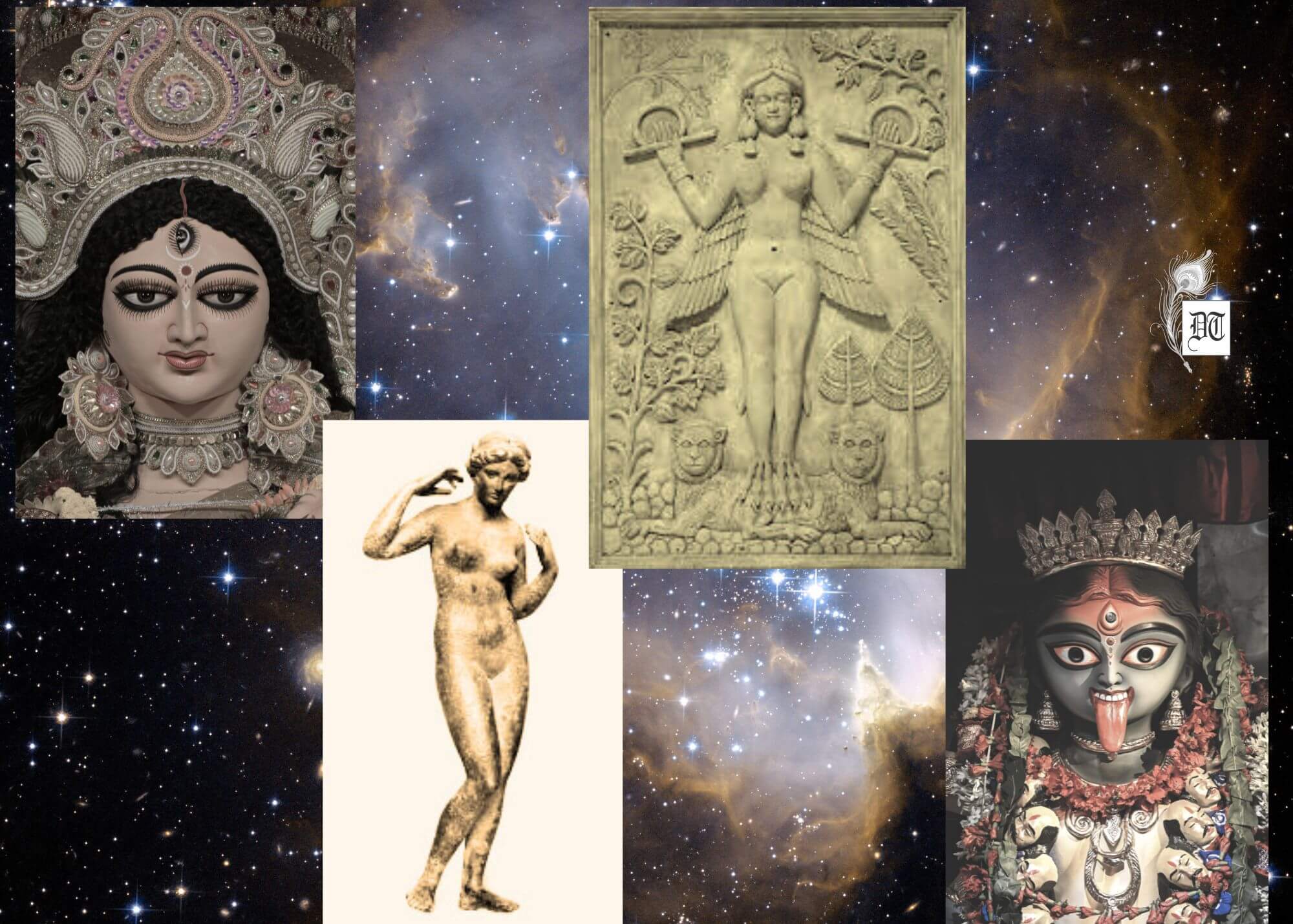
Our ultimate feminist, wild, boundless energy icon, the Mother, raging and ravaging to heal and protect, the unbridled feminine tsunami that leads to light … has her counterparts in other civilisations too.
Anahita is a fertility, water, and women’s protection goddess. She is sometimes shown as riding a tiger (like Durga!)… An image of Anahita from the 4th century BC shows her radiant and seated on a lion as Artaxerxes II worships her. Artaxerxes II Mnemon ruled Persia from 404 BC until he died in 358 BC. He was the child of Parysatis and Darius II of Persia. Kali, Bhagavati, Bhavani, Ambika, Lalita, Gauri, Kandalini, Java, Rajeswari, and other incarnations of Durga are just a few.
Inanna in Sumerian Texts
Inanna, the ancestor of the Akkadian goddess Ishtar, is depicted in the earliest known Sumerian religious texts. Her principal “attributes” are as follows: The female figure, the helmet, the weaponry (arrows on the back, axe or mace in left hand), and the standing atop a wild animal (possibly a lion) are all prominent features. As with all ancient deities, it is critical to record those “attributes” correctly since frequently, they were the only way to distinguish between a particular god or goddess whose depictions could otherwise vary greatly throughout time and space. Hindus still use this process to determine their deities… About Hinduism, Kali is a contemporary divinity that Hindus worship. The characteristics of Durga are all present, including her female form, helmet, weapons, and tiger, as there are no lions in India. Even some of the weapons, like the bow and mace, are the same.
“Inanna was arguably the most well-known female deity in pre-dynastic Mesopotamia. [1] Inanna was connected to the city of Uruk as early as the Uruk period (about 4000-3100 BC). As the goddess of the E-Anna temple in Uruk, her major centre, Inanna (Sumerian: Inanna; Akkadian: Itar) was a Sumerian deity of love, fertility, and war.
Durga: Lord Vishnu’s Sister
“Durga, also known as ‘the inaccessible’ or ‘the invincible,” is the most well-known manifestation of Devi and one of the principal incarnations of the Goddess Shakti in the Hindu pantheon. In her kind form, she is the goddesses Lakshmi and Saraswati; in her harsh form, she is the goddesses Chandi and Kali. The sister of Lord Vishnu, Durga, is also referred to as Padmanabha-Sahodari and Narayani.
She is preeminent in Shaivism and Shaktism, but to resurrect Lord Shiva in Sansar, she was resurrectated as Sati and Parvati and forced to wed Shiva. Kartikeya was the first child born to Durga.
In addition to Durga, numerous additional goddesses in Hinduism share Inanna/Ishtar’s characteristics: The West Semitic goddess Astarte is a close clone of the frequently mentioned Ishtar in the Bible. Caesar referred to the Greek/Roman goddess Aphrodite/Venus as his ancestor under the name “Venus Victrix” (the victory giver) or, in Greek, “Aphrodite Enoplios” (the armed, same root as in “hoplite”), even though she was primarily associated with sexuality.
Aphrodite/Venus is linked to Adonis
The fact that Aphrodite/Venus is linked to Adonis, who is commonly regarded as a replica of the deity Dumuzi/Tammuz, connected to all Semitic forms of Inanna/Ishtar, including Astarte, is notable. In the Bible, Tammuz is mentioned: 8:14 in Ezekiel. Then, when he led me to the north gate of the Lord’s temple, I saw women sitting there sobbing for Tammuz. Athena/Minerva, the goddess of Greece and Rome, is frequently depicted wearing a helmet and clutching a javelin and a shield.
Take note of the weapons, the helmet, and the serpent—animals that are usually linked to Ishtar/Inanna, just as they are with Eve in Genesis. The Greek name for the Mesopotamian (Assyrian, Akkadian, and Babylonian) Semitic goddess Ishtar is Astarte (Ancient Greek: “Astárt”). Astarte was associated with sexuality, conflict, and fertility. She used the lion, horse, sphinx, dove, and a star within a circle to represent Venus, as well as other animals. She is frequently depicted in naked form. She has been referred to as the evening star deified”. Vajradakini. Vajradakini is the name for Vajravarahi’s dancing, semi-wrathful form. She has a cup of amrita, or perhaps a vial, in one hand and a vajra knife in the other. She raises a cup to her lips, and its meaning is connected to the activities of Durga, the Great Goddess of India. When she is compared to Machig Labdron, who popularised the Chod (pron. cho) as a full path, she is sometimes seen with a two-sided drum.
Who are Yoginis?
Yogini is the full form of the masculine yogi and the neutral/plural “yogin”. It is important to note that the term “Yogini” refers to both a female master practitioner of yoga as well as a group of contemporary female spiritual teachers (in both Hinduism and Buddhism) in eastern nations like India, Nepal, and Tibet. The Vedas describe several notable female mystics and yoginis; in fact, many of the Vedic rishis were yoginis, or rishikas. The term “Yogini” refers to a group of female tantric sorceresses who serve Durga, who are occasionally counted as 60, 64, or 65 (Harivaa, Kathsaritsgara).
Here, female power means balance. According to author Miranda Shaw’s book, Passionate Enlightenment: Women in Tantric Buddhism, many women, including Dombiyogini, Sahajayogicinta, Mekhala, Kankhala Gangadhara, Siddharajni, and others, were revered yoginis and experienced seekers of enlightenment.
“A female practitioner of Buddhism is referred to as a ngagma (see ngagpa) in Tibetan Buddhism and the Bön lineage and as a togdenma (Tenzin Palmo) in the Drikung Kagyu school of Buddhism. These married tantric practitioners must spend a lot of time in retreat and engaging in spiritual practice.
Birth rites, marriages, burials, divinations, and the pacification of psychic disturbances are among the specialities of the Ngagma. In terms of practice, some ngagmas resemble the Mahasiddha yoginis of Indian Buddhism.
Rishika: A Female Rishi
Fifty-two Yogini is a phrase that appears in numerous Hindu and Buddhist writings. Its literal meaning is “shaman” or “wisdom seer” (rishi), though it could also be understood to imply “alchemist”. Women were among the greatest of the ancient rishis. Rishika refers to a female rishi.
The 64 temples of the Yogini… The Chausathi Yogini (64 Yogini) Temple is in Hirapur, Odisha. One of the Yoginis in the Hirapur, Odisha, Chausathi Yogini Temple. In India, there are four significant yogini temples still in existence—two in Madhya Pradesh and two in Odisha. The hypaethral Chausathi yogini (sixty-four yogini) temple, built in the ninth century CE and situated at Hirapur in the Khurda district, 15 km south of Bhubaneshwar, is one of the most remarkable yogini temples in Odisha.
The Chausathi yogini pitha is another hypaethral sixty-four yogini temple in Odisha and is located at Jharial, close to Titilagarh in the Balangir district. There are currently only 62 images in this temple.
Kali: Goddess of Time and Change
With her long tongue protruding from her mouth, Kali stands atop Shiva’s corpse. Kali is decked out with a complete arm-skirt and a skull garland. The gloomy Hindu goddess of time and change is known as Kali.
Goddess Durga is the most well-known manifestation of Devi and one of the primary manifestations of the Goddess Shakti in the Hindu pantheon. Her name means “the inaccessible” or “the invincible” in Sanskrit. The following passage by Ramprasad Chanda describes how Durga changed from a prehistoric deity to her modern appearance”… two distinct layers may be distinguished, one that is primitive and the other that is advanced. The original form of Durga is a synthesis of four goddesses: the vegetation spirit personified as a woman, the war goddess, and the goddess of the mountains, who was worshipped by the inhabitants of the Himalaya and the Vindhyas.
The primitive war goddess was gradually brought into alignment with Brahmanic mythology and philosophy as her devotees advanced in civilisation, becoming the personification of the all-devouring time (Kali), the vegetation spirit into the primordial energy (Adya Sakti), and the saviour from “samsara” (cycle of rebirths).
The world is one, and Shaktism manifests itself all over, as a deity, as a cult, and as an ethos; the Divine Feminine, the raging symbol of annihilation and light, rules the world. Now and forever.
Cowritten by Rishi Dasgupta

Rishi Dasgupta, a Masters in Economics from the University of St. Andrews, Scotland, is a millennial, multilingual, global citizen, currently pursuing a career in the UK. An accomplished guitarist and gamer, his myriad pursuits extend to the study of the ancient philosophies and mythologies of India. ‘Adi Shiva: The Philosophy of Cosmic Unity’ is Rishi’s second book as co-author.
Picture design by Anumita Roy

Sohini Roychowdhury is a renowned Bharatanatyam dancer, choreographer, artistic director, speaker, social activist, and professor of Natyashastra. She founded Sohinimoksha World Dance & Communications in Madrid/Berlin/Kolkata/New York. A visiting professor of dance at 17 universities worldwide, she won several awards, including the “Mahatma Gandhi Pravasi Samman” by The House of Lords, the Priyadarshini Award for Outstanding Achievement in Arts, and the Governor’s Commendation for Distinguished World Artiste. She has also authored several books, including ‘Dancing with the Gods’.



 By
By
 By
By
What an informative article connecting the icons to the Supreme power! The only difference lie in their forms. The Divine Shakti is all prevailing .
Excellent and extremely well documented, learned and acknowledgeing gratitude to the authors of this historical facts.