
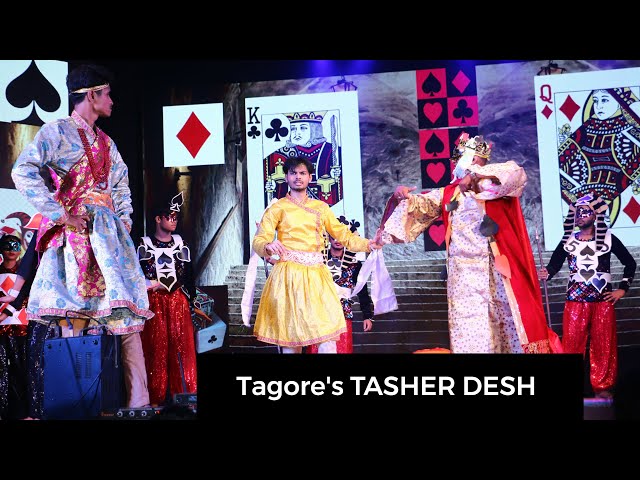

Ruchira discusses Tagore’s unique thoughts and ideas in a live show in NCR, ‘Natoker Gaan’, featuring his dramatic songs and legacy, exclusively for Different Truths.

Tagore’s vistas of creative activities were as vast and unending as the skies above. Prose, poetry, fiction, drama, or lyrics. He was a pundit in these genres. His well-known dramatic oeuvres had a determined and specific objective behind them. Each was a medley of lofty ideals, philosophy, love, romance, or passion interspersed with light-hearted banter and humour that served as comic interludes (catharsis if you please).
The playwright in Tagore dabbled with an infinite variety of topics. At times, Tagore comes across as a harbinger of change showing zero tolerance for prevailing social malaises. However, he does this concisely and subtly rather than being downright brusque or violent.
The poet’s unique and unconventional thoughts, ideas, and views were recently presented in a live show in Delhi by Anandadhara, a musical troupe based in Gurugram (NCR). The event was titled Natoker Gaan, i.e., a bouquet of songs used in myriad plays penned by the Bard during his lifetime.
Six Plays Selected
The six plays selected for the occasion were relevant in the present-day context. For instance, Raktakarabi (Red Oleanders) lashes out at a dark, dismal, ruthless social system where anarchy and tyranny prevail; in this claustrophobic atmosphere, the female protagonist Nandini—who has a penchant for these blossoms—ushers in a breath of fresh air, symbolising respite from autocracy.
In Falguni (Spring), the characters yearn for freedom from the sordid reality of this mundane world. The ambience of the play is bright and cheerful.
In another play, namely Achalayatan (an unmoving, static citadel), the inmates are shown rejoicing when the winds of change begin to blow, eventually shaking up the tower’s foundation.
The next play was Arupratan (an abridged version of Raja, or King of the Dark Chamber), wherein the female protagonist (nayika) yearns to reunite with her beloved king, who appears nebulous and mysterious. Her quest for the king takes her far and wide. Then, suddenly, realisation dawns upon her: She decides to search for her dear lord by dispelling the darkness and eventually marches ahead in unison – towards a realm of brightness and sunshine to find fulfillment in their love.
A Comical Satire
Chirokumar Sabha (Bachelors’ Assembly) is a comical satire lambasting hypocrisy prevailing in the social circles of educated affluent Babusin erstwhile Bengali society. A group of young, educated freedom fighters vow to shun matrimony and dedicate themselves wholeheartedly to the cause of their motherland. Later, they succumb to matrimony, thus forsaking their ideology.
The last play of the evening was Taasher Desh (Kingdom of Playing Cards), which Tagore had dedicated to Netaji Subhash Bose for his outstanding contribution to the then-ongoing struggle for freedom. The story runs thus: A prince and his merchant crony get shipwrecked on an island. There, the duo is bewildered to observe that the inhabitants are ‘playing cards’ instead of humans. The card population lives monotonous mechanical lives utterly devoid of emotions or joie-de-vivre. The prince couldn’t care less; he mingled freely with the locals, trying to dispel their stupor. Folks, impressed by his vivacity, eventually revolt against the dictatorial regime, with women assuming avant-garde roles. The play lambasts harsh colonial laws that governed the Indians in that era.
Some familiar, intensely mellifluous songs culled from the plays included “poush toder daak diyechhe,” (timefor winter harvest), “Aakash amaye bhorlo aloye” (the sky floods my heart with light), “Tumi daak diyecho kon sokale” (you awoke me when dawn was breaking), “Mono monmondiro sundari” (the lovely, yet capricious lady), “Elem notun deshe” and more…
The dedicated team of dedicated vocalists led by Akashvani veteran Mahua Pramanik sang with great zeal and passion. The songs were punctuated with rhythmic dances by pupils of Delhi’s reputed dance schools.
All said and done, it was a delightful music-filled evening and a befitting tribute to Tagore’s versatility.
Photos sourced by the author

Born in Guwahati and raised across Delhi and Punjab, Ruchira Adhikari Ghosh is an alumna of Sacred Heart Convent, Ludhiana. She holds a master’s degree in English literature from Punjab University, Chandigarh, and a postgraduate diploma in Journalism. With nearly 25 years of experience in print, web, and television media, she has carved a niche as a feature writer. Her writing focuses on women’s issues, food, travel, and literature, reflecting both versatility and depth.


 By
By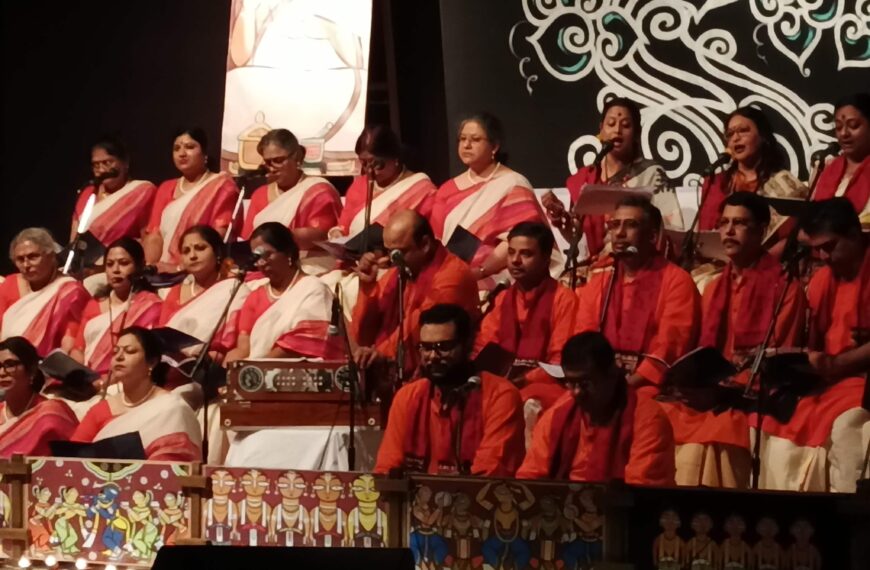
 By
By