
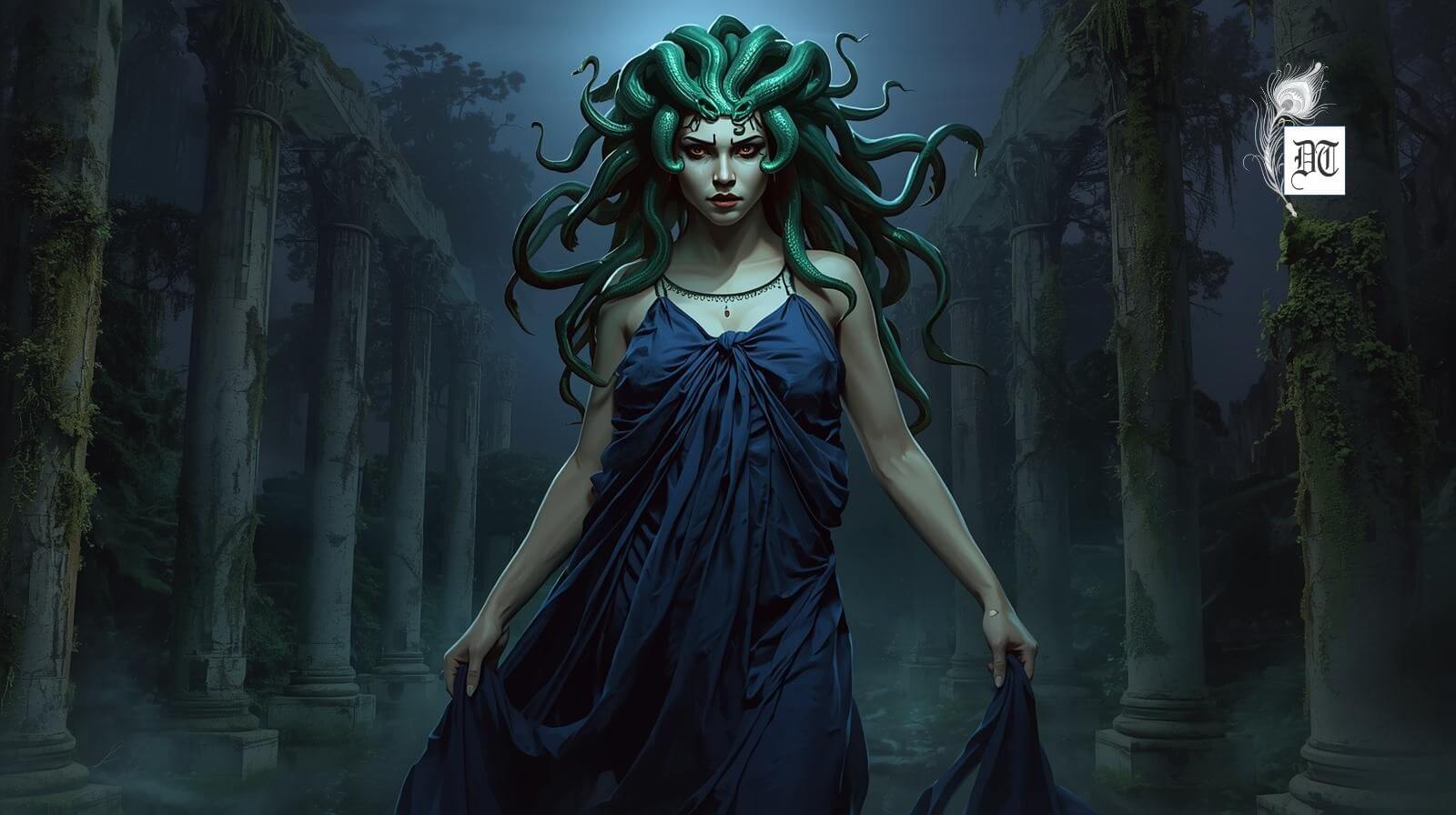
Akash explores Medusa, for Different Truths, beyond the monster; her tragic myth unveils a powerful story of violated innocence, patriarchal cruelty, and enduring resilience.
In the vast expanse of Greek mythology, where gods quarrel, heroes boast, and monsters rise from the shadows of human imagination, few figures possess the tragic magnetism of Medusa. Her story, often flattened into the crude image of a monstrous woman with serpents for hair, whose gaze turns mortals into stone, is far richer, more intricate, and far more human than the popular caricature suggests. Medusa is not simply a monster: she is a symbol of violated innocence, punished beauty, patriarchal cruelty, female rage, protective strength, the inevitability of transformation, and the poetic justice of a mythos that thrives on complexity. To understand Medusa is to step into the tension between terror and tenderness, divinity and vulnerability, myth and humanity.
At the heart of Medusa’s myth lies a paradox. She is simultaneously the most feared of monsters and the most wronged of victims. Her name evokes fear, yet her story evokes compassion. And it is precisely this duality, this tragic entangling of the monstrous and the humane, that has preserved her prominence across millennia. From ancient Greek pottery to modern feminist discourse, Medusa’s image evolves not simply because she is visually striking, but because she captures something fundamentally painful about human experience: the way suffering can deform us, the way injustice can transform innocence into something the world recoils from, and the way society often punishes the victim rather than the perpetrator.
Medusa’s Story
To begin Medusa’s story, one must look not at her end: severed head dangling in Perseus’ triumphant grip, but at her beginning. Before she became the dreadful Gorgon, before terror defined her name, Medusa was beautiful. Her beauty was not merely aesthetic; she embodied a kind of sacred radiance. Some versions describe her as a maiden priestess in Athena’s temple, devoted to purity and wisdom. Her hair, described as long and cascading like the dark waves of a quiet sea, was said to be her most striking feature — “the envy of every nymph, the fascination of every god,” as one poet put it. But beauty in the Greek world was a dangerous possession, particularly for mortal women coveted by gods, used by poets, and often punished by jealous deities.
The tragedy unfolds when Poseidon, god of the sea, an entity as tempestuous as the waters he commanded, becomes enamoured of Medusa. In some retellings, he seduces her; in many others, he violently assaults her. What matters is the location: Athena’s sacred temple. Whether Poseidon’s intentions were lust, vengeance, or pride, Medusa’s fate was sealed not by her actions but by where she happened to be. Athena, goddess of wisdom and war, found her temple defiled. Yet instead of punishing the perpetrator, Poseidon, a fellow god whose might matched her own, Athena chose to punish Medusa, the powerless mortal who bore the consequences of divine conflict.
A Turning Point
This moment represents a turning point in Medusa’s story and, indeed, in much of Greek mythology. It reveals the harsh moral architecture of ancient mythic systems: gods punish not according to justice, but according to power; mortals suffer consequences not for wrongdoing, but for being caught in the crossfire of divine whims. Athena, unable to retaliate against Poseidon, turned her anger toward Medusa, transforming her once-beautiful hair into serpents and her face into something so terrible that a single glance would petrify onlookers.
This transformation is not merely physical. It is symbolic, psychological, existential. Medusa becomes the embodiment of her trauma; her body turned into a monstrous testament to the violation she endured and the injustice she suffered. She becomes fearsome because she was first afraid. She becomes dangerous because she was first endangered. She becomes a monster because she had once been made powerless. Such is the cruel cycle of suffering in many myths, and one might argue in human life itself.
Medusa’s Exile
Medusa’s exile to a distant, desolate land further deepens this tragedy. Once surrounded by fellow priestesses and admired for her beauty, she is now forced into solitude on the edge of the world, where even gods seldom wander. Her sisters, Stheno and Euryale, also transform into Gorgons in some accounts, though they remain immortal, whereas Medusa does not. The distinction, Medusa’s mortality plays a crucial role later in the tale. But it also underscores a narrative contrast: Medusa’s suffering is rooted in her humanity. Gods may fight and cause storms, but they do not perish. Mortals, however, bear the full weight of divine decisions.
The terror associated with Medusa is not that she kills intentionally. Unlike many monstrous figures of Greek lore, she does not seek out victims. She does not chase heroes, attack cities, or revel in destruction. Her gaze, her solitary existence, her monstrous isolation, these are not acts of aggression but consequences of a curse. She is feared because she cannot help being feared. Her monstrosity is not chosen; it is imposed. And therein lies the tragedy: Medusa becomes a symbol of suffering that punishes not only the victim but everyone who comes near her.
Perseus, Medusa’s Slayer
Enter Perseus: the hero destined to slay Medusa. Heroes in Greek mythology rarely seek justice; they seek glory. Perseus is no different. Tasked with bringing Medusa’s head to King Polydectes, who set him this impossible quest to rid himself of an inconvenient youth, Perseus embarks not out of moral duty but out of necessity and coercion. Yet even this part of the story highlights a striking imbalance in mythic narratives. Medusa, traumatised and exiled, desires nothing more than peace. Perseus, armed with divine gifts, a shield from Athena, winged sandals from Hermes, and a curved sword of adamantine, invades her sanctuary. The gods who cursed Medusa now empower the hero who will kill her. The imbalance of divine favour is striking, and it casts Perseus’ triumph in a complicated light.
When Perseus arrives at Medusa’s lair, she is asleep. A detail often glossed over in retellings, yet profoundly telling. Medusa, the fearsome monster, is asleep- vulnerable, unguarded, perhaps exhausted by the curse that defines her existence. Perseus, guided by Athena’s shield, avoids direct eye contact and decapitates her. It is swift, silent, and altogether without confrontation. In many ways, it is an execution, not a battle. Medusa’s death is not the triumph of good over evil; it is the silencing of a woman who suffered too much to remain part of the living world.
Yet even in death, Medusa retains a spark of agency, an echo of her past power. From her severed neck spring Pegasus, the winged horse, and Chrysaor, a giant or warrior, depending on the version. These children, fathered by Poseidon, had been carried within Medusa, concealed beneath her monstrous exterior. In her final moment, something beautiful and powerful emerges from the violence inflicted upon her: a metaphor, perhaps, for how strength, creativity, and transformation can emerge from suffering.
Medusa’s Head
Perseus, carrying Medusa’s head, uses it as a powerful weapon, turning enemies to stone and ultimately delivering it to Athena, who places it upon her aegis or shield. The irony is painful. Athena, who once transformed Medusa into a monster as punishment, now adorns herself with Medusa’s likeness as a protective emblem. The victim becomes a symbol of power, her suffering repurposed for divine utility. Even in death, Medusa is used rather than understood.
But this is not where Medusa’s story ends. Over centuries, her image has evolved. Medieval Christian writers reinterpret her as a symbol of sin, temptation, and moral corruption. Renaissance artists fixate on her horror and beauty. Romantic poets, such as Shelley, resurrect her humanity, portraying her as a tragic figure whose suffering evokes irresistible empathy. In modern feminist literature, Medusa becomes a figure reclaimed: a symbol of women punished for their beauty, desire, or defiance; a metaphor for the silencing of women through shame, fear, or violence. Her serpents become symbols of resilience; her gaze becomes a warning against those who attempt to dominate or violate.
The Enigma of Medusa
What makes Medusa such a compelling figure for modern sensibilities is the emotional core at the centre of her myth. Medusa is not a monster created by wickedness. She is a monster created by cruelty. She is not dangerous because she chose to be. She is dangerous because power was taken from her. She is not isolated because she hates the world; she is isolated because the world fears and blames her. In Medusa, we find a character whose suffering mirrors the experience of many who are punished for circumstances beyond their control and transformed by trauma in ways that society misinterprets as hostility.
In examining the myth, one must also confront the psychology of fear embedded in the story. Why does Medusa terrify? Is it the serpents? The petrifying gaze? Or is it, more profoundly, the fear of confronting what trauma looks like? The fear of acknowledging that beauty can decay not by its own failing but by violence inflicted upon it. The fear that innocence can be transformed by injustice into something unsettling. Medusa forces us to acknowledge that suffering has consequences that the human spirit, when wounded deeply enough, can become unrecognisable even to itself.
Perseus’ Triumph
Perseus’ triumph, often celebrated in classical art and literature, carries within it an uncomfortable truth. Heroes are often celebrated at the expense of individuals who never asked to be antagonists. Medusa is not a villain that Perseus must conquer; she is an obstacle used to glorify him. His victory is built upon her tragedy. And though his deeds earn him praise and immortalisation, Medusa’s story lingers longer in collective memory not for her defeat, but for the profundity of her suffering.
In considering Medusa’s place within Greek mythology, one might reflect on how Greek culture perceived women, power, and justice. Many myths feature women punished for beauty, curiosity, disobedience, or merely existing at the wrong time: Pandora, Helen, Europa, and Andromeda. Medusa fits firmly into this pattern, punished because a god desired her, further punished because a goddess could not punish that god, and finally executed because a hero needed a quest. Medusa’s story becomes a chapter in the broader narrative of gendered suffering in mythic literature.
Yet Medusa is not merely a passive victim. Her transformation, though tragic, imbues her with power: fearsome, destructive, yet undeniably potent. She becomes one of the few mortals whose presence commands respect from gods and men alike. Her gaze, cursed though it is, becomes a mechanism of self-defence, protecting her from further harm. In isolation, she gains a strange sovereignty: she cannot be touched, approached, or harmed except by the most cunning of heroes.
Medusa Represents Empowerment
Perhaps this is why modern retellings often reclaim Medusa as a figure of empowerment: a woman who turns to stone those who would harm her, a survivor whose trauma becomes her shield. The serpents upon her head, once a mark of punishment, are reimagined as symbols of wisdom and transformation. In many cultures, serpents are associated with rebirth, healing, and guardianship. What Athena intended as a curse becomes, over time, a crown: twisted, tragic, but powerful.
Medusa’s gaze, too, takes on new meaning. Instead of petrifying from malice, it petrifies from truth, forcing those who look upon her to confront their own fear, cruelty, or guilt. In psychological terms, Medusa becomes an archetype, the wounded healer, the traumatised protector, the embodiment of experiences too painful to face directly. Her story resonates because it speaks to those who have been shamed into silence, transformed by suffering, or blamed for the actions of others.
Thus, the mythical story of Medusa transcends its origins. It becomes a narrative not only of ancient gods and monsters but of human resilience, the consequences of injustice, and the complexity of victimhood. In Medusa, we find a mirror, a reflection of how society demonises those who bear the marks of trauma. Her story challenges us to reconsider our perceptions of beauty, power, vulnerability, and fear. It asks whether monstrosity lies in appearance or in the eye of the beholder.
Medusa’s Tragedy
In conclusion, Medusa’s myth endures not because she is terrifying, but because she is tragically human. She is the embodiment of a truth as old as storytelling itself: that those who suffer unjustly may be transformed in ways that frighten others not out of evil, but out of pain. Medusa’s serpents, her gaze, her isolation, all these elements become metaphors for the scars left by trauma, the misinterpretation of wounded souls, and the haunting legacy of injustice. And yet, in her death, new life bursts forth, Pegasus, radiant and free, suggesting that even the darkest suffering can give rise to beauty.
Medusa is not simply a monster slain by a hero. She is a woman wronged, transformed, silenced, and finally immortalised. Her story invites compassion, reflection, and reinterpretation. Perhaps that is her greatest power, not the power to turn men to stone, but the power to force us to look deeper, to see beyond surface terrors, and to confront the tragedies that shape human existence.
Medusa lives not in stone statues or monstrous depictions but in the human imagination, fiercely reminding us that behind every myth lies a heart once capable of breaking and behind every monster, a story once capable of being loved.
Picture design by Anumita Roy

Akash Paul, a renowned criminologist, theologian, and demonologist, and the author of two globally acclaimed textbooks, pioneered post-crime analysis in criminology and comparative religious studies in theology. His expertise spans criminal profiling, sexual offenses, Christianity, and religious history, with notable contributions to each of these fields. An insightful critic of contemporary society, he also writes poetry, short stories, and novels, blending creativity with profound societal analysis.


 By
By
 By
By
Exciting son❤️
Wonderful story 💕💕💗💗✨✨