
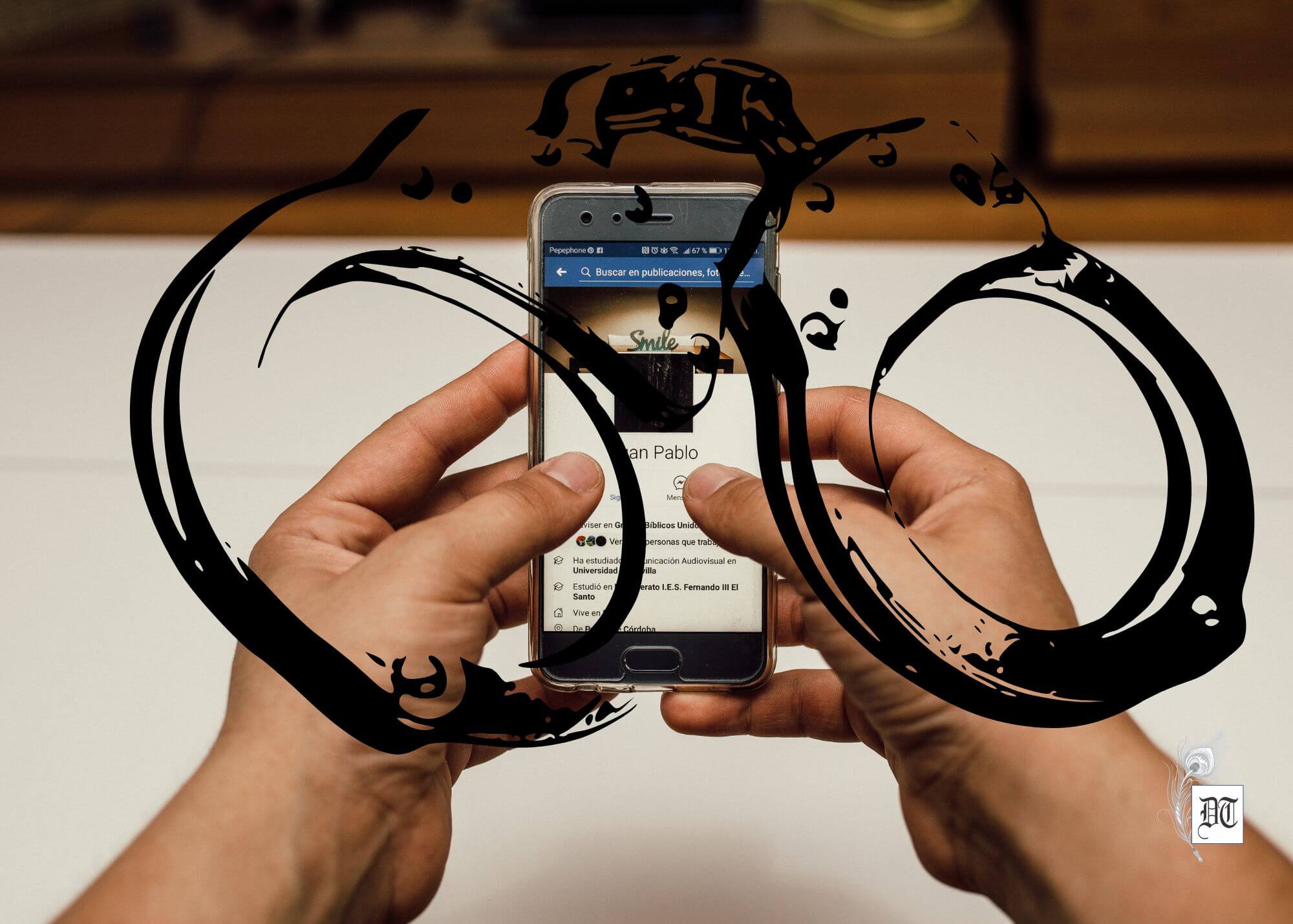
Prof Bhaskar questioned the value and risks of writing, particularly when it challenges authority, exemplified by the arrest of a professor for a Facebook post exclusively for Different Truths.

Before the question ‘Does writing help?’ is answered, two points are to be kept in mind—writing what and the public concern. The second one is expressed in Bengali like ‘kichui habe na’ (nothing will come out as a consequence). Let me respond.
‘Ki habe’ (What will be the outcome?) is a possibility that depends not only on writing for circulation among the people but more on the objective conditions where people have ‘head high’ and ‘mind fear-free’. Both are intertwined; however, aversion to reading what is being written for social-cultural elevation may further exasperate the effort of the thinker-writer.
Some philosophers opine, what is the utility of writing when the authority (read, core state) has already decided what is to be done and what not! Some philosophers opine that still then writing should continue unabated to shake a corroded system or to show the right path.
Writing What
Writing is a commitment, and writing is often risky – the latest arrest of a professor of Ashoka University by the police of Haryana based on one Facebook post by the professor proved the risks. This seems ridiculous, if not irrational. Hopefully, he is going to get bail from the Apex Court. But the point is not getting bail or not. The point is the content of the post and the dignity of the professor.
Has the core state chained the teacher-thinkers in the great civilisation of India? In my understanding, unless the individual, professor or not, consciously challenges the sovereignty of the state or threatens the lives of people, he does nothing wrong. Forced sedition charges by the mediocre police based on some First Information Report (FIR) by an innocent person with little knowledge of law and justice do not promote national integrity or nationalism. And nationalism must not be so brittle that one professor will break its neck.
In my understanding, the writers are not criminals and are not anti-national. What some of them can be at best is like poet Nazrul Islam, who was probably arrested by the British police. But now the country is not under British rule. The country is as free for the political masters as it is for the common man. This is, however, hardly understood.
Of course, arrest and imprisonment of teachers is not new and not the last one, as this case is – it is to continue. During British rule, it was Surya Sen or Masterda. In independent India, it was an internal emergency, declared in June 1975, when the government arrested some teachers, among others, through the Maintenance of Internal Security Act (MISA). Fifty years since then – the same tradition continues. In local common vocabulary, it is uttered, ‘Now it is of academic interest,’ like in announcing the probable outcome of a five-day cricket. In reality, academic interest does not remain academic – it hurts the omnipotent core state that does not tolerate academic discourse.
State Hurt
The core state has reasons to feel hurt, for it takes all the responsibility to protect people. If people go against the steps that the state takes, the state interprets it as anti-state. Then what the thinker-professor should have written: ‘The Earth moves round the Sun’ and ‘The Sun rises in the east’? The responsibility of a professor is more than and different from posting on Facebook, but that cannot be a reason to arrest a professor. I expect the accelerating capability of the professor will encourage him to pen and publish articles in national and international journals that go beyond the known frontier of knowledge. A core state is probably not a store of knowledge.
Posting any opinion on Facebook is essentially inconsequential. Had I been in the core state by direct actions, I would have ignored what trash is on Facebook. As I understand, Facebook posts are highly opinionated – personal. I had the idea that such posts had no ‘nuisance value’. The arrest of the professor proved to the contrary. I don’t know if any serious debate has been organised in the Parliament based on posts on Facebook or if the Courts of Law took Facebook posts as evidence.
Universities or Institutions
I question the relevance of institutions that seem constrained or avoidant. Institutions, in their essence, should provide value. It’s perplexing when universities of higher learning appear unable to support the actions of their faculty who write content that the core state finds objectionable. After all, these universities, as components of the state, have a pledged duty that surpasses that of an individual.
Intellectual Responsibility
Let me assure the core state that the intellectuals are innocuous – they are incapacitated from being anti-state, and often they are not aware of the coercive power of the core state. Some of them are, of course, non-conformists, and that is because of their scientific outlook and position much above the silent mass society or social average. The state has nothing to fear from the intellectuals. If these are facts, then based on posts on Facebook, it seems laughable to arrest an intellectual. It could have been prudent for the core state, if it got hurt, to make the relevant university/institute aware of the ‘nefarious’ posts on Facebook, and the university would have taken serious note of it, like asking the professor to show cause.
Right and Wrong
Arresting the intellectual or the professor was wrong; that happened. Guiding the professor was right; that did not happen. The professor did not become a professor from his home – he was well-trained institutionally. The institutions of the state, thus, cannot escape responsibility if education goes wrong, understood as miseducation, biased education, or education deviated from truth in an opportunistic direction.
Universal Ethics or Conclusion
Teachers are to be respected wherever they are. That country is doomed to failure that does not respect the teachers. That ethics is eternal and universal and is based on respect for teachers – call them by any designation – professor, shikshamitra or whatever.
Picture design by Anumita Roy

Prof. Bhaskar Majumder, an eminent economist, is the Professor of Economics at GB Pant Social Science Institute, Allahabad. He was the Professor and Head of the Centre for Development Studies, Central University of Bihar, Patna. He has published nine books, 69 research papers, 32 chapters,15 review articles and was invited to lectures at premier institutes and universities over 50 times. He has 85 papers published in various seminars and conferences.
He also worked in research projects for Planning Commission (India), World Bank, ICSSR (GoI), NTPC, etc. A meritorious student, Bhaskar was the Visiting Scholar in MSH, Paris under Indo-French Cultural Exchange Programme. He loves speed, football and radical ideology.



 By
By
 By
By

 By
By