
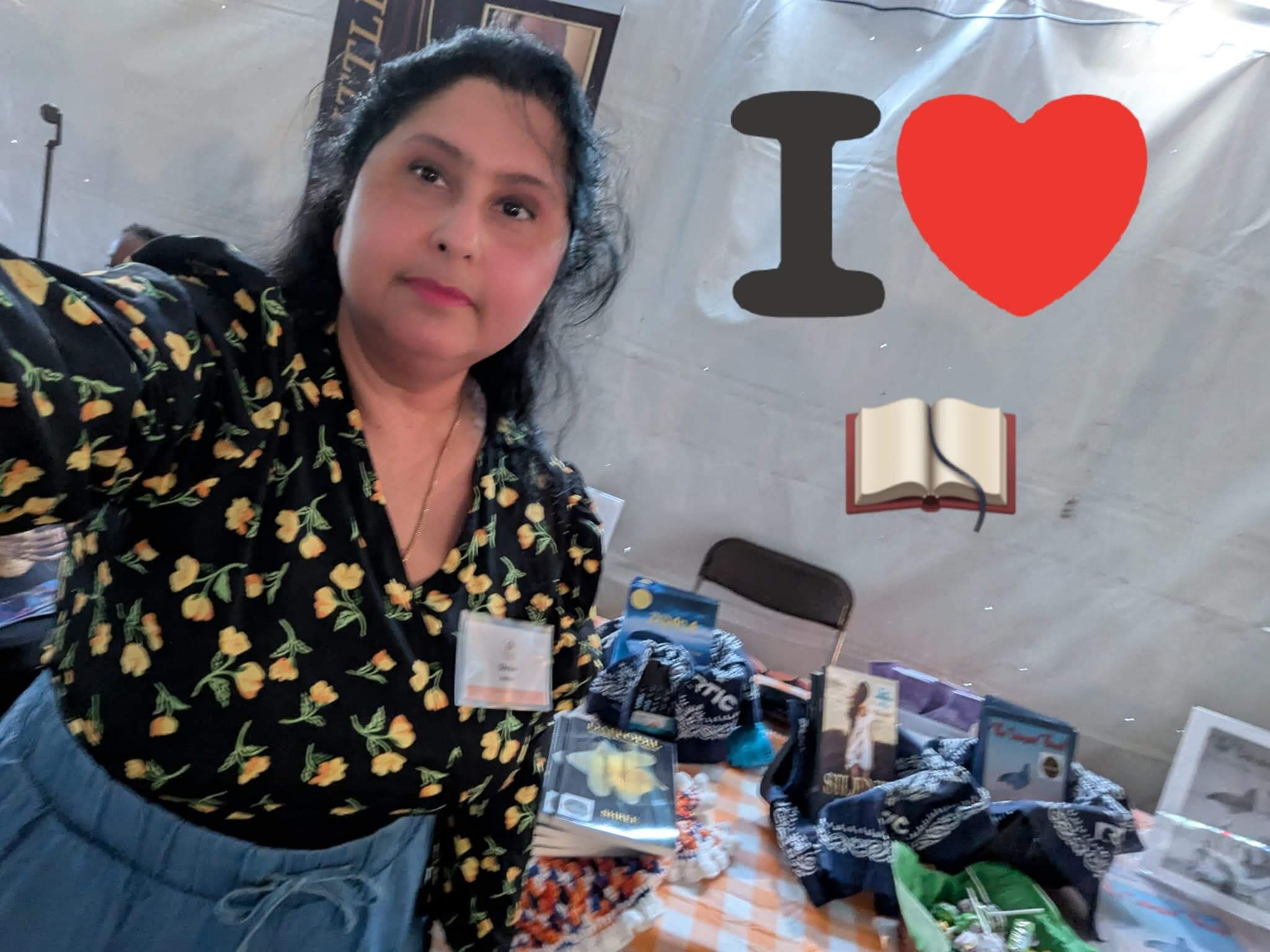

Lopamudra interviews Shree Mukherjee, an author blending IT acumen with diverse cultural art—storytelling, film, and social advocacy—shaping a powerful, award-winning journey, exclusively for Different Truths.
“Writing is my escape to the world of kaleidoscopic imagination”, says author, storyteller, film writer, and entrepreneur Shree Mukherjee
Anushree—known in the literary world as Shree—is an award-winning author, film writer, speaker, and entrepreneur. She holds a master’s degree in IT from Manipal University, specialised in technical and business writing from UC Berkeley, and leadership education from Harvard. Shree’s interests span health, lifestyle, women’s empowerment, medical science, philosophy, parenting, and child psychology. As an Asian-Indian residing in the USA, a British national, and a trained performer in Indian classical dance and music, she brings a unique cultural blend to her storytelling. A lifelong cinephile with a passion for South Asian cinema, Shree pursued “An Introduction to Screenwriting” at the University of East Anglia, which led her to write scripts for short films and narratives for music albums and videos.
Her entrepreneurial venture, ASAPS Solutions, along with her literary journey, has been featured in The New York Telegraph and the International Business Journal. Her social advocacy against gender-based violence was also highlighted on the ABP Live news platform. Most recently, Shree was invited to present her books at the prestigious Jaipur Literature Festival, Houston Chapter (September 2025), further cementing her presence on the global literary stage. She has been a recipient of multiple awards and recognitions for both her novella ‘The Crimson Thread’ and also for her short films ‘Ritual Curry’ and ‘Paani’, solidifying her place in many branches of the creative arena.
In a candid conversation with the author, it was my earnest attempt to uncover the various layers and themes of her books, her journey with short films and South Asian Cinema on the whole and also catch a glimpse of her publishing journey and her journey with the creative arts, and get to know her role as a changemaker in society.
Lopamudra Bannerjee (LB): Hello Shree, it is an absolute honour to have you on this selected panel of authors and creative artists whose myriad inward and outward journeys I am honoured to feature! Since we met for the first time in 2018 during the pre-Covid days when you were foraying into the literary world till this day, I am so touched to see you evolve so beautifully into an acclaimed author with five books now, with and also add more feathers to your hat, being a film writer, having formal training in script writing at the University of East Anglia, and also writing screenplays for short films over the years. Can you tell the readers a bit about your creative transition from Anushree, the IT professional, to Shree, the author and storyteller? Was it a planned transition/conscious choice, or did it just happen organically?
Shree Mukherjee (SM): Hi Lopa, it is an absolute honour for me to be featured in your series of interviews along with an exceptional panel of selected authors. I have always been a great admirer of your work and am amazed by your dedication and hard work towards your subject. I must thank you for this lovely introduction.
To answer your question here, more than a transition, I would rather say it was my introspection to acknowledge that I can introduce my writing to the outer world. I was probably waiting for the right time to recognise myself as a writer. As a kid, I was deeply fascinated by my dearest maternal grandmother’s storytelling talent. The knowledge she gained purely from reading books was remarkable, and I grew up in awe of her forte. My mother, too, played a pivotal role in shaping my literary interests—she is a voracious reader and a gifted creative writer in Bengali. Encouraged by these two inspiring women in my life, I began experimenting with essays, articles, short stories and poems for school and local festive magazines. The joy of being appreciated by my teachers and friends for my writing was unforgettable and fueled my desire to write more.

In those early days, writing was my way of feeding my mind with knowledge, satisfying my imagination, and quenching my thirst for learning. I wanted to engage people with my simple yet heartfelt storytelling. Over time, as I wrote for local magazines and newsletters, I realised that writing wasn’t just a hobby—it was what I truly wanted to pursue on a larger scale. I took the first step to publish a book in 2015, and my journey as an author took off, alongside my professional life as an IT pro and now as an entrepreneur. And I’m glad that all of my books and screenplays so far have received some kind of recognition and awards. The closest to my heart is the ‘Screencraft Hollywood Cinematic Story – Quarter Finalist’ award for my novella ‘Silent Invaders’.
LB: Like many South Asian Diaspora authors and poets that I have come to know while being in the United States, would you say that your journey from your homeland to the West, your philosophy of immigration and how we all have discovered our diverse cultural milieu have defined your writer self? Does that philosophy spill over in your writing?
SM: This is so true, Lopa. I have been telling this in all my interviews, that immigrating to various geographical locations has helped me to bring a unique cultural blend to my storytelling. I was born in India, naturalised as a British citizen and am currently residing in the United States. I also spent a few months in the Middle East while pursuing my IT degree. Settling down in new continents, trying to fit into entirely different cultures, understanding new lifestyles and trying to become a part of unknown societies are indeed challenging. I constantly re-created myself according to life’s demands. No wonder these impacted the way I write and, of course, defined my writer self to a certain extent. Most of my stories have multicultural settings, and this pattern comes to me spontaneously due to my diverse cultural experiences.
LB: Your five solo author books span various genres—ranging from fiction to poetry (being a bilingually published poet—in both English and Bengali), mystery thriller novel and human-interest stories. How did you depict the complex trajectories of life through the experiences of your protagonists? And also, when you write poems for books and anthologies, are you driven more by a poetic, lyrical voice that meanders into the metaphorical realities of life? Would you say one voice feeds into the other, or are they disparate identities of your writer self?
SM: I have a favourite quote of Sylvia Plath:
"You ask me why I spend my life writing?
Do I find entertainment?
Is it worthwhile?
Above all, does it pay?
If not, then, is there a reason? …
I write only because
There is a voice within me
That will not be still."
This question of yours resonates with these lines. You are right, I see my journey as one of the constant explorations across multiple genres – starting from flash fictions to novels, poems to articles, documentaries to self-help, reportage to reviews, music albums to films. I have learnt a lot from my own life—the phase of me growing up innocently, my sudden exposure to the unfamiliar world, unexpected and unpleasant incidents, relationships, travel, motherhood, professional life, community work and every success and failure has taught me unique life-lessons. These inspire me to explore a multitude of genres in writing. Saying that, despite all this evolution, my reasons for writing have always remained the same. Anything in the real world which makes me pause to think or question, or reflect – I write. If I wish to talk about the atrocities taking place in society, I write. Anything that bothers me about dealing with human complexities, shifting emotions—I write. Any noticeable mannerism of characters around me or any incident or situation which leaves a mark, any reason that shakes or shocks my existence – everything makes me write. Writing is not always methodical for me; often, it is spontaneous, a release of thoughts and emotions. And it is true, when I write poems, I’m driven more by a poetic, lyrical voice that meanders into the metaphorical realities of life. Yet, when I touch upon sensitive or factual topics, I take research very seriously. Otherwise, I just pour my heart out on the papers, as that is the only way I can release the pressure of wild thoughts accumulating in my mind. Writing is my escape to the world of kaleidoscopic imagination, where I can express my thoughts without restrictions or conformity.
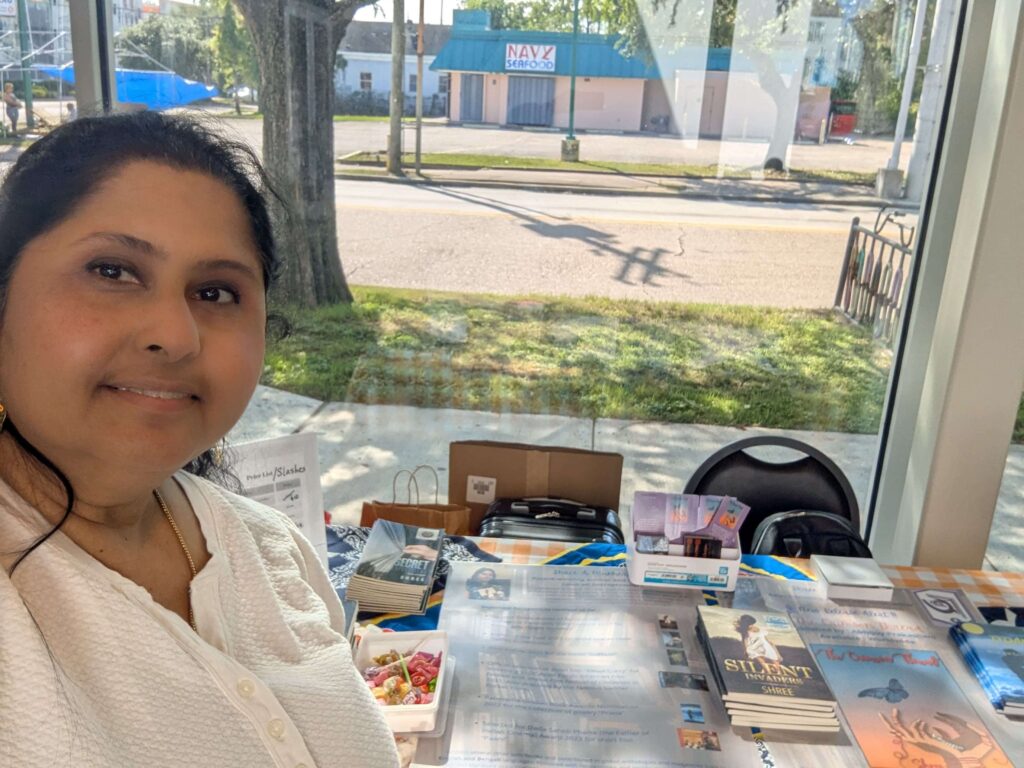
LB: Stories of human experiences seem to be a central thread that binds your fiction writing in terms of the various themes you have dealt with in your books.For example, in ‘Crimson Thread’, your contemporary urban fiction, you have addressed the various turbulent situations and disturbing journeys of parenthood, while in ‘Silent Invaders’, your mystery thriller, you write the story of a protagonist afflicted with mental illness, which probably stems from being assaulted as a child. Can you describe your vision and perspective behind these works of fiction, and what inspired you to pen these fictional journeys?
SM: I think I have somewhat answered this question in my previous response. Unless I’m writing science fiction or fantasy, every other fiction an author wants to depict grows from lived experience, collective memory, and the emotional truths of being human. Even when the specific plot is invented, its roots are still in things we’ve seen, felt, or sensed around us. Like we Bengalis have a proverb “যাহা নাই ভারতে, তাহা নাই ভারতে” [jaha nai bharat e, taha nai bharat e] – which means there is no incident on earth which has not been narrated in our epic Mahabharata. Yet my deliberate choice is to write compelling stories about experiences that society avoids or labels as taboo. Fiction has always been a safe vessel for difficult truths — it lets me illuminate what is whispered, hidden, or unspoken. When I bring such topics into the story, I offer readers not just recognition but also relief: “someone else has thought this, lived this, felt this too.” My imagination doesn’t replace reality — it reframes it. It turns lived shadows into narrative light, without losing authenticity. And that keeps me inspired to write the kind of fiction I write.
LB: How did your poetry collection titled Prana: Breath, Life, Love and other Energies germinate within you, and how did it take shape? As a mystical and metaphorical concept, ‘Prana’, the body’s central source of energy and the body’s vital air, is etymologically a Sanskrit word, and is also connected with the esoteric nature of Hindu spirituality. Can you share your poetic vision behind this collection and what inspired you to write about such a theme?
SM: Love this question. “Prana – breath, life, love and other energies” is a collection of poems based on the wonderful theme prompted by the ‘Panorama International Literature Festival 2023’. It revolves around “Prana”(a Sanskrit word) or the breath, which focuses on the element of “air” in philosophy. Prana is the body’s ‘vital air’ or energy. Breath controls all aspects of life from the seen to the unseen. There is an association between breath and thought, & breath and life. Air is the basis of all existence, movement, as well as evokes emotions. Hence, I collated all my poems which sing about breath, life, love and all other vital energies into this book – a tribute to our human existence.
LB: Some years back, I know you have also published your Bengali poetry collection ‘Onuronon’. What has made you look back at your Kolkata roots and express your innermost world in the garb of Bangla poetry? Is it only your affinity towards your Bengali ethnic heritage?
SB: ‘Onuronon’, which means resonance in English, is my only published book in my mother tongue, Bengali, and quite naturally, I am very proud of it. As you rightly said, one aspect of writing this collection is definitely my affinity towards my own culture and heritage. Sitting thousands of miles away from my homeland, using the Bengali language as a medium of expression gives me the fondness and warmth of my mother’s arms. Given an opportunity, I would like to publish more in my mother tongue, especially for Bengali kids growing up in foreign lands.
LB: Looking at your writing journey and your career graph till now, I was also very intrigued to know more about your foray into screenwriting that started with your critically acclaimed short films like ‘Ritual Curry’ and ‘Paani’. Both these short films, as described in their blurb, address significant social issues, like parents raising children with special needs, or the social implications of following traditional rituals. Can you share with the readers your vision and your perspectives behind writing the script for these films? Did your coursework in screenwriting at the University of East Anglia prepare you for writing such narratives?
SM: First, let me make it clear that my screenwriting course taught me the process of how to create a screenplay – the structure, the techniques, the patterns, the tone variations, different formats, etc. Coming to the topics of the films, I have already said in my earlier responses that if anything in the real world makes me pause to think or question or reflect, or if I wish to talk about the atrocities taking place in society, I write. Anything that bothers me about dealing with human complexities, shifting emotions, or even any reason that shakes or shocks my existence—I write. That can be any form or genre of writing. I am fortunate that I was associated with a film director who loves to create films on topics which make the audience question or even make them uncomfortable. He inspired me to convert some of my story premises into screenwriting. ‘Ritual Curry’ and ‘Paani’ are the results of such stories written by me, and I am blessed that both films were screened in renowned international film festivals and have received several awards. ‘Paani’ was also officially selected for the prestigious “Dadasaheb Phalke Short Film Awards’.
LB: From your scriptwriting journey, let us move to the domain of feature film production, which you have done recently. ‘Ahana’, the debut feature film directed by Kolkata-based poet-filmmaker Promita Bhowmik, has recently received many awards and accolades, and I recently had the honour of interviewing her too! I also got to know that the company you have formed, ASAPS Solutions, had stepped in as the Associate partner for this very significant indie film on a woman author and the vicissitudes of her life. Do tell us what inspired you in this new journey, and what your feelings are about the theme of a woman’s awakening, reflected in the film.
SM: I have known Promita personally as a writer and filmmaker for the past four years, although we have been Facebook friends since the pre-COVID period. Her thought process, her approach to writing, and her versatility have always impressed me. We connected naturally because we both think deeply about knowledge, creativity, society, and humanity. Over time, we began sharing each other’s work for feedback and agreed that, if opportunity permitted, we would collaborate professionally. In 2023, Promita decided to make a Bengali feature-length film titled Ahana. The story was woman-centric and highlighted a crucial social issue—one that most of society is either unaware of or unwilling to discuss openly. As a result, she struggled to find funding and was discouraged from directing the film. But she remained determined and began a fundraising initiative. When she approached me for support, I did not hesitate. I involved my company and launched a networking project to help bring the film to life. I felt a strong personal connection to the project because, at the same time, I was working on my book The Crimson Thread, which explores a similar theme—an issue still widely unexplained and seldom discussed. Thus, my company, ASAPS Solutions, became the Associate Partner of Ahana. I am proud to be part of this project, which has gone on to win multiple awards, including a Special Mention at the prestigious Dadasaheb Phalke Film Festival.
LB: Besides your writing and other creative works/collaboration with your company, I have also seen your pictures performing classical dance on stage and know that your passion for all creative arts shines through your persona.Do you see this involvement of yours in many creative endeavours, including writing, screenwriting, storytelling, dancing, mentoring, and working as an entrepreneur, as various facets of your diverse callings? Or are they interconnected journeys?
SM: Actually, both. Everything I do may appear diverse—from dance, music, art, stories, and film-writing to the companies I build—yet I feel they are all interconnected because they originate from the same source: me. Whatever I create carries my personal touch, my way of seeing and interpreting the world. That is the thread that binds all my work together, no matter how different the forms may seem on the surface.
LB: As a writer being a product of our postmodern times, I see a lot of chaos and also information overload around me, especially in the proliferation ofwords, images, videos shared in the various online platforms, the constant pressure to be ‘seen’ in the social media with news of awards, lit fests and the buzz surrounding them in the vastly changing socio-cultural milieu. How do you process all of this? Or is it something you have made peace with as an inevitable phenomenon?
SM: And our society today is indeed being impacted by the information overload on social media. The constant pressure of being in the spotlight and the tension of fierce competition are unhealthy for human brains. But I have always been an introverted and self-centred person. I work on my strengths and try to progress towards the goal I have set for myself. Manifestation works for me. Whenever I am in the right place at the right time, my honest hard work shows results. I am content with whatever positive outcome I receive and consider them as blessings from the universe. Being ambitious is great, but being practical is equally important. Hence, all the buzz around me affects me minimally.
LB: Any project/s you are working on currently that you would like to share with the readers? Also, do you have any favourite quote by any luminary author/artist that you would like to share as a parting message with the readers?
SM: I am currently working on collating all my published works—featured across magazines, online portals, anthologies, and other media platforms—into a single book. The project is still in its nascent stage, but I am excited to see how it evolves and what shape it ultimately takes.
And my favourite quotes – I have already quoted Sylvia Plath in one of my answers above. And I would like to end this interview with two inspirational quotes by Nelson Mandela: “It always seems impossible until it’s done”, and “I never lose. I either win or learn.”
Photos sourced by the interviewer

Lopamudra Banerjee is a multi-talented author, poet, translator, and editor with eight published books and six anthologies in fiction, nonfiction, and poetry. She has been a featured poet at Rice University, Houston (2019), ‘Life in Quarantine’, the Digital Humanities Archive of Stanford University, USA. Her recent translations include ‘Bakul Katha: Tale of the Emancipated Woman’ and ‘The Bard and his Sister-in-law’.


 By
By
 By
By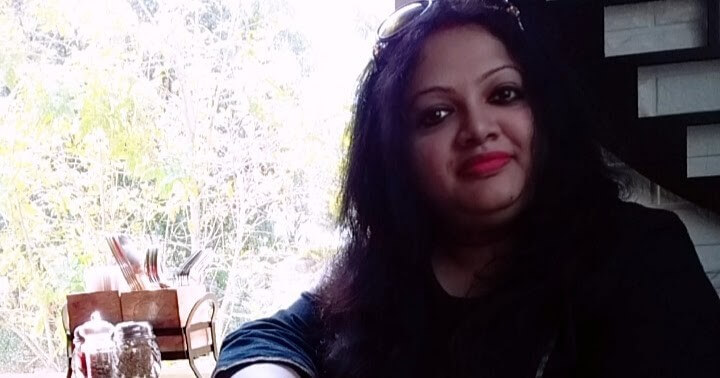
 By
By