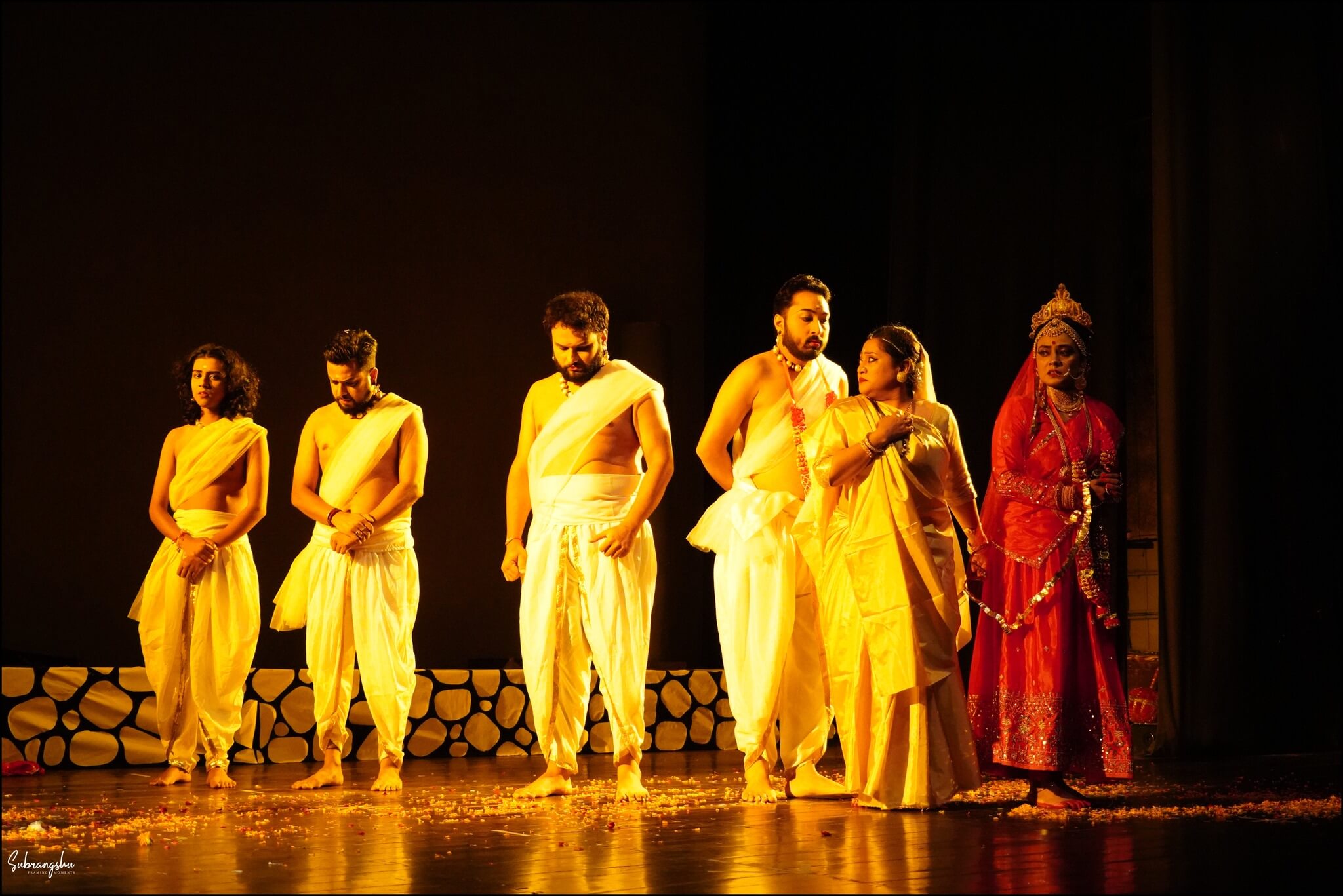

Ruchira reviews Yagyaseni, Draupadi’s legend of resilience and strength, exploring her untold story, a timeless tale for today’s world, exclusively for Different Truths.

In the vast realm of mythology, legends, and folklore, Draupadi, the first wife of the renowned five Pandava brothers, stands out as an intriguing and enigmatic figure. She is often feared, suspected, and hated; yet her story also stirs curiosity in the hearts of many. Firstly, she faces vilification for marrying five men instead of one. However, polygamy was the norm in that bygone era and still exists in certain parts of contemporary society. Those familiar with the epic Mahabharata must acknowledge that her situation was not her fault; it was, in fact, a rash and indiscreet act on the part of Kunti, the matriarch.
Despite her extraordinary circumstances, life was far from easy for Draupadi after her marriage. In a primarily male-dominated society, she faced numerous challenges while living with her five husbands. The public mockingly labelled her ‘panchavartika’ (meaning one who flaunts five male consorts) due to the absence of the concept of polyandry, which continues to be the case even today. Even the valiant Karna referred to her as a concubine or harlot, claiming she brought disgrace to the royal clan.
Her humiliation reached its nadir when she was nearly disrobed in front of an esteemed audience, while her elderly relatives – spouses included – looked on in anguish and dismay. The story of her salvation through divine intervention is well-known and need not be reiterated here.
Despite all the injustices and humiliation that she endured, Draupadi maintained a stoic demeanour, refusing to buckle under pressure while discreetly concealing the turmoil raging within her. She demonstrated immense patience, opting to remain low-profile until her husband, Bheema, avenged her dishonour and the indignities she faced. Ultimately, Draupadi emerged as a symbol of resilience, an indomitable spirit, and inner strength; she truly embodies the essence of an empowered woman!!
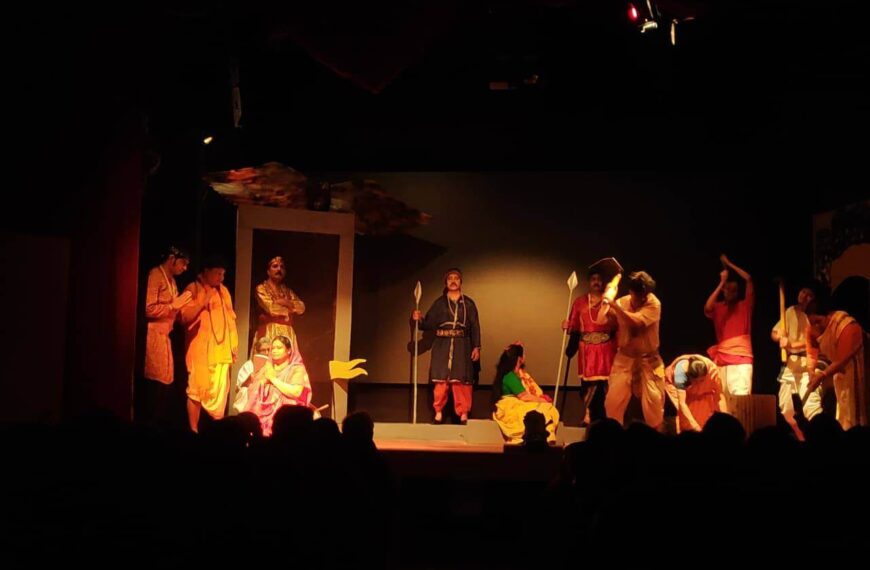
Last week, I had the pleasure of attending a musical dance-drama event titled “Yagyaseni”, presented at the prestigious Shri Ram Centre in New Delhi by the Creation Dance Academy, a notable cultural institution in the capital.
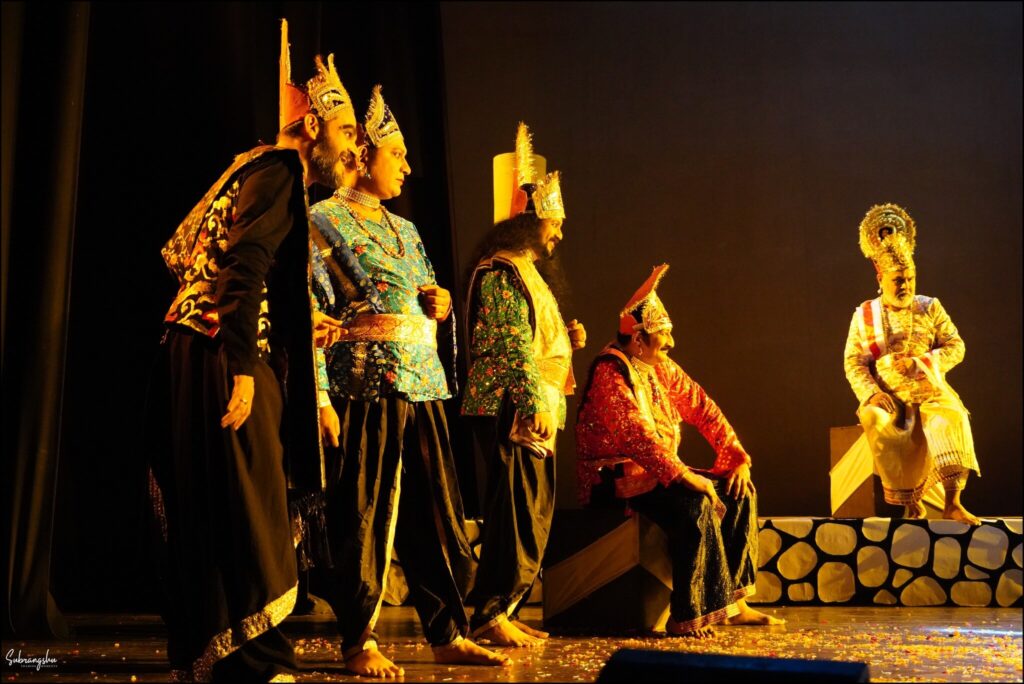
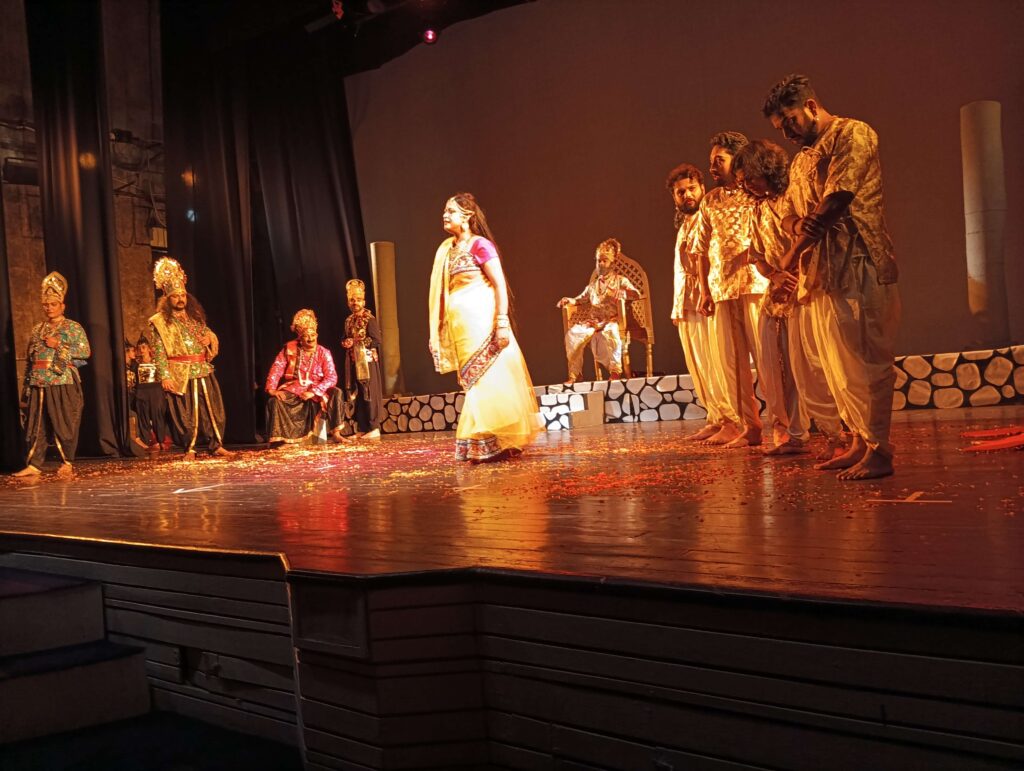
The performance began with a portrayal of Draupadi’s birth, showing how she emerged from the sacrificial fire ignited by her father, King Drupada, the ruler of Panchal (she is also known as Panchali). Thus, she earned the name Yagyaseni, meaning “she who sprang from the sacred fire”.
According to another version, King Drupada earned the sobriquet “Yajnasena” because he possessed “an army ready for any sacrifice” (Yagya + Sena). Drupada had originally kindled the sacred sacrificial fire to obtain a son who could defeat Drona, the mentor of both the Kauravas and Pandavas, with whom Drupada had an acrimonious relationship.
The narrative traces her eventful journey: becoming Arjuna’s bride through the Swayamvara, her initial bewilderment following Kunti’s verdict, blissful matrimony, her bond with her mother-in-law, and the friendship she fostered with Keshav (Lord Krishna), Arjuna’s bosom friend. It also portrays her trauma after Yudhishthira gambles her away to the Kauravas in the disastrous game of dice.
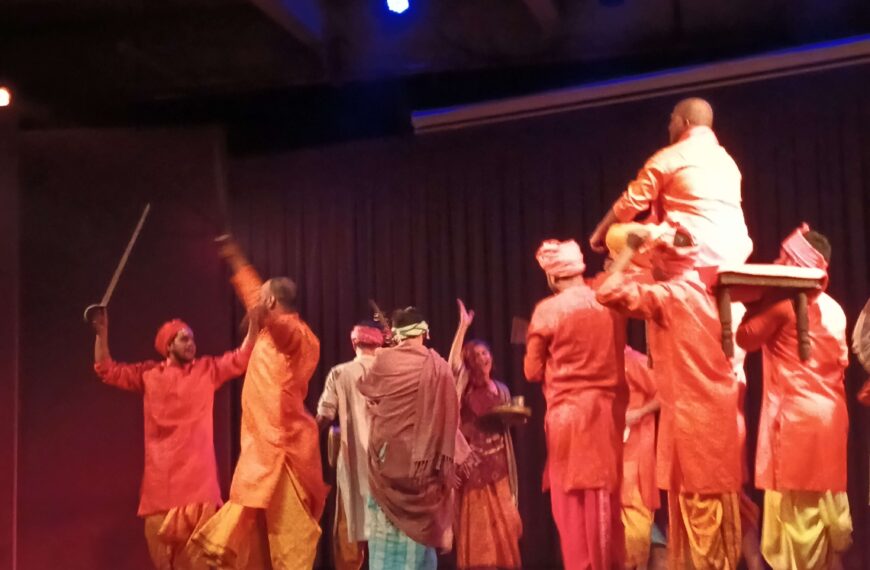
The most outstanding aspect of the performance was its contour, which mirrored a jatra pala, the quintessential folk theatre of Bengal. In a jatra, the audience sits around a small, low stage while the actors (or artists) mingle with them, actively engaging rather than just presenting to the onlookers. In this case, the awestruck spectators witnessed Dushshasana darting amid the crowd and ruthlessly dragging a screaming, wailing Yagyaseni (lurking in the shadows) onto the stage. The larger-than-life action was met with thunderous applause.
Another memorable scene depicted the aftermath of the Battle of Kurukshetra, which left a trail of devastation, destruction, and genocide. The Pandava siblings, rather than feeling triumphant, appeared dejected, downcast, and morose as they grappled with the futility of war, violence, and bloodshed.
The finale was aptly marked by an allegorical journey of the brothers to the Himalayas, although, in the epic, this journey, known as Mahaprasthan, occurs much later.
To add a realistic touch to their “Exodus”, the actors threaded through the audience as they retreated to the back of the auditorium, a commendable aspect of the performance.
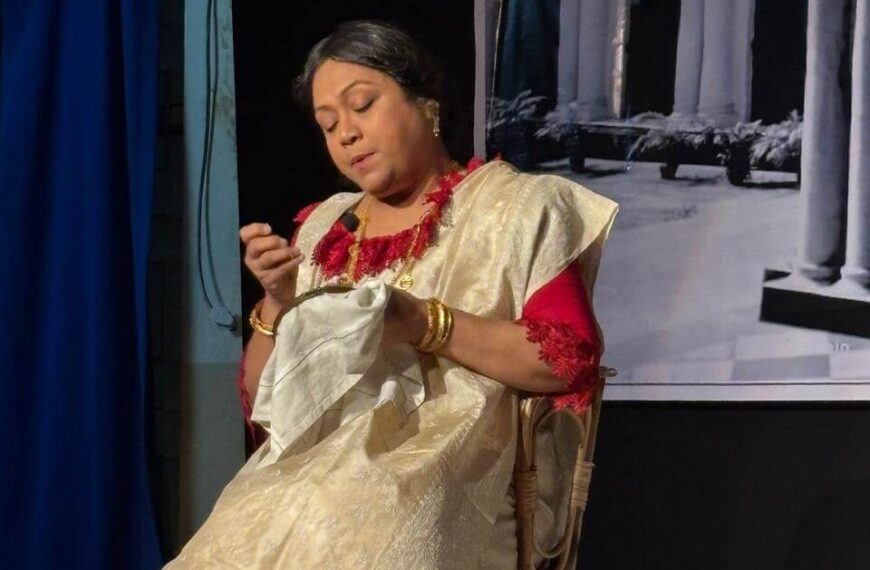
The star performers, Ayan Banerji (as Dushasana) and Anindita Seth (as Yagyaseni), certainly deserve accolades for their remarkable portrayals.
A word about Arunava Dhar, the mastermind behind the presentation: Dhar received training in various dancing styles, notably those of Ananda Shankar and Martha Graham, among many others.
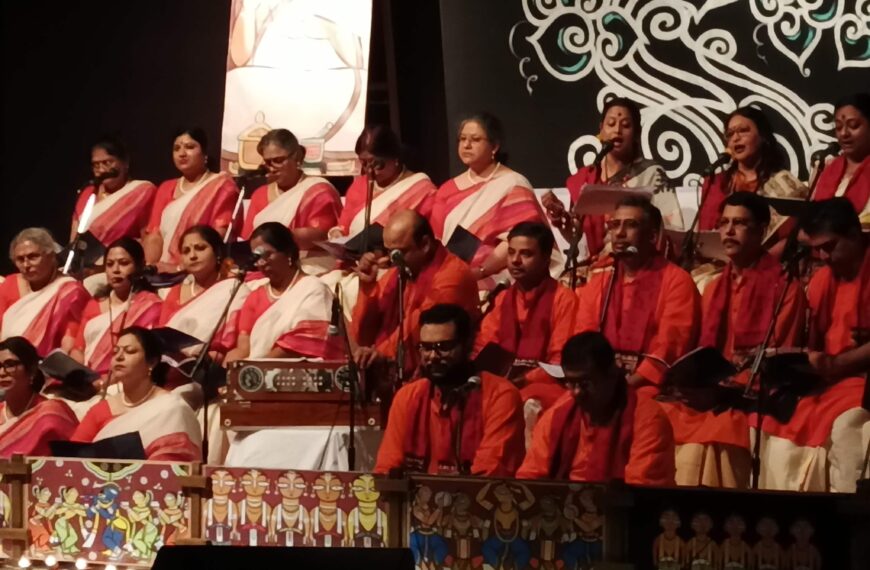
The team behind the scenes, responsible for the lighting and stage decor, did an excellent job enhancing the overall experience. Aniruddh Chowdhury, modest and unassuming. arranged the music.
On a serious note, this mythological episode remains relevant to contemporary Indian society. Every day, every hour, nameless and faceless Yagyasenis silently suffer humiliation and oppression at the hands of their menfolk. Will they find the likes of Krishna and Bheema to redeem them?
Photo Credit: Subrangshu Chakravarty

Born in Guwahati and raised across Delhi and Punjab, Ruchira Adhikari Ghosh is an alumna of Sacred Heart Convent, Ludhiana. She holds a master’s degree in English literature from Punjab University, Chandigarh, and a postgraduate diploma in Journalism. With nearly 25 years of experience in print, web, and television media, she has carved a niche as a feature writer. Her writing focuses on women’s issues, food, travel, and literature, reflecting both versatility and depth.