
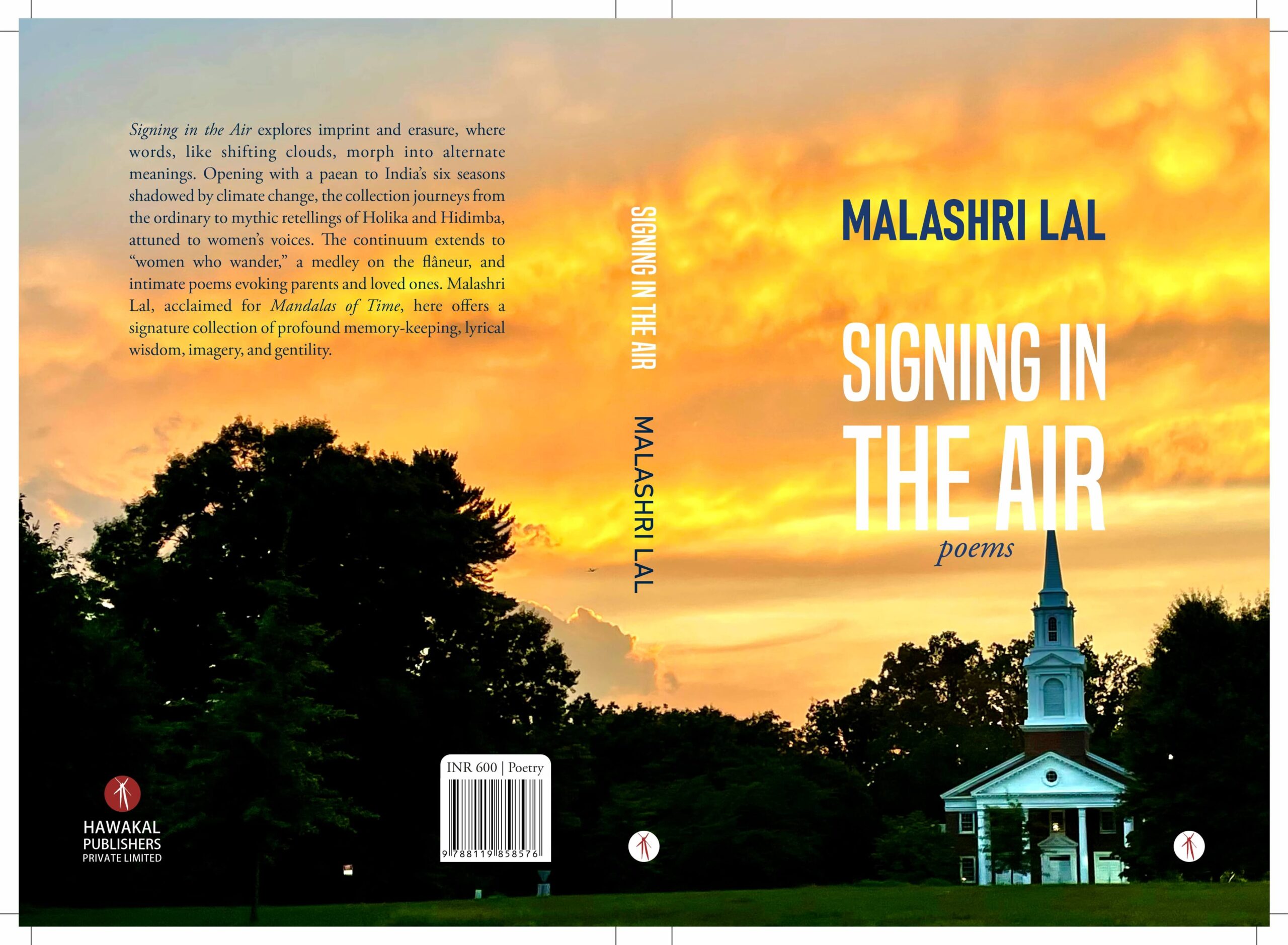
Urna reviews Malashri Lal’s Signing in the Air, a profound collection, brilliantly exploring consciousness, myth, and the resilient feminine power within a boundless poetic canvas, for Different Truths.

Any attempts to describe Malashri Lal’s poetry must begin at the nuanced, observational liminality of her poetics, shimmering with the iridescence of where words pivot into being more than words. Signing in the Air can perhaps be understood like a softened, glistening “seemaheen” horizon of a reflective summer afternoon, where interiority collides into exteriority, the unnamable coalesces into the nameable, and submission sits next to surrender, looking it in the eye.
Malashri Lal’s Signing in the Air is a collection of seventy-six poems divided into five sections – Whispers of the Earth, Installations, Echo of Myths, Meditative Missives, and Women Who Wander. As one digs deeper into Signing in the Air, published by Hawakal Publishers, one is firmly convinced that Lal’s work is hinged on the building of worlds – a “universum litterarum” of ideas and idioms, introspection and illuminations, images and initiations that are soft, gentle nudges upon the door of one’s consciousness. Reiterating Harold Bloom’s elucidation, “Consciousness is the materia poetica” that gets sculpted as it undergoes ceaseless expansion.
Signing in the Air begins with a conjuration, a summoning of what’s primal to our culture – the sense of shakti bubbling through our arterial veins, our blood, our tissues, our nerve endings. The calling upon of the feminine power that instinctively knows that creation and destruction are merely both sides of the existential coin.
The poem acts both as an invitational chant as well as sets the tone for the sheer range, spectrum and sweep – the cosmography of Lal’s poetry, as her lines hum into our bones the need to reclaim every morsel of faith, conviction, and benediction at a time that not only teeters on the apocalyptic brink of melting ice sheets and depleting rainforests but also of repeated acts of brutality towards women, at home and in the world.
“Ya Devi Sarvabhuteshu…
We know not Your ways
Your supremacy we must yield to
in Faith and Conviction
that your protection will be
the sacred halo
keeping away
violence, brutality, torture
of the everyday woman.”
       Invocation – Devi Stuti: The Divine Feminine, page 17
Malashri Lal’s exploration of the seasonality of nature deftly interweaves with the ebb and flow of life, finding expression in the section named Whispers of the Earth. As Lal writes in the preface, “There is both ravage and rejuvenation”. The Sarat Ritu marks the aching transition from summer to winter, and the poetic sonority of this ache intensifies further when a military convoy is attacked by terrorists in Srinagar.
“The tourist crouched behind her
window curtain
and saw middle-aged mothers
picking up the fallen, bruised apples
a feast for their hungry fatherless children”.
        Sarat Ritu Amidst Terror, page 24
In another poem that will stir you to the core, Lal adds an unexpected poetic irony to the metaphor of the birds of paradise – the flower symbolic of freedom and liberation. The poem soon unravels sensorial details of how these “birds” push their “colours” through the dark, shishir-laden habitation of bushes, as Lal adroitly turns the reader’s gaze upon the higher octaves of consciousness.
“Paradise is a cheat
birds, a misnomer
Language, only a blister.”
     Birds of Paradise in Winter: Shishir, page 26
In Chocolate Wrappers, Lal takes the art of poetic personification to the stratosphere of sharp social commentary, while keeping the tonality light, witty, and tongue-in-cheek. Here, Lal laments the demise of the art of conversation and genuine human connection as friends impersonate into “distilled from sugar” chocolate wrappers and friendship crumbles into delusional fool’s gold. Glittery and glamorous, but nothing more than shiny trophies of 5-star hospitality and badges of affluence, flaunting the next poster boy of airport shopping.
“A week later, the chatter begins anew,
sans memory.
One chocolate foil ventures:
‘A shopping trip to Dubai
I’m so longing for the Gold Souk’,
‘Oh but that’s old stuff,
try Abu Dhabi’s airport’, shrugs the other wrapper.”
      Chocolate Wrappers, page 41
The ethos of Lal’s poetry, I feel, is migratory – rooted in words, but searching, seeking, digging, and unearthing through the indefinable borders of Jaipur, Bengal, Delhi, as much as the ineffable boundaries of myths and mythologies, the symbolic leitmotifs of Lakshmi, Parvati, and Ahalya. Her poetic oeuvre often turns to mythology as a vast, fertile ground for exploration and meaning, implication and interpretation.
Many of the poems in the section titled Echo of Myths are, in fact, representations of a dialogue with a rich, complex, alluvium of symbols, archetypes, histories, and narratives that allow for these poems to delve into profound themes ranging from patriarchy to the swing of the moral pendulum, from spirituality to culturally indoctrinated societal taboos.
It is at this poetic juncture, as the reader is drawn into a billowing act of participation in the reading of the poems, that it dawns upon the reader that these poems unfurl like vistas and roads, fields and harvests that no simplistic retelling of old stories can hope to do. That these poems are a subterranean engagement in search of continuity between the past and the present, a way to reimagine ancient tales for contemporary concerns, and a means of connecting individual experiences to a universal, timeless connective tissue – that of hermeneutic inquiry.
One such visceral reimagining is a poem that’s both haunting and human. An electrifying depiction of the gut-wrenching intersectionality of motherhood and the urgent need to protect a child on one hand, and when the prey is compelled to make peace with the predator on the other.
Lal wipes off centuries and centuries of cobwebs from the deeply embedded notions of Hidimba and Ghatotkuch with artisanal poise and reminds us to think deeper before jumping to easy, instantaneous vilification. Thereby redeeming not only the mythological Hidimba and Ghatotkuch, but every woman who walks upon the hot coals of systemic otherization.
“The guard was pulling her towards a van with bars,
hindered by young Ghatotkuch
holding on to her dupatta.
Her crime: begging on the streets
Her ploy: bewitching the man.”
      Hidimba on Delhi Streets, page 63
Lal’s poetry is undergirded with a finely meshed responsiveness that not only frames the moment and savours it, but brings it to the reader’s full attention, thereby upholding the sacredness of “eyes that see beyond”. Signing in the Air reminds us ever so evocatively that the past is rarely static, consciousness is never chronological, and that one moment can be overlaid onto the next, the past, present, and future intermingled, everything cascading into a stratified “signature in the air”.
“Watch with care, friend,
The people are around
and the palm prints
their signature in the air
visible only to eyes that seek beyond
the stamps of the past.”
        Palm Prints, page 97
In conclusion, Signing in the Air can perhaps be described as a “seemaheen” vanguard of poetic seeing. The word “seemaheen” can also be transliterated as simahin or simaheen, formed from the words “seema” (limit/boundary) and “heen” (without). And it is this boundlessness, this limitlessness, and this sense of infinity that Lal’s poetry seeks to bring to light, relentlessly invested in shifting the gaze from the surface to the substratum of consciousness.
As Henry David Thoreau points out lucidly, “The question is not what you look at, but what you see.” This is exactly what makes Signing in the Air a continuum of attentive intersectionalities. A wakeup call to an unfolding that resides in the marrow of looking beyond the edifices of socio-cultural prima facie. And finally, a literary conduit of seeing and sensing, watching and observing, discerning and perceiving. As the lines from Lal’s poem Palm Prints say, “visible only to the eyes that seek beyond”.
Cover image sourced by the reviewer

Urna Bose is an award-winning advertising professional, writer, poet, editor, and reviewer. Her poetry has gone viral, globally. She won ‘The Enchanting Editor Award 2019’, from the Telangana Poetry Forum, and the ‘Women Empowered – Scintillating Creative Impactful – Feminine Power Inspiration Award 2020’. And the prestigious Nissim International Prize for Poetry, 2021. As the Deputy Editor for Different Truths, Urna devotes her time to the ‘Poet 2 Poet’ column.

 By
By
 By
By
 By
By
Discerning. You have said it, Bose.