
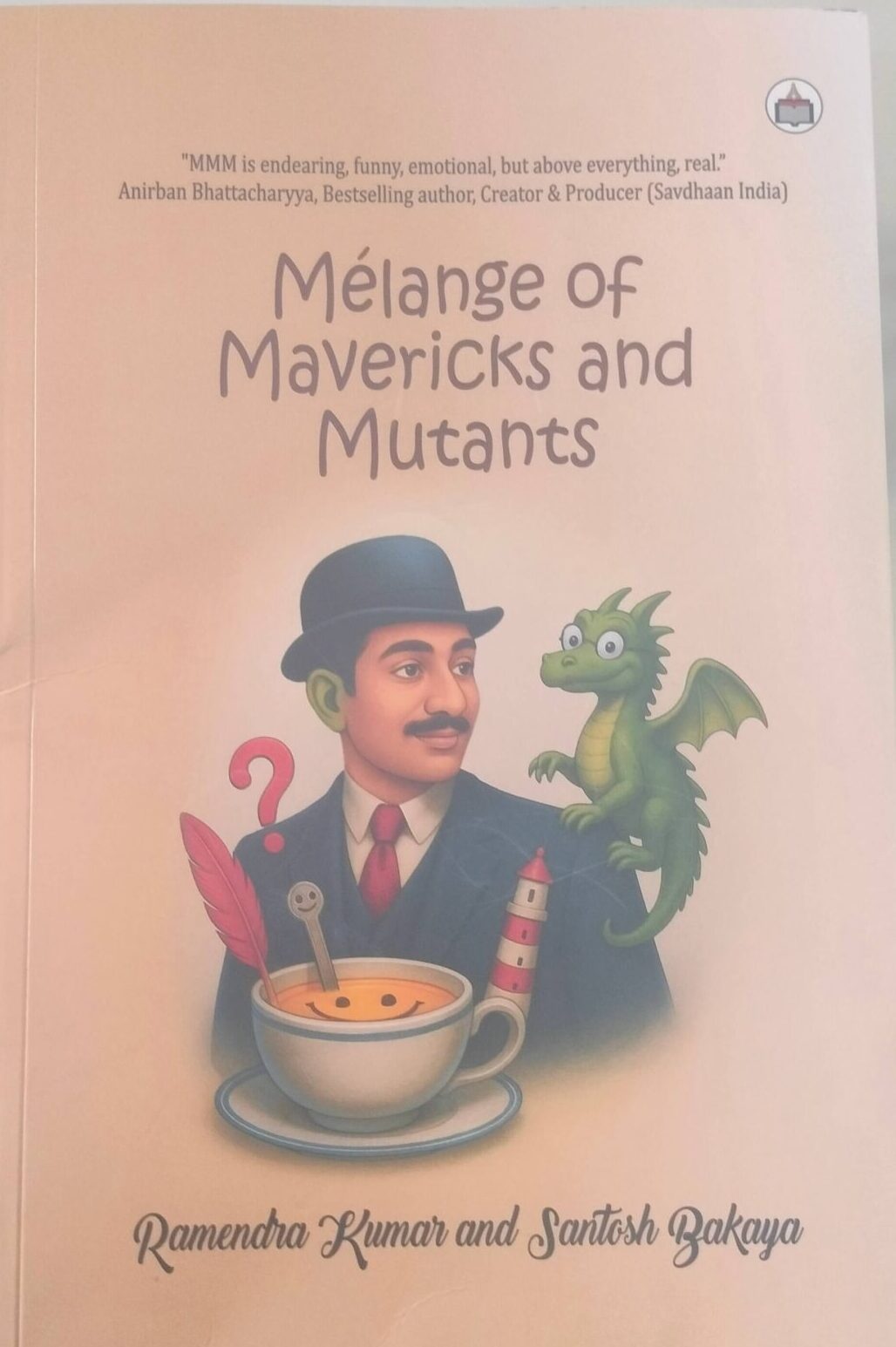
Prof. Nandini hails Mélange of Mavericks and Mutants by Prof. Santosh Bakaya and Er. Ramendra Kumar on DifferentTruths.com – humour as vital literary praxis.

AI Summary
- Transforms everyday absurdities into witty socio-political critique, blending satire with empathy.
- Ramendra’s cancer battle is reframed as resilient parody; Bakaya’s poetic prose elevates the ordinary.
- Advocates institutionalising humour studies for deeper cultural and medical humanities analysis.
Humour as Text, Context and Aesthetic Praxis
Last weekend, I had the pleasure of reading a refreshing, creative and humorous book, collaboratively written by two committed authors and dear friends, Prof. Santosh Bakaya and Er. Ramendra Kumar, and aesthetically published by a dear friend, Sudarshan, from Authorspress. The authors never requested me to review it, unlike many people, yet I wanted to bring this book to the notice of my readers. We need a lot of humour in literature during these fractured times. Humour studies are coming up in a big way in literary studies, thanks to writers like Bakaya and Ramen, who handle humongous humour most humanly and humanely.
Mélange of Mavericks and Mutants is a compendium of humorous sketches, and it is an intervention into the epistemology of wit. The text resists the trivialisation of humour as light entertainment; it situates it as a critical and ethical mode of engaging with the absurdities of contemporary life. The very self-fashioning of the authors as ‘mutants’, a playful yet subversive identity, becomes a metaphor for literary non-conformity, signalling their departure from normative narrative decorum and canonical seriousness.
What emerges is a dialogic text, a mélange in the truest Bakhtinian and ‘Bakayan’ sense, where two distinct yet harmoniously harmless, hearteningly interwoven authorial voices create a polyphonic engagement of wit, satire and existential reflection. The collaborative nature of the work is not incidental; it is constitutive. The text thrives on the friction and fusion of two sensibilities, producing what may be termed a co-authored humour consciousness.
Transforming Quotidian Episodes
Both authors draw extensively from lived experiences, transforming quotidian episodes into sites of literary and philosophical inquiry. Their narratives are rooted in the banal, the overcrowded bus, the bargaining marketplace, the domestic squabble, but these are elevated into what Henri Lefebvre would call the ‘critique of everyday life’.
Their humour is not escapist; rather, it is diagnostic. As one reviewer notes, the book ‘captures the nuances of the society we are a part of’ while embedding humour in deeper socio-cultural critique. The laughter elicited is double-edged, simultaneously funny and unsettling and yet self-deprecating.
In Ramendra Kumar, humour becomes a mode of existential resistance, an ontological defiance. His battle with cancer is not narrated through the rhetoric of suffering alone, but rather through a radical reconfiguration of illness as a site of ironic resilience. He does not just survive tumours; he satirises them, converting pathology into parody. The best part of Ramen is that he is the ‘family man’. His supportive family during the crisis is something that the reader falls in love with.
Yet, he doesn’t trivialise suffering; he reframes it. His writing exemplifies what may be termed therapeutic humour, a form that confronts mortality without surrendering to it. The idea that he ‘fights his tumour with humour’ is not an anecdote; it’s heartbreaking and emblematic of a larger philosophical stance – humour as a weapon against despair, a means of reclaiming agency in the face of bodily vulnerability.
His observational acuity, whether in domestic scenes or institutional absurdities, reveals a sharp satirical edge. The reimagining of bureaucratic systems (such as the witty play on ‘IRS’) underscores his ability to expose socio-political incongruities through laughter.
Hybrid Form Blurs Generic Boundaries
If Ramendra Kumar’s humour is incisive and defiant, Santosh Bakaya offers a more fluid, lyrical and academic register with her narrative grace, poetic prose, and affective depth. Her prose frequently dissolves into poetry, the unassuming style of a real professor of English, creating a hybrid form that blurs generic boundaries. Her narrative technique is marked by rhythmic language, alliteration and an almost musical cadence that transforms prose into a sensuous experience.
Her stories, drawn from real-life incidents, possess a lingering emotional resonance. They are humorous, yet imbued with pathos – what might be called ‘poignant humour’. The theatre of the overcrowded bus or the anxiety of everyday survival becomes, in her hands, a site of both laughter and empathy.
Bakaya’s strength lies in her ability to render the ordinary extraordinary. Her characters are recognisable, almost intimate, evoking what reader-response theory would describe as affective identification. Her humour ‘forces you to think about the struggles of the common man’, thereby aligning her work with socially conscious literary traditions.
The authors’ self-description as ‘mutants’ is not whimsical; they are theoretically significant. It gestures towards a post-human, post-normative identity, writers who refuse to conform to rigid literary categories. This self-irony destabilises authorial authority, inviting readers into a participatory space where laughter becomes a shared epistemic act.
The mutant becomes a figure of resistance, against solemnity, against canonical rigidity, and against the hierarchies that marginalise humour in literary studies.
The Institutionalisation of Humour Studies
One of the most compelling aspects of Mélange of Mavericks and Mutants is its implicit argument for the institutionalisation of humour studies. In Indian academia, humour has been relegated to the peripheries, overshadowed by more serious literary forms. This text challenges that hierarchy.
Humour here functions as a critical tool for socio-political commentary, a part of medical humanities as a discipline, and a narrative innovation.
The work aligns with global shifts in literary theory that recognise humour as a legitimate field of scholarly inquiry. It calls for a reconfiguration of curricula to include humour as an ancillary genre and elective courses, wherever necessary, and then as a central mode of literary and cultural analysis in the mainstream.
Both authors are writers driven by the craft and by an almost obsessive commitment to storytelling. Their writing is never detached, never pedantic; it is deeply invested, emotionally charged, and ethically grounded. This passion is palpable in every anecdote, every turn of phrase, every satirical jab.
Text’s Moral Centre
Their humanity, deeply human and humane, is the text’s moral centre. Whether it is Ramendra’s courageous engagement with illness or Bakaya’s empathetic portrayal of everyday lives, the book sings of compassion as a literary value.
Mélange of Mavericks and Mutants ultimately proposes a theory of what may be called humane humour, a form that laughs with humanity. It is inclusive, empathetic and critically engaged.
In an age marked by alienation, anxiety, war, and socio-political fragmentation, this book offers humour as escapism and as a mode of survival, critique and connection. The collaboration between Ramendra Kumar and Santosh Bakaya is aesthetically successful and ethically significant.
Their contribution to humour studies is substantial; they expand its scope, deepen its affective range, and demonstrate its relevance to contemporary literary discourses.
In doing so, they remind us that laughter, when wielded with intelligence and compassion, is not trivial; it is transformative.
Cover photo sourced by the reviewer
Prof Nandini Sahu is the Vice Chancellor of Hindi University, West Bengal, and a celebrated Indian English poet and Amazon’s Best-selling Author. Formerly a Professor and Director at IGNOU, New Delhi, she is the author/editor of 23 books. A double Gold-Medalist, her accolades include a Gold Medal from the Vice President of India for English Studies, the Michael Madhusudan Academy Award-2024, and the Tagore Samman-2025. Her expertise spans Folklore, Hindu Studies, Comparative Literature, and Critical Theory.

 By
By
 By
By
 By
By
 By
By