
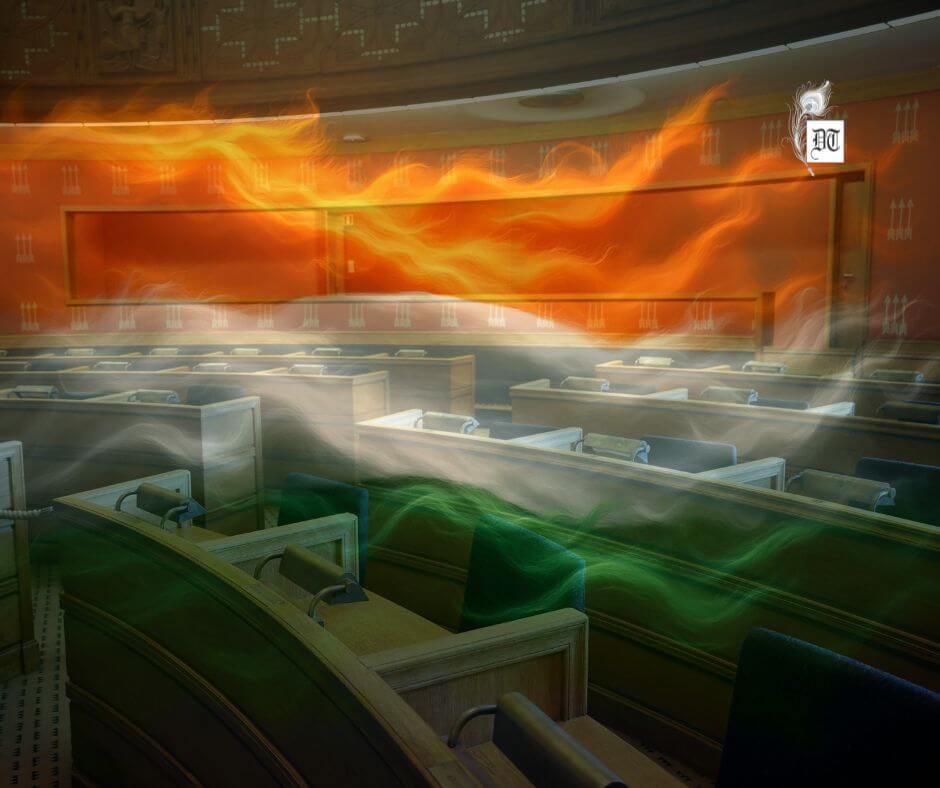
Prof Bhaskar debates, for Different Truths, that in a world where consensus and dissent coexist, the debate over India’s national symbols reflects a deeper struggle for identity.

In the case of more than one individual that forms a society, debates are natural, where each one ultimately agrees to arrive at a consensus or agrees to differ or disagrees temporarily to agree, which affects them as they perceive from their actions in a reciprocal frame. Parliamentary debates are no exceptions, with two sides – one in government and the other in opposition – both sides for the elevation of the nation to a higher height. Debates are welcome then.
It is not that questions that had not been debated yesterday cannot be debated today, of course, keeping in mind the probable consequences for tomorrow. Among many such debates of late, the latest one is the proposal for the introduction of Vandematram to replace Janaganamana – the former one penned by Bankim Chandra Chattopadhyay and the latter by Rabindranath Tagore. India as a nation has followed the latter as the National Anthem 2025 since 1947. The government at the centre is proposing to give Vandematram its place of pride. It is, of course, not very clear if Rabindranath is being substituted by Bankim Chandra, both from undivided Bengal. Of course, these two individuals – Rabindranath as ‘Kobi Guru’ and Bankim Chandra as ‘Sahitya Samrat’ – have nothing to do with parochialism.
What surprises me, being an elderly citizen of the state and a natural member of the nation, is the abrupt introduction of an issue such as this when there were many burning issues like the falling rupee, rising gold prices, adverse trade balance, crises on oil imports from Russia under hegemonic pressure, hostile neighbours, employment/underemployment, security of women, and migration of people suspected as infiltrators – the list is unnumbered. If poverty-inequality and disasters called ‘natural’ are taken into account, India may need to use the old Parliament building also, in addition to the newly built one, to ponder over where we as the nation stand now and look forward to seeing Vikshit Bharat in 2047. But that is the task of the political masters. Let me confine myself to one issue at a time – Vandematram.
Infantile Appropriation
Who belongs to whom? Probably Rabindranath was no less than any ruling political authority, though he was never in the chair of Prime Minister or Ministers in descending order. So was Bankim Chandra, who was highly formally educated – both were saints, to say the least – Bankim Chandra was called Rishi (saint), and Rabindranath was Gurudeva. In a two-by-two political electoral game or on a broad canvas of competing cultural space, one political authority contemplates appropriating Bankim Chandra, the timing of which raises doubt. And as if Rabindranath belonged to another player who is now in opposition in the Parliament of India. By the way, the election is knocking at the door of West Bengal, where people know more about Rabindranath for poetry, songs, stories, novels, dance-drama, etc., while Bankim Chandra is known less. History penned by power, of course, may erase the memory of acceptance in the past. However, at this juncture, these two saints seem non-substitutable and non-excludable.
Electoral Priority?
If capturing the voter market of West Bengal was the strategy by floating Bankim Chandra, then it may fail. The ruling political authority at the Centre will have to discover other saints or former cricketers to influence voters apart from cash transfers and so on. India is a political society, and West Bengal is no exception. In electoral politics, some ideas are so ingrained that it may take decades to make people understand the relevance of, for example, Shyamaprasad Mukherjee. Also, for example, many enlightened people do not know MN Roy, the radical humanist. In the Bengal basket, there are unnumbered saints like Rishi Aurobindo Ghosh and Ramakrishna. It seems clear who will fulfil the non-satiety of the political masters.
Prophets and Aam Janta
Based on my survey in a Kolkata-adjoining suburban area, taking Aam Janta engaged in both formal and informal sectors and homemakers as the sample, I found little relevance to the debate that is going on in the esteemed Parliament of India. The survey with a random sample of 50 individuals, most of whom had formal education, was unstructured, and the survey was conducted over three consecutive days in December 2025, where individuals were asked about their opinion on Vandematram and what happens if Janaganamana is bid a goodbye. Most of the respondents felt baffled – there were no responses, ignorance and counter-questions. Some were cynical, also. But the Parliament of India carries the debate forward as a life-and-death question – a question that is an integral component of the ambition of being the best country in the world. If that is so, then one may consider the names of DL Roy, who was no less a patriot in his poetry, or why not Kazi Nazrul Islam? At this point, I also feel baffled.
Substitutability and Excludability
It demands brainstormed ideas and indicators of when two are substitutable, when one is excludable and why. Many issues in the processes are involved here, like the children in educational institutions of India needing to parrot one and not the other. If the choice is left to the children, they may go for whichever seems easy for them. This also opens up the linguistic issue, like pronouncing ‘sujalang suphalang malayeja shitalang shashya shyamalang mataram’ vis-à-vis ‘jana gana mano adhinayaka joyohe’. I fear that children may go for the latter one because they may like to distance themselves from intimidating “Sanskrit” as they understand it by the end “-ang”.
Instead of a Conclusion
In the midst of debates in Parliament, the bigger question that remains is national integration through education, including adult education. It seems unclear whether the substitution of Rabindranath by Bankim Chandra will serve that purpose in the foreseeable future. It seems rational; if these saints are not dragged into the political society, let them live in peace in heaven. There are numerous agendas where the political masters can go for a tug of war to make India a better country for a better world – ‘eyi bharater mahamanaber sagartire’.
Picture design by Anumita Roy
Prof. Bhaskar Majumder, an eminent economist, is the Professor of Economics at GB Pant Social Science Institute, Allahabad. He was the Professor and Head of the Centre for Development Studies, Central University of Bihar, Patna. He has published nine books, 69 research papers, 32 chapters,15 review articles and was invited to lectures at premier institutes and universities over 50 times. He has 85 papers published in various seminars and conferences.
He also worked in research projects for Planning Commission (India), World Bank, ICSSR (GoI), NTPC, etc. A meritorious student, Bhaskar was the Visiting Scholar in MSH, Paris under Indo-French Cultural Exchange Programme. He loves speed, football and radical ideology.



 By
By
 By
By
 By
By