
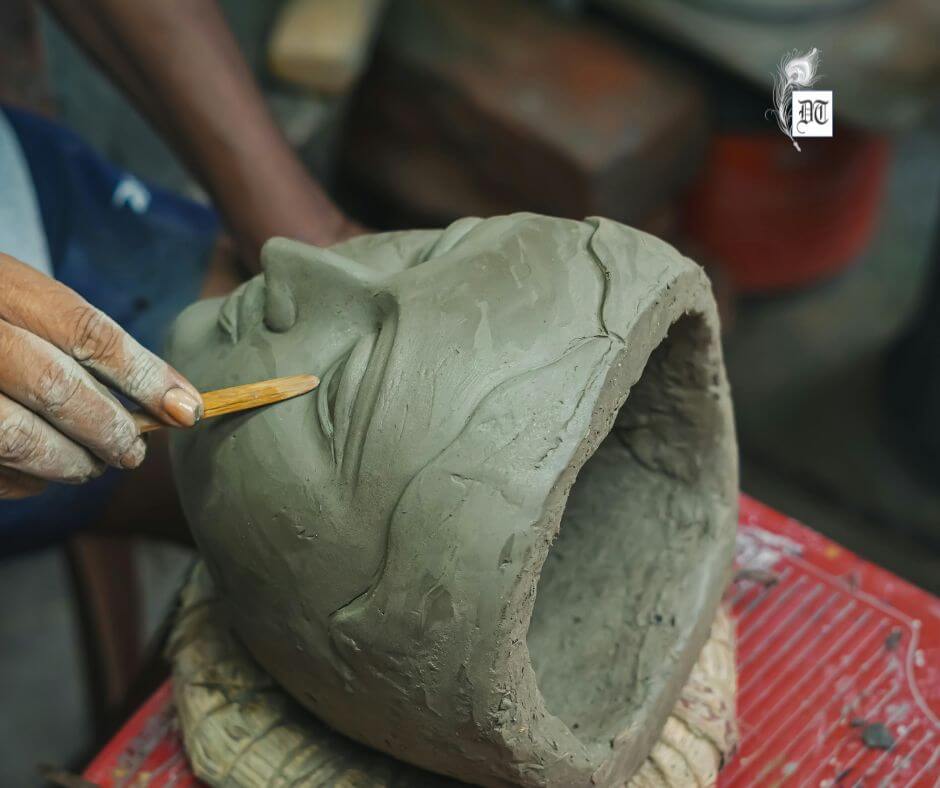
Mowmita elucidates how ‘Punyamati’ reveals that the sacred clay from forbidden thresholds transforms stigma into divine love, proving Durga is the Mother of all, for Different Truths.
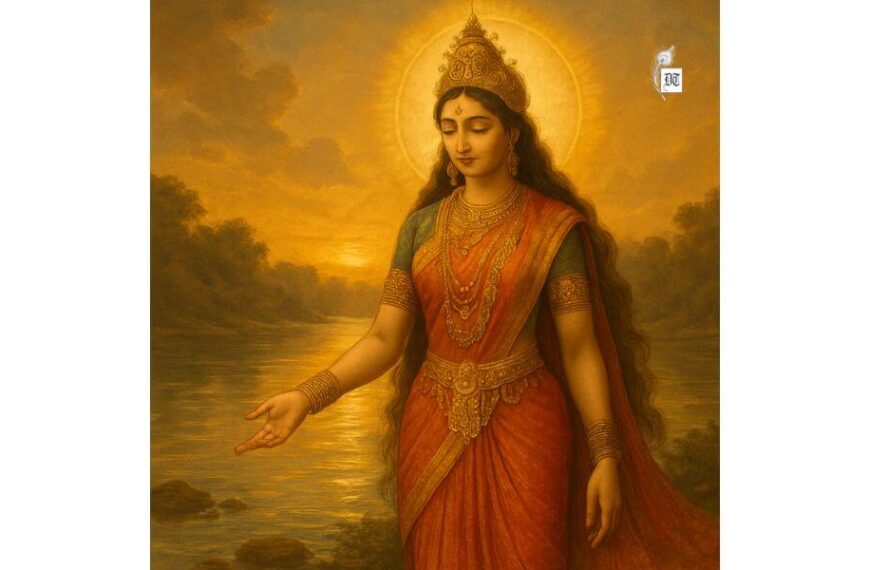
From forbidden doors the clay is drawn,
A mother’s embrace makes all reborn.
Compassion crowns humanity,
The soil is called ‘Punyamati’
Durga as the Mother of All: Soil, Stigma, and Sanctity
Each autumn in Bengal, as the monsoon clouds fade and the air fills with anticipation, artisans in Kumartuli start their sacred work. Their hands, both strong and gentle, gather clay from the banks of the Ganga and from places society often ignores. A handful of soil from brothels, called nishiddho maati or forbidden earth, is mixed into the clay that forms the goddess Durga.
At first glance, the ritual seems startling. Why should the most revered mother figure in Hindu tradition be born from soil touched by stigma? Yet therein lies its radical beauty. The act proclaims that divinity cannot be fenced by human prejudice. Durga is not the goddess of the respectable alone; she is the mother of all.
Artisans talk about this truth with quiet confidence. One sculptor said, “The goddess is the mother of all. If we exclude anyone, the idol is incomplete.” His words reflect a belief that goes beyond religion: motherhood is not about social status but about accepting everyone without condition.
Historical Roots of the Ritual
The tradition of gathering soil from brothels is centuries old, though its exact beginnings are lost in myth and stories passed down by word of mouth. Some believe it started as a symbol to remind people that the goddess does not judge. Others link it to tantric traditions, where the sacred and the ordinary are mixed to break down barriers.
Durga Puja itself is a relatively modern festival in its grand public form, gaining prominence in Bengal during the 18th and 19th centuries. Wealthy zamindars sponsored elaborate celebrations, turning the goddess’s victory over Mahishasura into a spectacle of community pride. Yet even then, artisans insisted on including soil from brothels. The ritual was not about spectacle; it was about philosophy.
By using forbidden soil, artisans sent a message: the goddess is not limited to temples or holy books. She is present in every woman, every home, and every piece of earth. Her motherhood includes everyone.
Philosophical Depth: Motherhood Beyond Respectability
Motherhood in Hindu thought is not merely a biological concept. It is cosmic, archetypal, and expansive. Durga embodies shakti, the primal energy that animates the universe. She is both a valiant fighter and a tender mother, both a destroyer of demons and a nurturer of children.
By beginning her idol with soil from brothels, artisans remind us that motherhood is not about social respectability. It is about unconditional embrace. The ritual insists that even those marginalised by society are part of the goddess’s family.
This idea rings through cultures. In Christianity, Mary is venerated as the mother of compassion, embracing sinners and saints alike. In Buddhism, Tara is the mother who hears the cries of the world. In each case, motherhood transcends judgement. Durga’s ritual in Bengal adds a radical twist: it does not merely preach inclusion; it enacts it through the medium of clay.
Social Critique: Stigma and Inclusion
The soil from brothels is more than a handful of earth. It is a cultural statement, a philosophical paradox, and a social critique. It says that the goddess belongs to all, that divinity cannot be confined by prejudice, and that even the most marginalised voices are part of the sacred chorus.
In a society quick to judge and exclude, the ritual becomes a mirror. It asks uncomfortable questions:
- Why do we stigmatise women whose lives fall outside conventional norms?
- Why do we equate respectability with worthiness?
- Why do we fear the touch of soil from places we deem impure?
Durga Puja answers by dissolving these boundaries. The goddess is born from soil that society fears to touch. And perhaps that is her greatest power: the ability to turn stigma into sanctity, exclusion into embrace, and forbidden soil into divine clay.
The Artisan’s Perspective: Hands of Compassion
Walk into Kumartuli during the weeks before Puja, and you will see artisans bent over half‑formed idols. The smell of wet earth mingles with incense. The sound of chisels and brushes fills the air. Each idol begins with a straw skeleton, layered with clay. And within that clay lies the paradoxical handful of soil.
For artisans, the ritual is not abstract philosophy. It is a lived practice. They speak of it with reverence, not sensationalism. “If we exclude anyone, the idol is incomplete,” one said. Another explained, “The goddess is the mother of all. She cannot be born from selective soil.”
Their words remind us that philosophy is not confined to books. It lives in hands, in gestures, in rituals. The artisan’s labour becomes theology in motion.
Contemporary Resonance: Breaking Boundaries
In today’s world, where stigma still clings to sex work, the ritual acquires renewed relevance. It challenges us to rethink inclusion. If the goddess herself is born from soil touched by marginalised lives, who are we to exclude?
The ritual speaks to broader debates about gender, caste, and class. It insists that divinity is not the property of the privileged. It belongs to all. In this sense, Durga Puja becomes more than a festival. It becomes a social manifesto.
Durga’s victory over Mahishasura is not just a myth of good triumphing over evil. It is also a metaphor for breaking boundaries, for asserting that power and purity lie beyond human judgement.
Sensory Meditation: The Atmosphere of Puja
To fully understand the ritual, one must feel the atmosphere of Puja. The streets of Kolkata glow with lights. Drums beat in rhythm. Crowds throng pandals, their faces lit with joy. Amid the spectacle, the goddess stands tall, her eyes wide, her weapons gleaming, her children by her side.
Yet beneath the grandeur lies the humble clay. The soil from brothels, mixed quietly into the idol, remains invisible. No one points to it. No one marks it. And yet it is there, silently proclaiming inclusion.
This invisibility is itself profound. The ritual does not sensationalise stigma. It dissolves it. The soil becomes indistinguishable from the rest, reminding us that inclusion is not about token gestures. It is about a genuine embrace.
Comparative Reflections: Sacred and Profane
The blending of sacred and profane is not unique to Bengal. In many traditions, holiness emerges from paradox. In Sufi poetry, the tavern becomes a metaphor for divine intoxication. In Christian mysticism, the cross—an instrument of execution—becomes a symbol of salvation.
Durga’s soil ritual belongs to this lineage of paradox. It insists that holiness is not about separation but about transformation. Forbidden soil becomes divine clay. Marginalised voices become part of the sacred chorus.
Personal Reflection: Lessons of Compassion
For me, the ritual is a lesson in radical compassion. It reminds me that inclusion is not about charity; it is about recognition. The goddess does not pity the marginalised; she embraces them as her own.
In a world quick to judge, this lesson feels urgent. We live amid divisions—of class, caste, gender, and religion. The soil ritual whispers a counter‑truth: compassion begins at the doorstep of the forbidden.
Durga, the mother of all, is born from soil that society fears to touch. And perhaps that is her greatest power—the ability to turn stigma into sanctity, exclusion into embrace, and forbidden soil into divine clay.
A Ritual of Radical Compassion
The soil from brothels is more than a handful of earth. It is a cultural statement, a philosophical paradox, and a social critique. It says that the goddess belongs to all, that divinity cannot be confined by prejudice, and that even the most marginalised voices are part of the sacred chorus.
In a world quick to judge and exclude, this ritual offers a radical lesson: compassion begins at the doorstep of the forbidden. Durga, the mother of all, is born from soil that society fears to touch. And perhaps that is her greatest power: the ability to turn stigma into sanctity, exclusion into embrace, and forbidden soil into divine clay.
From brothels’ soil the mother’s love is spun,
Ma Durga’s mati unites everyone!
Picture design by Anumita Roy

Mowmita Sur is an educationist, author, poet, and content writer. She has received many accolades for her writings at both the national and international levels. She was awarded as one of the best 50 poets of India. Many of her published book gets effusive praise and good reviews. Her books are captivating, incredibly well-researched and evoke strong emotions. She writes witty fiction, non-fiction, horror and mysteries. Her characters are clever and fearless like her.


 By
By
 By
By
A beautiful and comprehensive explanation of a divine mystery.
Thank you so much. Regards 🙏🏻