
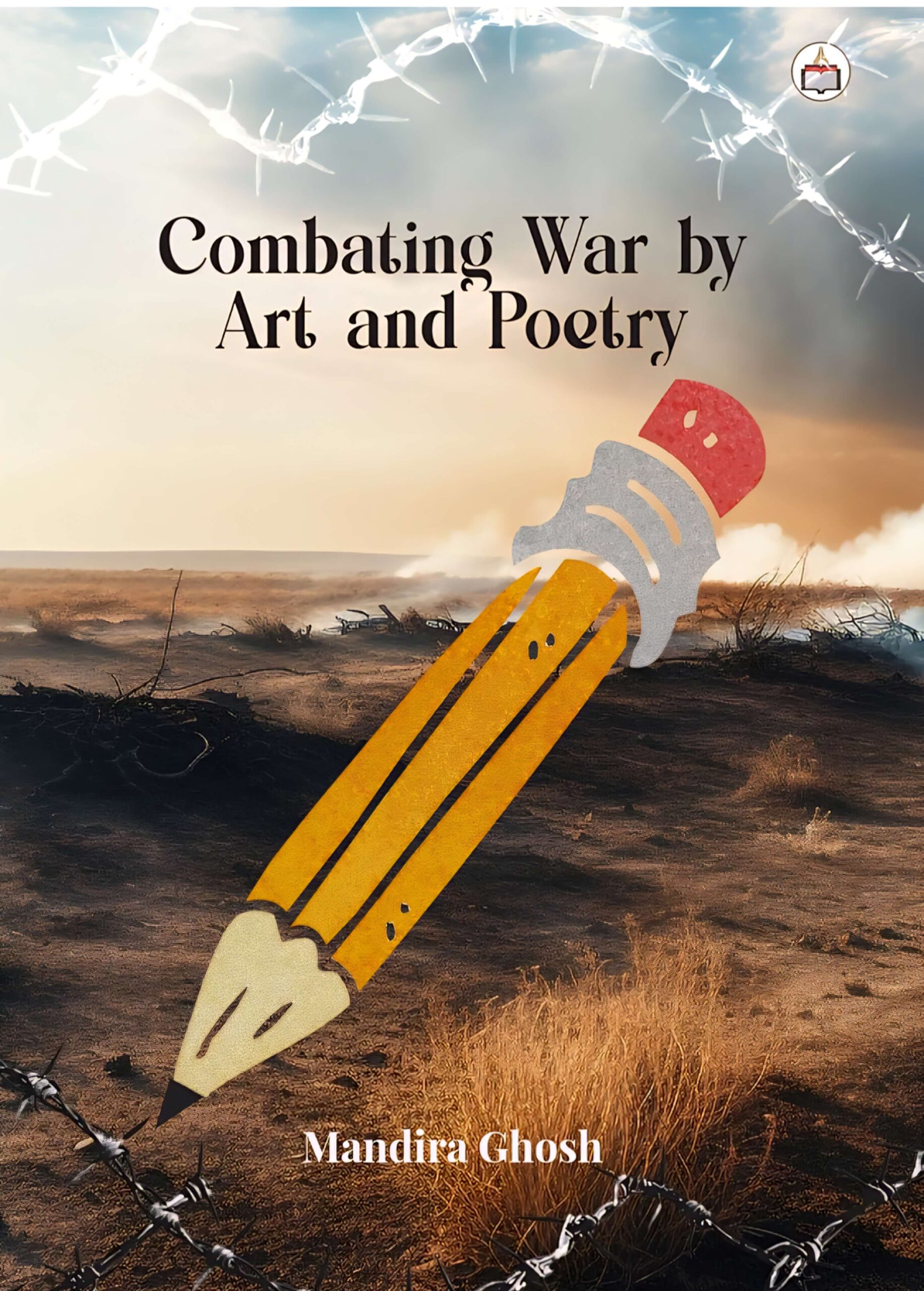
Experience a profound exploration of the human spirit, where timeless art and powerful poetry collide to defy the devastation of war, in a book review by Radha for Different Truths.

This collection of poems, Combatting War by Art & Poetry, by Mandira Ghosh, is timeless and topical, for war, art and poetry have been around as long as human civilisation has been in existence. It has twin points of focus: the ravages of war and the redemptive power of the artistic imagination. The poems explore the paradoxical impulse of the human spirit to embrace both destruction and creation, a dichotomy highlighted in K. Jayakumar’s Foreword: ‘The poems in this unusual volume are as much a covenant of faith in human creativity as a powerful negation of war’ (8).
Poetry glorifying war is, of course, a consistent strand in literary traditions across the globe. Many Indian readers of our generation have studied Alfred Tennyson’s “Charge of the Light Brigade” in school. Bengalis are familiar with Tagore’s poem ‘Bandi Bir’ about the conflict between Sikhs and Pathans and with the martial songs of Kazi Nazrul Islam. Readers in Hindi know Nirala’s heroic poem immortalising Rana Pratap and his indomitable horse Chetak. But in Combating War by Art & Poetry, Mandira takes a more complex stance, arguing that ‘War poems are oxymorons/ Dark visuals/ No glory can be watched/ In fire poems’ (65). She insists that we must wage war against war. ‘Don’t combat peace,’ she exhorts us: Just say / “No” (‘World War III’, 59).
Poetry inspired by painting becomes a key motif in the poet’s sustained critique of war. In her preface, Mandira refers to two paintings: Picasso’s ‘Guernica’ and Salvador Dali’s ‘The Face of War’. These painters, along with others such as Renoir, Van Gogh and Matisse, figure in the poems as a source of inspiration and a counterpoint to the devastation of war. ‘Art and Iris’ refers to Monet’s garden: ‘Eternal Shangri-la/ Art and Iris come to rescue/ A morbid world’ (68). In such instances, ekphrasis, the aesthetic process where one art form inspires another, becomes a powerful medium of expression.
Another prominent thematic strand concerns women, war and art. The wars women have to fight are different. They are not waged on battlefields and often remain invisible to the public eye. In one poem, the sickle becomes emblematic of the woman’s daily battles: ‘A woman battles wars, everyday/ with a sickle in a farm of abundance’ (37). For women, such battles often involve the body. In ‘For All Women in the Studio’, a female model uses her body as a commodity that will earn her the money to feed her hungry children.
                             Woman in the studio.
                             Waits for love.
                             And a life of dignity.
                             And looks back
                             Her wailing children.
                             Slept early yesterday
                             On an empty stomach.            (28)
The poem ‘Love’ (36) argues that while the woman seeks nature, humanity and happiness, men search only for beauty in women. ‘Johar’, about the traditional practice of women’s self-immolation, and the rape and murder victim, alluding to the contemporary RG Kar incident, highlight how society has continued to treat the female body as a site of violence throughout the ages.
The poems on war also highlight the fact that history repeats itself, compelling us to reflect upon the present-day global scenario. They draw upon our collective memory of famous wars, mythical, historical and contemporary. Recollections of World War II and the atom bomb arouse anxiety about an impending World War III. In these poems, the primitive instincts of mankind lurk close beneath the veneer of progress and emancipation that we pride ourselves on. War here is not only a public affair but may also invade the private domain. ‘Deaths in love/Are also wars’ (64), the poet argues in ‘Romeo and Juliet died in love’, though she recognises that such deaths are different from the mass killings portrayed by Picasso and Dali.
In these poems, the personal is also the political. There is a strong autobiographical element in the poem ‘Wars’, where Mandira narrates the horrific torture and murder of her activist grandfather Dhirendranath Datta during the Bangladesh Liberation War:
                                    Prithviraj was blinded
                                    By ferocious men
                                    My grandfather Dhirendranath Datta
                                    Too was blinded and tortured
                                    In Mainamati Cantonment
                                    When the river Gomti turned red.
                                    Birds’ voices were gagged
                                    Over his place of birth.           (61)
The poem links this episode with the blinding of Prithviraj to underscore the brutality of war. But it adopts an ambivalent perspective, reminding us that some wars can also be fought for a just cause. ‘Submarine’, celebrating the valour of Subhas Chandra Bose, also takes this tone, honouring his participation in the Indian nationalist movement: “You, Subhas, / You freed the country from death” (17).
Alongside contemporary references, we find a running thread of mythological and literary allusions. Veda Vyasa is reproached for creating the Mahabharata, and the role of Krishna in shaping the Kurukshetra war comes under critical scrutiny. More than one poem alludes to Abhimanyu. The poet’s sustained critique of war does not spare even the gods.
                                   Oh! Krishna
                                   How could you do it?
                                   To throw your sister’s son
                                   in a fiery war, to win…
                                   All of you killed a young boy.
                                   Who paid the price for all of your vice.’                    (42-3)
In this book, love emerges as a counterforce to the violence of war. So does the labour of those engaged in daily toil. ‘Potters’ reflects on the fact that the reign of monarchs is time-bound. At the same time, the cycle of labour and creativity continues unabated: ‘King dies/ Empire perishes/ Blood of the artist/ Lives till eternity/ And the peasants still/ Goes on/ Ploughing the fields/ Potters still create with mud replicas of maidens and their men'(20). Poems like ‘Three Owlets’ and ‘Apples Falling’ depict the natural world as an alternative to the destructive tendencies of human society.
From the tensions between these contraries, Mandira Ghosh’s poems derive their dynamism and cogency. At times, it seems that poetry itself serves as the battlefield where the drama of these encounters unfolds.
The book cover photo was sourced by the reviewer

Radha Chakravarty is a poet, critic and translator. She has published over 20 books, including two collections of poems, Subliminal and In Your Eyes a River; translations of major Bengali writers, including Rabindranath Tagore and Mahasweta Devi; critical studies of contemporary women writers; and several anthologies of South Asian writing. She co-edited The Essential Tagore with Fakrul Alam and contributed to ‘Pandemic: A Worldwide Community Poem’, nominated for the Pushcart Prize 2020.


 By
By
 By
By
 By
By
 By
By