
Ruchira cohabited with four elderly women, each with a bizarre cleanliness fetish, creating a surreal domestic landscape with peculiar rituals and bewilderment, exclusively for Different Truths.
For seven long, dreary, years I had shared space with four elderly women in my marital home. My husband’s mother, a spinster sister and two spinster aunts (masi). Each of them displayed an overpowering fetish for ‘cleanliness’. Whenever we had local guests, after they had departed, Aunt Mira (who wore the pants in the house) would begin to wash the handles and knobs of the main door touched by the retreating visitors. Additionally, she would diligently wipe the foam/leather of the sofas and upholstered chairs with a wet rag.
There is more. Be it the pizza or courier boy, newspaper or cable guys, milkman or janitor, the moment anyone handed Aunt Mira or Aunt Rita some coins these would be forthwith rinsed in the kitchen sink or the wash basin, dried, and only then put in the purse or box. I was filled with shock and bewilderment each time I observed my mother-in-law or anyone of her siblings passing by the dining table; their hands would immediately grab a jug or water bottle, water would be sprinkled on the surface and palms would lovingly wipe the table-top even if it was squeaky clean!
Why had mobile/cellular phones not been invented then…
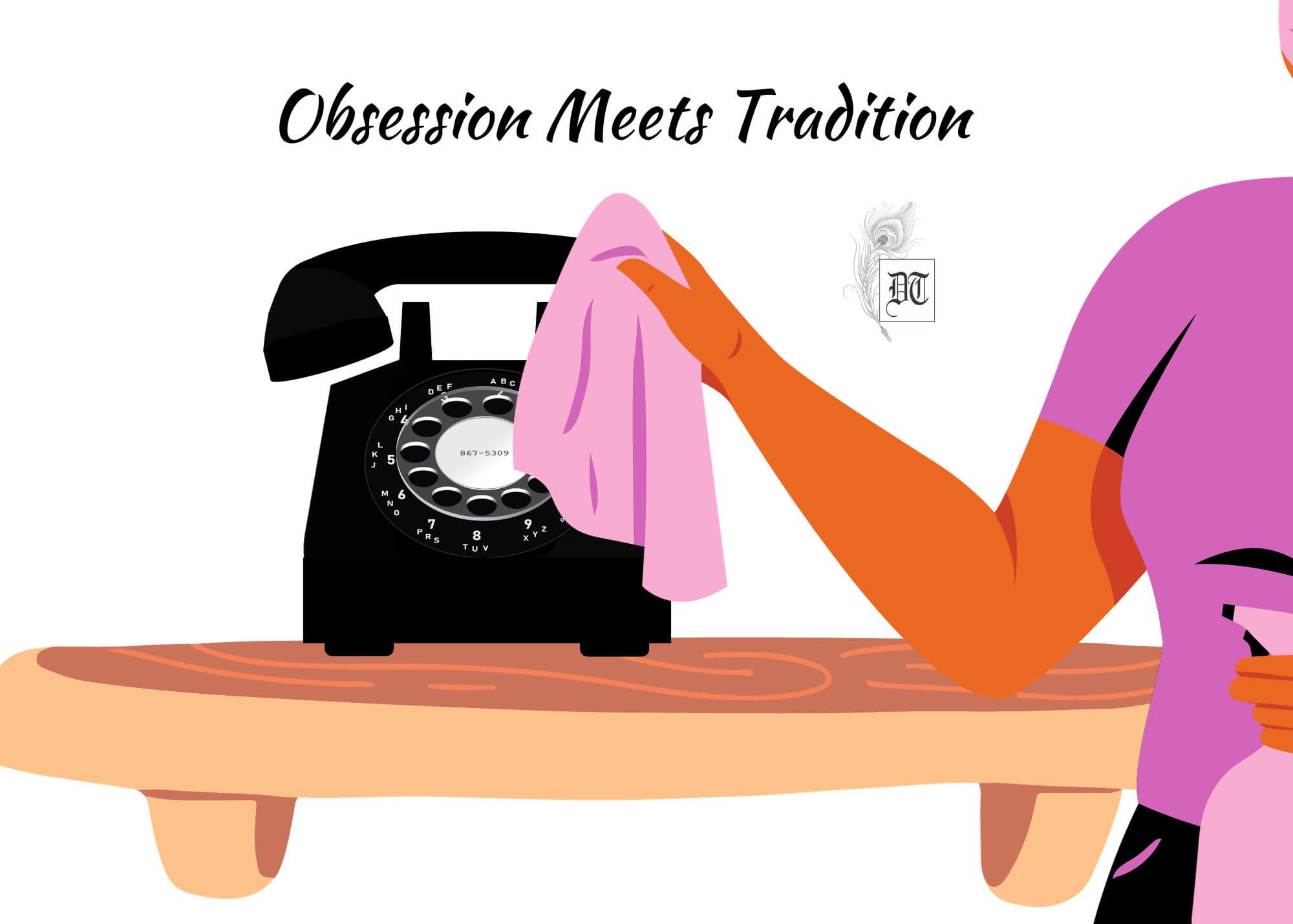
Many times, when an outsider or a non-family member happened to use their “precious” telephone placed in the living room, at the earliest opportunity, the phone would be vigorously rubbed with a wet cloth! And who will believe me if I say when I received incoming calls or made a “few rare” outgoing calls (accompanied by growls from the dad-in-law who fumed over the waste of money) my dearest sister-in-law Jhuma would materialise from nowhere with a damp napkin and embark on her “Safai Abhiyaan” with such vengeance that I felt ashamed to touch the dratted instrument again. I rue those terrible times even now. Why had mobile/cellular phones not been invented then or at least not become part of our lifestyle? My life would have been less horrific then.
Let me narrate a bizarre incident. About a month and a half after our wedding, both of us had gone to the picturesque Neemrana Fort resort, located near Jaipur. This was meant to be a mini honeymoon plus an editorial assignment for me.
When we returned, my Jhuma didi grabbed our moulded plastic VIP suitcase and cleaned it thoroughly with detergent soap water! Why? Because it had travelled so many kilometres. So quite naturally it was unclean and unfit for a “bhadralok” household.
Now I am sure everyone who is well-acquainted with Bengali traditions and lifestyle must be familiar with what is colloquially termed shuchi bayi (pure air) syndrome also known as baatik.
This is what the rest of the world recognises as obsessive compulsive disorder (OCD) i.e., a “craze” for cleanliness.
However, never … have I heard or seen wives…and a bevy of virgins/kumaris suffering from this aberration.
I have never lived in Bengal, but as far as my knowledge regarding this phenomenon goes, it manifests mainly among “untimely”, young, or middle-aged widows who embark on such “purity” or cleanliness drives to ward off undue attention from the opposite sex. I garnered these from the vast anthology of drama literature and poetry in our vernacular. However, never in the fifty-odd decades of my life have I heard or seen wives (suhagans, my sasuma precisely) and a bevy of virgins/kumaris suffering from this aberration? And that too in the family of a well-established, practicing allopathic doctor! I am befuddled as to why the Hon gentleman (my father-in-law) did not get them treated at the appropriate time.
Now for the weirdest part: If you had an upset tummy, diarrhoea, or dysentery, or just had a dump, a complete bath was mandatory – thunder, lightning or rain, cold wintry night, or chilly morning notwithstanding. Since I am susceptible to cough and cold, I was unable to comply. As a penalty, I was banished from the kitchen as well as from the prayer room forever!
Picture design by Anumita Roy

Born in Guwahati and raised across Delhi and Punjab, Ruchira Adhikari Ghosh is an alumna of Sacred Heart Convent, Ludhiana. She holds a master’s degree in English literature from Punjab University, Chandigarh, and a postgraduate diploma in Journalism. With nearly 25 years of experience in print, web, and television media, she has carved a niche as a feature writer. Her writing focuses on women’s issues, food, travel, and literature, reflecting both versatility and depth.



 By
By
 By
By
 By
By