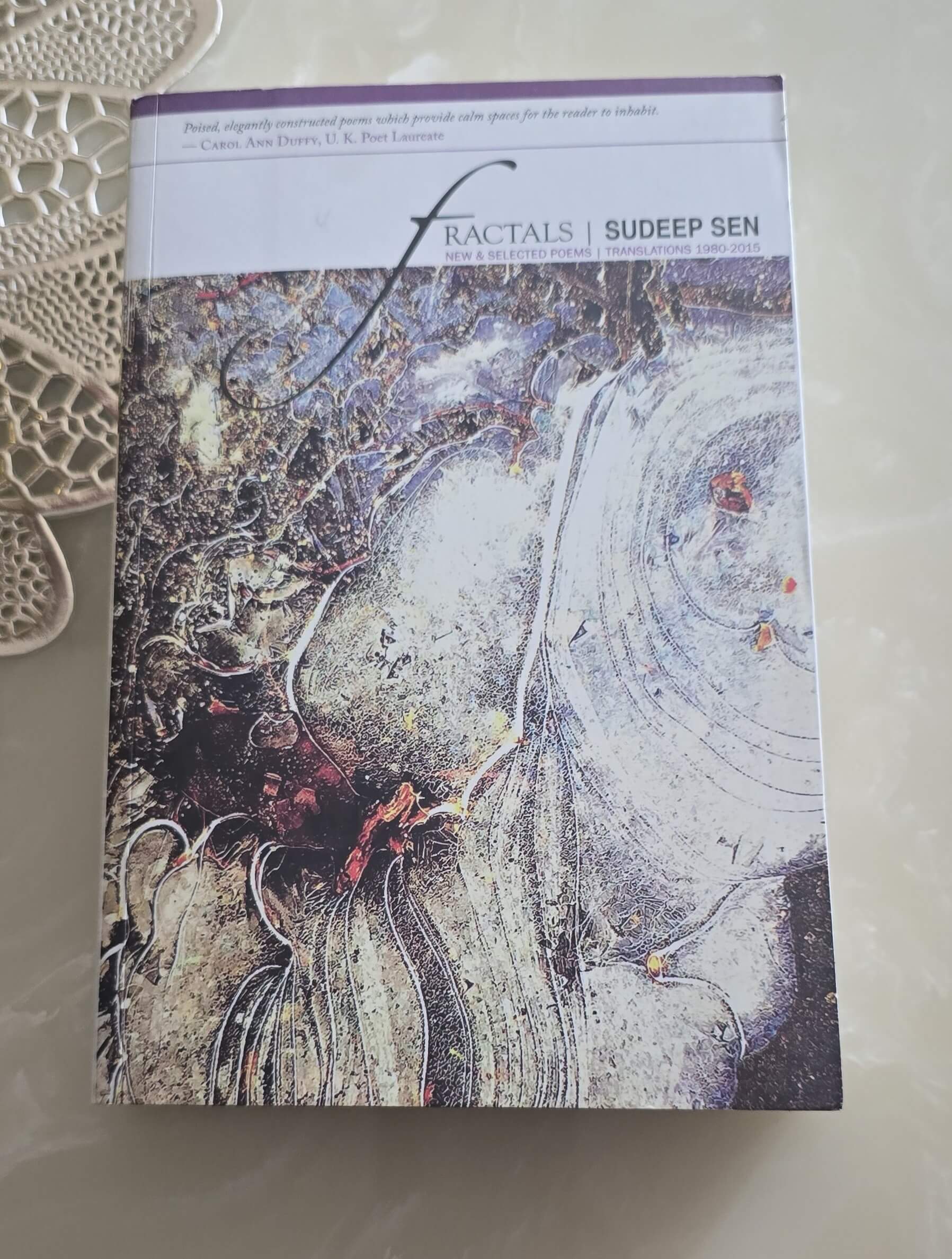
Vandana in DifferentTruths.com unveils Sudeep Sen’s Fractals: a poetic dialectic of bone-hard trauma and watercolour fluidity in cultural memory.
AI Summary
- Synthesises Assmann’s cultural memory and Jungian archetypes to reveal Sen’s “bone vs. watercolour” dialectic softening subaltern and geopolitical scars.
- Analyses poems like “The Railway Station, Bombay,” “Kargil,” and “Drass” as fractal reimaginings of borders, hierarchies, and resilience.
- Positions Sen as memory’s architect, tuning English to India’s indigenous rhythms for global consciousness.
Abstract
This paper investigates the intersection of cultural mnemonics and poetic architecture in the works of Sudeep Sen, specifically focusing on his collection Fractals. By synthesising Jan Assmann’s theory of “Cultural Memory” with Jungian archetypes, this study explores how Sen navigates the “lived past” through a sophisticated dialectic between material trauma and artistic translucency. The paper introduces the concept of the “bone vs. watercolour” dialectic, arguing that Sen utilises a “watercolour aesthetic” to soften the rigid, “blackened” historical realities of subaltern marginalisation and geopolitical conflict.
Through an analysis of poems like “The Railway Station, Bombay,” “Kargil,” and “Drass,” the research demonstrates how Sen deconstructs the permanence of political borders (the LOC) and class hierarchies, reimagining identity not as a linear post-colonial struggle, but as a fractal pattern of human resilience. Ultimately, the study positions Sen as an “architect of memory” who tunes the English language to the indigenous frequencies of the Indian landscape, offering a template for an integrated, globalised consciousness.
A Sophisticated Liminal Space
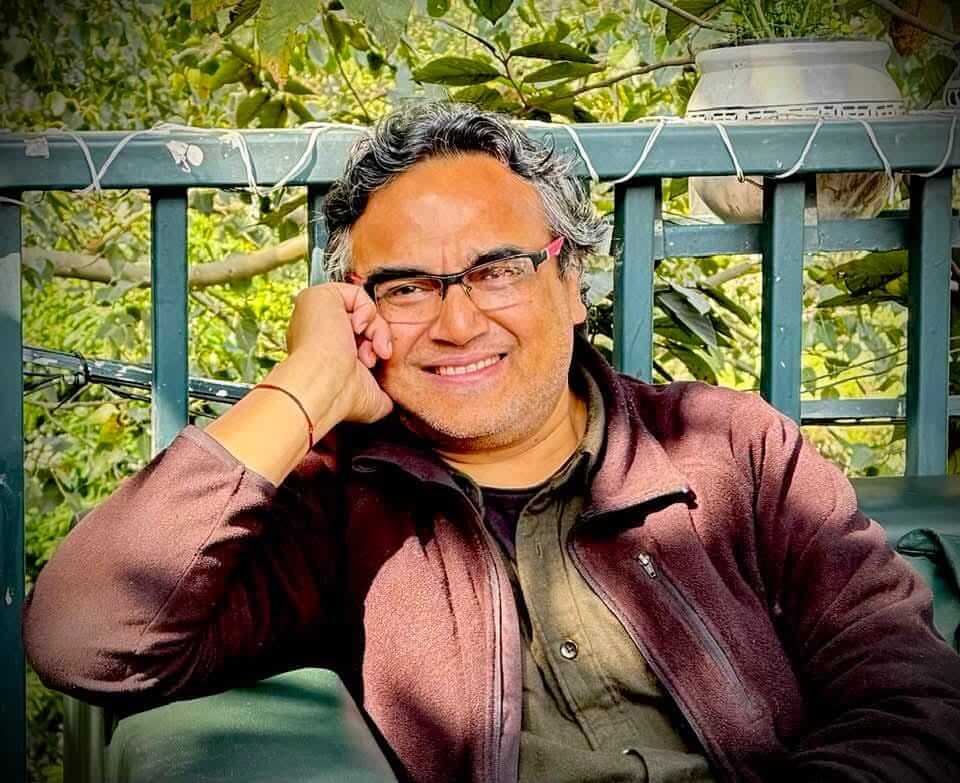
Sudeep Sen’s oeuvre serves as a sophisticated liminal space where the cultural designs of a society—its ontological truths, theological frameworks, and inherent anxieties—are meticulously mapped. Culture, in this context, acts as the primary mechanism for societal engagement, a framework through which the “lived past” is transmitted into the future. By synthesising the theories of Jan Assmann and Carl Jung, one can perceive Sen’s poetry not merely as aesthetic expression, but as an act of cultural mnemonics: the preservation of identity through the strategic interplay of remembering and forgetting.
As Prof Dr Jan Assmann suggests, culture functions as a “non-biologically transmitted memory,” essential for the survival of civilisation. In Sen’s poetics, this memory is structured across three distinct planes: The Neuro-Mental (Individual): The interiority of the persona’s cognitive experience. The Social (Collective): Shared consciousness akin to language, where memory is a communal property. The Cultural (Socialised): The systemic control and curation of these memories within a specific historical context.
This triad forms what can be termed “brain mappings”—socialised interpretative frames that dictate how an individual perceives both history and contemporary marginalisation. Sen navigates these “memory lanes,” tracing the cultural architecture that Plato argued preceded the soul’s entry into the world.
The title of Sen’s collection, Fractal, invokes a geometric metaphor for history: patterns that maintain self-similarity across varying scales. This “eagle-eye” perspective allows for a rigorous interrogation of the subaltern experience. In “The Railway Station, Bombay,” Sen employs a visceral realism to depict the porter (coolie). The “red jacket” and “blackened bones” serve as semiotic markers of a body consumed by labour. Here, the “coolie” is not merely a figure of labour but an icon of the marginalised, whose fate is etched into a culturally imposed frame of racial and class-based discrimination. Sen’s use of watercolour imagery suggests that the profound sorrows of these “minors of history” require a delicate, fluid medium—one that captures the discomfort neglected by the rigid structures of modern economic advancement.
Spatiality and Marginalisation: From Mughal Ruins to Modern Conflict
The contrast between the “blackened bones” of the subaltern and the “watercolour” medium in Sudeep Sen’s poetry represents a sophisticated dialectic between the physicality of suffering and the ethereality of representation. By analysing this juxtaposition, we can see how Sen navigates the “cultural designs” of marginalisation.
The “blackened bones” of the coolie in The Railway Station, Bombay, serve as a potent symbol of entropic labour. Within the cultural frame of the Indian subcontinent, the porter is often viewed as a piece of the infrastructure rather than a human agent. The “blackness” suggests a deep-seated, soot-like accumulation of both physical exhaustion and historical neglect. The iconic red uniform acts as a “cultural design” that attempts to standardise and sanitise the subaltern. It is a surface-level marker that hides the skeletal reality of a body being consumed by a system that prioritises economic velocity over human welfare.
Sen’s choice of watercolour as the artistic medium to capture these lives is an intentional move toward ontological softness. Unlike oil paints, which are heavy and layering, watercolours are transparent, bleed into one another, and are notoriously difficult to control. Just as the marginalised are often “fading elements” in the eyes of society, watercolour mimics this invisibility. It represents the “minor” status of individuals whose histories are not written in stone or ink, but in the fluid, passing moments of daily survival.
Emotional Translucency: The medium suggests that the pain of the subaltern is so profound that a “heavy” or literal description would fail to capture its essence. By using a “delicate” medium, Sen implies that the poet’s role is not to solidify the suffering, but to allow it to wash over the reader’s consciousness.
Art as a “Horizon”
As Sen notes, “art in its purest form never reveals all.” The transition from the “blackened bones” of reality to the “watercolour” of the poem is the exact point where Cultural Memory is synthesised. The poet does not merely report the bleakness of the past; he reinterprets it through an artistic lens that allows for the “germination” of new meaning, much like the Amaltas tree growing amidst the ruins. The “blackened bones” are the subject, but the “watercolour” is the method—a way of remembering the marginalised without trapping them forever in their suffering.
In Sudeep Sen’s geopolitical poems, such as “Kargil” and “Drass,” the “watercolour” technique transitions from a stylistic choice to a strategic political and psychological tool. By applying a fluid, translucent lens to the rigid “Line of Control” (LOC), Sen effectively deconstructs the permanence of borders, suggesting that while politics attempts to draw hard lines, cultural and natural memory remain permeable.
Cartography as Watercolour
The LOC is a “hard” political design—a jagged, artificial scar across the landscape. However, Sen’s poetic treatment treats this border as a watercolour wash where the edges are never truly dry. In the high-altitude landscapes of Drass and Kargil, the elements—mist, snow, and “divine white light”—act as natural solvents. They blur the man-made demarcations, allowing the shared religious and cultural heritage of the people to “bleed” across the line.
Just as watercolour pigments merge on wet paper, Sen depicts the cries of the muezzin and the chants of the monk dissolving into a single spiritual frequency. The border becomes a transparency laid over a shared history, rather than a wall.
Memory as “Social Echolalia”
Sen explores how the inhabitants of these borderlands navigate their environment with a “bird-like” instinct. This is where his theory of “brain mappings” meets the watercolour aesthetic.
The tragedy of conflict is so pervasive that it has become part of the background wash of daily life. The people “trace” their past memories with a practiced, almost unconscious precision.
While the residents have adapted (a form of “social echolalia” or repetitive survival), the poet uses his “watercolour” gaze to scan the depth of the underlying pain. He sees the “blackened bones” of the conflict beneath the beautiful, snowy surface. Throughout Sen’s work, there is an aspiration toward a “divine white light”—the ultimate watercolour “void” where all colours (cultures, histories, and conflicts) converge and disappear.
The Convergence of Ruin and Growth: In “Amaltas,” the yellow of the blossoms and the grey of the “defeated pillars” are layered like glazes. The light does not ignore the ruins of the Mughal or British eras; it illuminates them, turning a bleak historical record into a living, breathing landscape.
By viewing the LOC through a “naturalistic lens,” Sen argues that the land possesses its own “auspicious rhythms” (like Godhuli-lagna) that the political “design” of the border fails to interrupt. Sen’s “watercolour” approach to the LOC serves as a critique of modern nationalism. By rendering the most contentious “cultural designs” of our time—borders, religion, and war—in a medium that emphasises overlap and ambiguity, he suggests that the human spirit is ultimately uncontainable. The “blackened bones” of history are always there, but through art, they are integrated into a larger, more beautiful, and infinitely more complex tapestry of human experience.
Conclusion:
Sen’s poetics serves as a definitive bridge between the post-colonial anxieties of the 20th century and the globalised, “fractal” consciousness of the 21st. By synthesising the “blackened bones” of historical trauma with the “watercolour” fluidity of artistic expression, Sen offers a template that moves beyond the traditional binaries of East vs West or Tradition vs. Modernity.
In Sen’s framework, identity is no longer a linear progression from past to present. Instead, it is fractal: self-similar patterns of human struggle, spiritual longing, and cultural memory that repeat at every scale—from the individual labour in a Bombay station to the geopolitical tension of the Kargil heights.
The “cultural designs” of oppression and resilience that Sen traces in Mughal ruins are found in the modern “street play.” Whether examining the microscopic “neuro-mental” mappings of a single mind or the macroscopic “social memory” of a nation, the architecture of remembering and forgetting remains constant. Shashi Tharoor’s observation that India is as much an “absence” as an “influence” in Sen’s work is perhaps his greatest contribution to the canon. Unlike the earlier generation of Indian-English poets (Ezekiel, Ramanujan), who often focused on the conflict of being caught between two worlds, Sen operates from a position of integrated duality.
He uses the English language not as a colonial remnant, but as a “translucent wash” (watercolour) to reveal quintessential Indian truths (the Banyan, the Amaltas, the Godhuli-lagna). The Collective Man: Sen’s poetry suggests that the “modern Indian psyche” is a composite of every invasion, every prayer, and every marginalisation it has survived.
Ultimately, Sen’s “Fractal” poetics suggests that the poet’s role is to act as an architect. By navigating the “memory lanes” and identifying the “well-groomed frames” of interpretation buried in our psyche, the poet provides a map for the future.
“Art in its purest form never reveals all,” but through the interplay of bone and water, it ensures that the “lived past” successfully reaches the future without becoming a stagnant burden. Sudeep Sen has effectively “brought poetry back to his people” by proving that the English language can be tuned to the frequency of the Banyan tree and the Muezzin’s cry alike. He leaves us with a vision of culture that is not a static museum of the past, but a living, breathing mechanism of survival.
Picture procured by the author

Delhi-based author and researcher Vandana Garg holds a doctorate with distinction in linguistics from the Department of English Language & Cultural Studies. Her key 2024 book, Harold Pinter: A Study of Cultural Memory (Jewish Holocaust and Genocide), captures her major research. She has published the Hindi short story collection Refugiyon ki Ladki, delving into the 1947 Partition refugees’ struggles and aftermath. Her debut psychological thriller, Twilight Zone, launches in fall 2025.


 By
By
 By
By
 By
By