

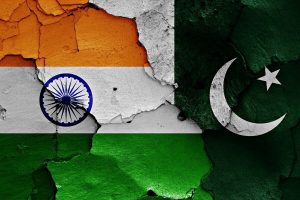
Why did the Pakistan Prime Minister Imran Khan last week said that the international community should be worried about the safety of nuclear weapons? Navodita, our Associate Editor, analyses the Nuke threat between India and Pakistan, exclusively for Different Truths.
Pakistan Prime Minister Imran Khan last week said the international community should be worried about the safety of nuclear weapons “in the control of the fascist, racist, Hindu supremacist Modi government”.
In a series of tweets, Khan said the “doctrine of hate and genocide” would continue to spread unless the international community intervened in the Kashmir matter.
In a series of tweets, Khan said the “doctrine of hate and genocide” would continue to spread unless the international community intervened in the Kashmir matter. Nine million Kashmiris were under siege in Jammu and Kashmir for the past two months, he added.
“And the threat also extends to Pakistan, the minorities in India and in fact the very fabric of Nehru and Gandhi’s India,” said the Pakistan Prime Minister. “One can simply Google to understand the link between the Nazi ideology and ethnic cleansing and genocide ideology of the Rashtriya Swayamsevak Sangh-Bharatiya Janata Party founding fathers.”
On Friday, Singh had said India had always maintained its “No First Use” (NFU) policy on nuclear weapons but added that “what happens in the future will depend on circumstances.”
Khan’s comments came hours after Defence Minister Rajnath Singh said any dialogue with Pakistan would be restricted to Pakistan-occupied Kashmir. On Friday, Singh had said India had always maintained its “No First Use” (NFU) policy on nuclear weapons but added that “what happens in the future will depend on circumstances.” Pakistan Foreign Minister Shah Mahmood Qureshi on Saturday said India’s suggestion that its nuclear policy might change was a “damning reminder” of the country’s “unbridled thirst for violence”.
Rajesh Rajagopalan, Professor, JNU, said that this is possibly a signal to Pakistan that it should not take India’s restraint for granted for all times to come…. Pakistan repeatedly raises this bogey of nuclear escalation every time it engages in some action in terms of sending terrorists across.
Singh’s statement has raised apprehensions on the likely revision of India’s NFU policy and nuclear doctrine. In this regard, Rajesh Rajagopalan, Professor, JNU, said that this is possibly a signal to Pakistan that it should not take India’s restraint for granted for all times to come. He goes on to add, “Pakistan repeatedly raises this bogey of nuclear escalation every time it engages in some action in terms of sending terrorists across. But that is a way of constraining India’s response, as a way of preventing India from responding militarily to those kinds of attacks. The idea is that if you raise the issue, if you bring in nuclear escalation as a threat, it will constrain India’s response. It is always a false expectation, a false argument, because there is no direct link between conventional escalation and nuclear escalation.”
Frankly, as far as the response of the rest of the world is concerned, we are already in a situation where arms control is crumbling: the US’s nuclear posture review is talking about limited nuclear war once again. The rest of the world will not care much about this change, except at the rhetoric level where there will be criticism of what is going on. So, the larger question is: what it will be for India in terms of investment in financial and technological capabilities to make a first use credible.
Amid tension with Pakistan, Rajnath Singh made the statement on ‘No First Use policy’ as he paid tribute to former Prime Minister Atal Behari Vajpayee, on his first death anniversary.
Amid tension with Pakistan, Rajnath Singh made the statement on ‘No First Use
policy’ as he paid tribute to former Prime Minister Atal Behari Vajpayee, on his first death anniversary.
Rajnath Singh tweeted, “Pokhran is the area which witnessed Atalji’s firm resolve to make India a nuclear power and yet remain firmly committed to the doctrine of ‘No First Use’. India has strictly adhered to this doctrine. What happens in future depends on the circumstances.”
The ruling BJP’s manifesto for 2014 election included a promise to ‘revise and update India’s nuclear doctrine’. But while campaigning for that election, Prime Minister had dismissed a question on scrapping the No First Use policy in an interview to news agency ANI.
The ruling BJP’s manifesto for 2014 election included a promise to ‘revise and update India’s nuclear doctrine’. But while campaigning for that election, Prime Minister had dismissed a question on scrapping the No First Use policy in an interview to news agency ANI. “No first use was a great initiative of Atal Behari Vajpayee – there is no compromise on that. We are very clear. No First Use is a clear reflection of our cultural inheritance,” he had said, in April 2014, on the verge of an election in which he stormed to power.
The Defence Minister’s statement has been read by many as a well-timed warning amid tension with Pakistan, which has targeted India over the government’s move to end special status to Jammu and Kashmir under Article 370. Especially since the Narendra Modi government, after winning a second term by a landslide, has shown it is ready to take radical decisions.
In November 2016, the then Defence Minister Manohar Parrikar – who died last year – had expressed reservations over India’s nuclear position.
This is not the first time in the last few years that BJP leaders have said it was time to amend India’s position. In November 2016, the then Defence Minister Manohar Parrikar – who died last year – had expressed reservations over India’s nuclear position. More recently, Lieutenant-General B.S. Nagpal, the former commander-in-chief of the Strategic Forces Command, is reported to have said that the No First Use policy was a ‘formula for disaster’.
Ties between India and Pakistan have hit rock bottom since the Pulwama attack in which 40 soldiers were killed by a suicide bomber of Pakistan-based Jaish-e-Mohammad. Days later, India sent fighter jets to Pakistan’s Balakot to bomb a terror training facility, which led to a dogfight between the two nations at the Line of Control.
New Delhi has repeatedly said its internal decisions are its own in which no country should interfere. Pakistan has called upon the UN Security Council to take it up.
Photo from the Internet

Navodita Pande teaches Mass Media and Communication and English to ICSE/ISC school in Assam. She also trains students in Yoga, gratitude and healing. She loves to paint, write and read as her pastimes. She lives in Assam with her daughter.

 By
By
 By
By
 By
By
 By
By