
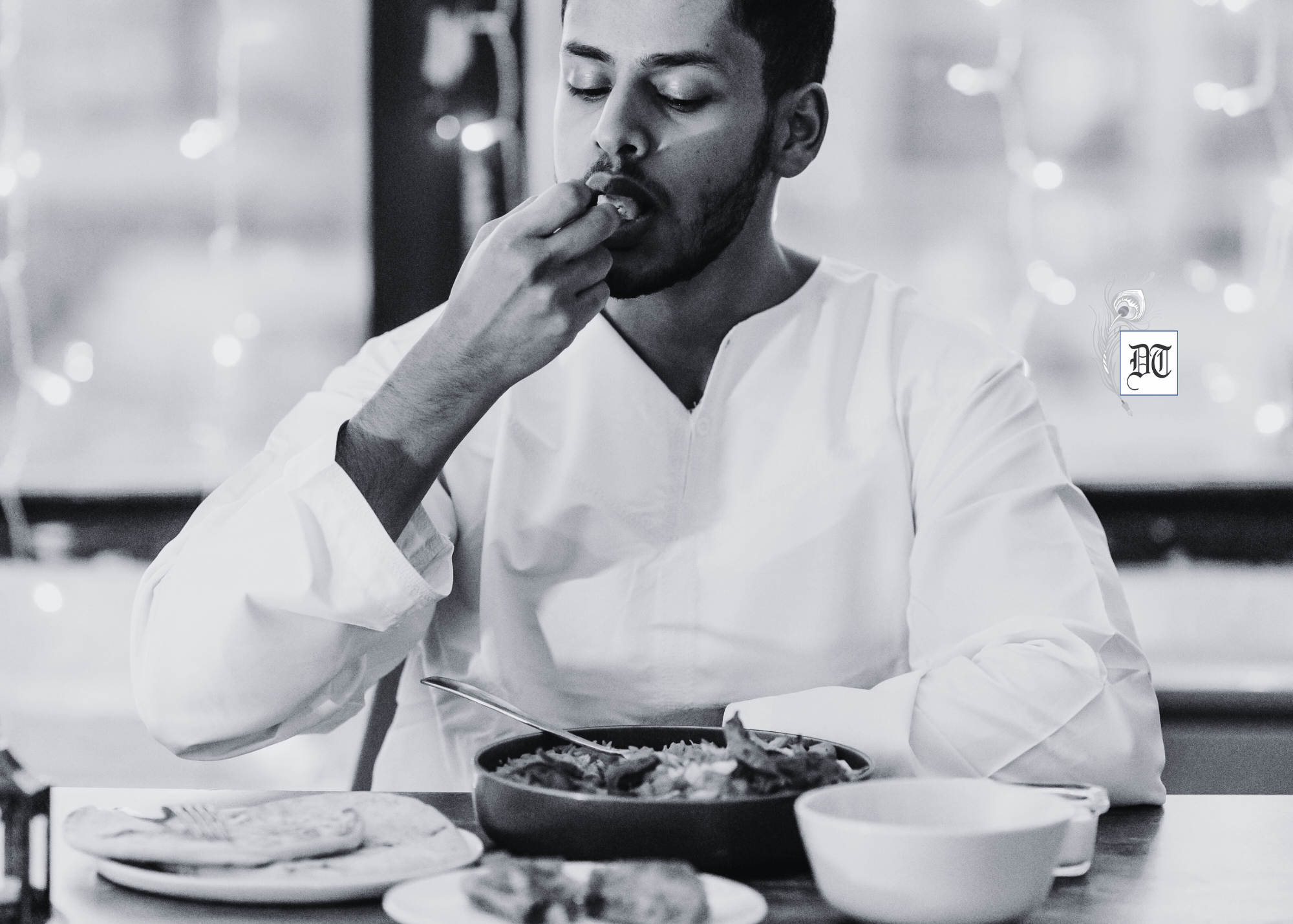

Canada-based Kavita, writing exclusively for Different Truths, celebrates love and Indian ways of eating by hand, embracing cultural pride despite a controversy in the US.
The fierce debate currently raging on the internet has been sparked by a comment made by a Republican in the US criticising the Democratic mayoral candidate of New York, who happens to be of Indian origin, as he was seen eating rice with his hands. Apparently, the comment by the Republican also mentioned that the “civilised people in America don’t eat like this” and told the mayoral candidate to go back to the Third World if he couldn’t adapt to Western customs. I believe members of the US Republicans’ family, also of Indian origin, have been seen eating the same rice, which happens to be biryani, with their hands! I will not try to discuss the implications of this either politically or racially.
The comment took me back to my memories of eating food by hand.
Rather than being offended, I was quite amused by the comment, since Westerners eat pizza, hamburgers, tacos, and even KFC chicken by hand!
I was born and raised in Bombay, India. Eating with my hands was how we ate our food at home, a practice learned in childhood and an integral part of our culture. Moreover, on weekends and holidays, we ate our lunch sitting cross-legged on a simple chatai. A chatai is an Indian mat made from natural materials such as reeds, palm leaves, or bamboo. Chatais are now available in all sorts of styles and fancy designs and made from polypropylene. They are used as an item for decorating the home. We also lazed on wide chatais spread on cool floors on sweltering summer afternoons.
My mother placed the utensils with rice, dal, vegetables, and fish in front of the chatai and served food to each of us. The food eaten with our hands was especially pleasurable. As a child, I was a messy eater, and often the rice mixed with dal would stray into the palm of my right hand, with which I ate. It was a bit of a struggle! Placing the food directly into our mouths without an intervening object added to the pleasure of eating Indian food. It was a sensory experience. There was also, I realise now, an aspect of mindfulness to eating with our hands. We didn’t rush through the food and savoured the flavours and aromas of the meal being eaten.
And eating a ripe mango! One didn’t care about the orange mustache that formed around the lips with a rivulet of juice dripping down! But, of course, one cannot do this sort of thing in company, and one must be sensitive to the occasion and how comfortable others feel in a dining situation.
Before we ate, my mother called out to us in Marathi, “haat dhooyoon gya, jevan tayar ahe,” which, translated, means “wash your hands, the food is ready.” We washed our hands before meals and, of course, after meals. So, there was a hygiene aspect to eating with our hands. She was very particular about handwashing.
The kitchen was at the far end of the house, so bringing the utensils in front of the chatai was a convenient way to portion out the food, instead of the children crowding around the kitchen and carrying the plates of food through the bedroom to the living room. My mother prepared the food once every morning and fresh rice in the evenings at exactly 8 PM, in time for dinner, which we ate promptly at 8:30. In the evenings, she would spend her time helping us to study.
My father was the only one who ate the rice with a spoon, sitting at the small dining table in the corner of the living room. He could not manage to eat the rice with his hands, though he did make some effort. He ate the chapati and the cooked vegetables with his hands. He used the chapati to scoop the vegetables into his mouth. Eating rice and dal or rice and curry using his hands posed a challenge for him. Having lived in England for a long time might have conditioned him to form these habits. We never made fun of his attempts.
Each person has their habits. There is no need to pass on a character or value judgement based on a person’s culture, using a Western or other yardstick, nor a discussion of what is civilised and what is not from another culture’s viewpoint. Every civilisation has its influence on how we eat our food, how we dress, our accents, and how we do any number of things that shape our behaviour and attitudes.
There was hardly any cutlery in my parents’ home, just a couple of forks and spoons in case of guests who preferred to eat with a fork and spoon. No knives, except the butter knife placed firmly in the butter dish. For the children, small teaspoons to eat half-boiled eggs for breakfast and select snacks if necessary. Breakfasts were eaten on the dining table since the glasses of milk needed a firm base to rest on. Small spoons were available to eat porridge and cornflakes, in my father’s case.
After the comment by the Republican, I had a lively discussion with my husband about eating food by hand. At his home, rice and curry were eaten by hand. He recalls that the only fork they had in the house was the fork his mother used to poke into an onion, which she dipped into the oil and swirled around the frying pan to fry the batter for the dosas each Sunday. We ate the dosas (savoury Indian pancakes) with our hands and dipped them into the coconut chutney she made as an accompaniment. A couple of spoons and forks were available to visitors who declared they did not eat by hand, though they were Indian! It was a matter of comfort. “Each to their own” was a favourite proverb of my mother’s.
Eating with one’s hands is second nature to many Indians, me included. I don’t even think about it. It is an ancient custom, and if you do some research about this practice, you will find even doctors detailing its health benefits. The other benefits of this custom are also undeniable, as we tend not to rush through food, and the control of portion size is a factor. In India, eating with hands also has a spiritual benefit, according to the Vedas. Each finger is said to communicate a specific sensory feeling.
The world today is already divided along so many lines. Why add the criticism of eating rice with your hands to it? In many parts of India, eating food on banana leaves is normal. When I was in England, I ate fish and chips on a newspaper, dipped the fish into the tartar sauce with my hands, and relished it. In India, we dip everything into a sauce, a curry, or the thing I most enjoyed was dipping “Glucose Biscuits” into my tea till it dissolved into a soggy mess. Then, I lifted the teacup to my lips and slurped the remains. That was the only time I slurped up something, and that too when my mother wasn’t looking. I was taught that slurping is rude.
But in some parts of India, people drink a certain type of tamarind curry by pouring it into the palms of their hands and drinking it. If that’s the way their tradition is, why should we stand in judgement of them? I say live and let live, and the world will be a more harmonious place.
When we put too much curry on our rice, my father called it “curry-drowned rice.” Well, that’s how I enjoyed it, and it was best eaten with my hands. I have lost the art of sitting cross-legged, and I don’t have a chatai in my home, but I can still eat rice with my hands!
Picture design by Anumita Roy

In a career spanning over four decades, Kavita Ezekiel Mendonca has taught English in Indian colleges, AP English in an International School in India, and French and Spanish in private schools in Canada. Her poems are featured in various journals and anthologies, including the Journal of Indian Literature published by the Sahitya Akademi and the Yearbook of Indian Poetry in English. Kavita has authored two collections of poetry.



 By
By
 By
By
 By
By
 By
By
You win your case hands down: anyway, at the end of the day, how a person eats has nothing to do with civilization!