
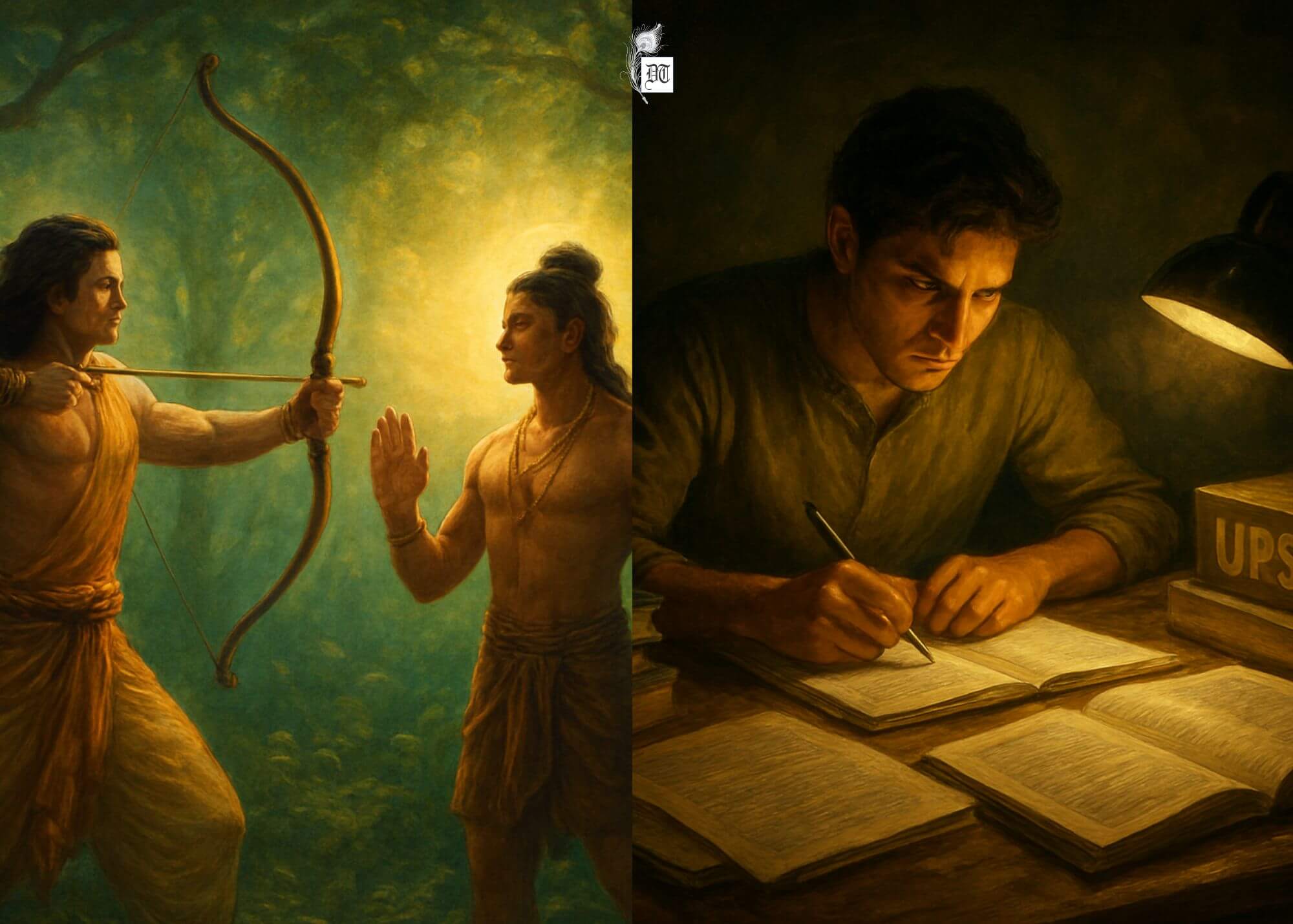
Sonia explores the intersection of ancient epics and modern meritocracy in this piercing critique, exclusively for DifferentTruths.com.
AI Summary
- Deconstructing Merit: The piece challenges the “merit list” illusion, using the Mahabharat to show how greatness is often manufactured and protected rather than purely earned.
- Arjun, Karna, and Eklavya: It contrasts Arjun’s curated success with Karna’s structural exclusion and Eklavya’s outright disqualification by the gatekeepers of hierarchy.
- Modern Parallel: Connects ancient archery to India’s coaching industry (Kota/UPSC), highlighting how systemic advantages still dictate who is allowed to succeed.
The modern world is obsessed with the “topper”. From the frenzy of the IIT-JEE results to the billboards of coaching institutes lining the highways of Kota, or the narrow lanes of Old Rajinder Nagar and Mukherjee Nagar for the UPSC exams, we operate under a comforting illusion: that merit is a pure, glowing essence that slowly but naturally and steadily rises to the top. We like to believe that our competitive exams and “merit lists” are honest ledgers of effort.
However, this contemporary anxiety over who is “the best” is an old ghost. It finds its most piercing critique not in a sociology textbook but in the layered verses of the Mahabharat.
The Mahabharat does not merely tell stories—it dissects them. It constructs heroes, only to quietly place fissures beneath their feet. Among its most enduring questions is one that appears deceptively straightforward: who was the sarva shresth dhanurdhar—the greatest archer? Tradition answers without hesitation: Arjun. But the epic itself, if read without the comfort of inherited conclusions, resists that finality. In the Mahabharat, greatness is not just demonstrated; it is distributed, protected, interrupted—and sometimes denied.
Before we name the greatest, we must ask what greatness is made of. Is it precision under pressure, mastery of weapons, or victory in decisive battle? Or is it the ability to rise without support, to carve skill out of constraint? The epic refuses to standardise these criteria. In doing so, it reveals something more unsettling: greatness is never evaluated in a vacuum. It is always shaped by the architecture around it.
The Curated Ideal: Arjun
Arjun is not merely a great archer; he is the ideal outcome of a perfectly aligned system. Under Dronacharya, his training is not just rigorous—it is curated. The lesson of the bird’s eye is less about vision than about conditioning: seeing only the target and nothing else. Arjun is taught not only how to shoot but also how to eliminate distraction itself. He is then armed with the Gandeev and granted access to celestial weapons that elevate him beyond ordinary warfare. On the battlefield, he is guided by Krishna, whose counsel is not merely strategic but existential. Elite instruction, superior resources, and unparalleled mentorship converge in him. Arjun’s greatness is real, but it is also reinforced at every stage. He is not simply the best archer; he is the most supported one.
The Challenger: Karna
If Arjun is the excellence that the system produces, Karna is the excellence that the system cannot comfortably contain. From his first appearance, Karna destabilises the hierarchy. He matches Arjun not only in promise but also in performance; yet his challenge is dismissed not for lack of skill but for lack of social legitimacy. In that moment, the epic reveals a fault line: Karna is not excluded from excellence; he is excluded from recognition. His life becomes a relentless negotiation with that exclusion. He seeks knowledge from Rishi Parashuram but must conceal his identity to access it. He masters advanced weaponry, only to be cursed at the moment of truth. On the battlefield, Karna does not fall short of Arjun in skill; he falls short in fortune and structural support. The question that lingers is not whether he was equal, but whether equality was ever truly available to him.
The Disqualified Competitor: Eklavya
If Karna challenges the system, Eklavya exposes it. Denied instruction by Dronacharya, Eklavya does not protest or seek entry. He bypasses the system entirely. In the forest, without institutional validation, he trains himself to a level of precision that rivals—and perhaps exceeds—the royal students. His feat of silencing a dog without killing it is not merely technical; it is philosophical, a demonstration of control over force itself. Yet his story does not culminate in recognition. When Drona demands his thumb as guru dakshina, Eklavya complies. The moment is often framed as devotion, but read differently, it is the removal of a competitor who had no sanctioned right to exist. Eklavya is not defeated; he is disqualified.
The Architect of Hierarchy
At the centre of these narratives stands Dronacharya, not merely as a teacher but as a custodian of hierarchy. His vow to make Arjun the greatest is not aspirational; it is operational. He channels resources, shapes opportunities, and, when necessary, eliminates threats to that outcome. In doing so, he does not merely train a great archer; he constructs one. Greatness, in the Mahabharata, is not entirely organic.
It is curated, protected, and, at times, enforced.
Modern Metaphors
This tension does not belong to the past. It persists, quietly, in our modern structures. We speak of “merit” as though it exists in a vacuum, but the Mahabharata suggests otherwise. Consider the contemporary Indian classroom. The student with access to premium private coaching, a quiet study room, and a network of mentors resembles Arjun. Their talent is real, but it is polished by a “modern Dronacharya” who ensures their focus never wavers from the need to survive.
In today’s context, that “modern Dronacharya” often takes institutional form. The student walking into the IIT-JEE or the UPSC Civil Services Examination after years of structured preparation—often through institutes in Kota—is not merely studying but entering a curated ecosystem. India’s coaching industry is estimated at over Rs 50,000 crore, with elite programmes costing Rs 2–5 lakh annually. In hubs like Kota, Old Rajinder Nagar, and Mukerjee Nagar, preparation is immersive—daily testing, rank analytics, peer competition, and continuous mentorship. A majority of IIT entrants, and a large share of successful UPSC candidates, have had some form of structured guidance.
The promise of universal education and the Right to Education (RTE) are our modern attempts to answer the tragedy of Eklavya. They represent the radical idea that a thumb should never be the price of entry.
Yet, even as we open the doors of the schoolhouse, the structure outside continues to matter.
The last decade has introduced a quiet disruption. Institutes like Khan Sir’s online coaching, along with India’s growing ecosystem of free educators, have begun to erode the monopoly of expensive coaching. The mobile internet revolution has brought high-quality lectures and problem-solving frameworks to students far beyond traditional hubs, often at affordable costs.
But access to content is not the same as access to the ecosystem.
So, even as we open the doors of education, the ghost of Karna lingers. We see him as a brilliant student who masters the curriculum but lacks the “cultural shorthand”—the English fluency or the social connections that the elite use to recognise their own. We see him as an aspirant who spends Rs 20,000 on a distance-learning course only to find that the degree is cursed the moment he applies for a job.
We see Eklavya too—not denied entry, but studying in conditions the system does not measure: shared spaces, financial pressure, unstable infrastructure. The removal of the thumb has become subtler; it is no longer demanded, it is embedded.
We continue to speak of merit as though it were discovered, but the epic shows us it is often manufactured, curated, and defended.
The Unsettling Truth
The genius of the Mahabharata lies in its refusal to let Arjun’s victory feel complete. It leaves behind a quiet discomfort, an awareness that something does not entirely align.
Perhaps the most honest conclusion is not a name, but a recognition. Arjun was the greatest archer the world could celebrate. Karna was the greatest, but he could not fully accept it. Eklavya was the greatest, but he chose not to remember.
Ultimately, we must realise that any system that must silence one, burden another, and elevate a third to define greatness is not measuring excellence—it is managing it. The question of the sarvashreth dhanurdhar was never a debate about archery; it was a decree of power. It was never about who could hit the target but who was allowed to hold the bow. And in the modern race for merit, unfortunately, it still is.
And until that changes, merit will continue to resemble truth—while quietly remaining a function of design. Perhaps, as in the epic, history will remember the victor—but not the conditions that made victory inevitable.
Picture design by Anumita Roy

A lifelong student of literature, Sonia Roy finds joy in ideas, words, and human stories. Balancing intellectual curiosity with family life, she also serves as a grassroots leader with the Singapore government, working to strengthen social bonds and foster inclusivity. Her journey blends reflection with engagement—rooted in empathy and civic purpose. She believes that both stories and societies are crafted through shared connections, each encounter weaving meaning into the rhythm of real lives.


 By
By
 By
By
 By
By
 By
By