
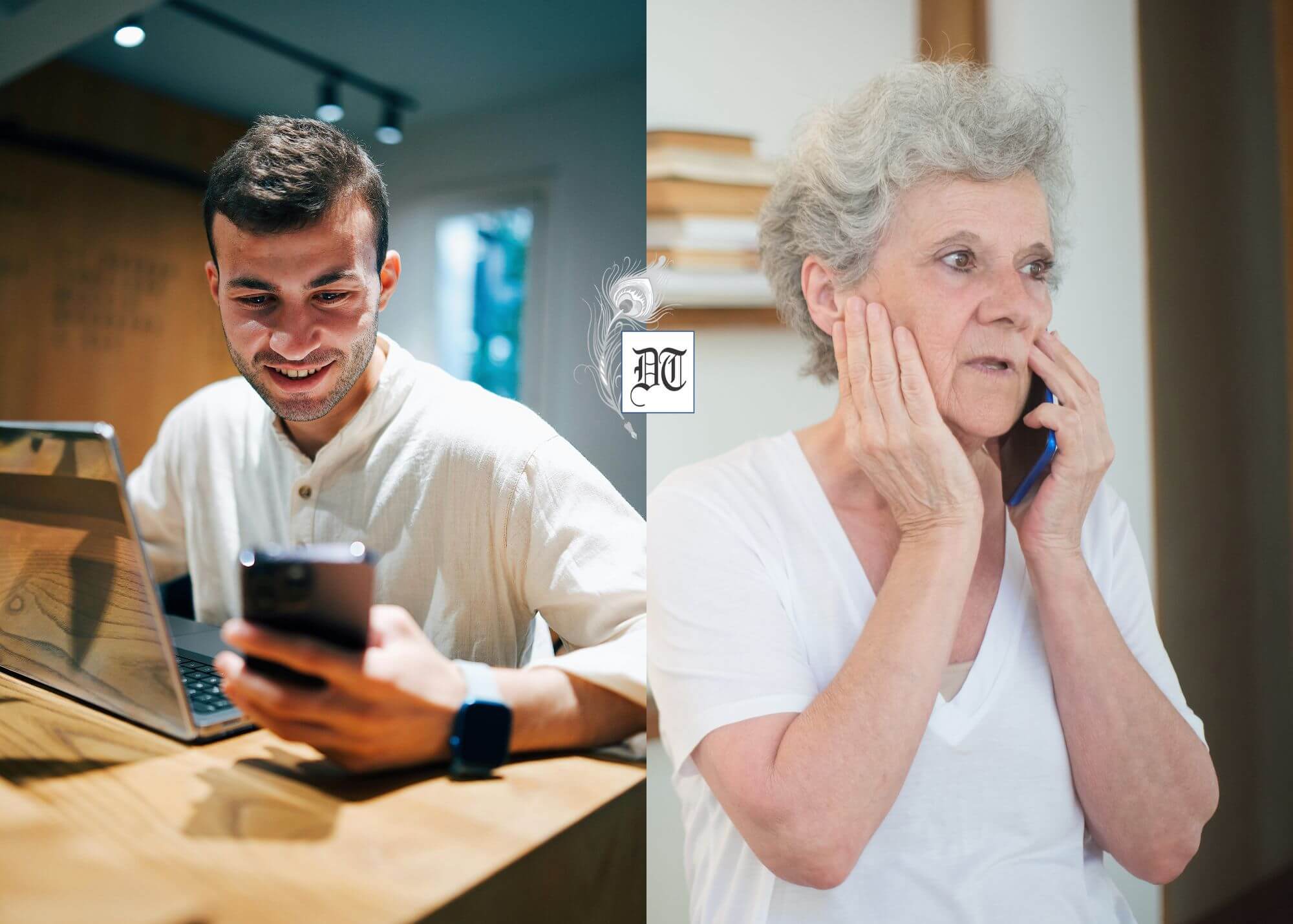
Candice’s compelling piece explores the evolving nature of human connection, ageing, and the shifting bonds that redefine relationships in our later years, exclusively for DifferentTruths.com.
Sitting in a recent psychotherapy conference, I overheard a colleague talking about how challenging it was to visit her elderly father in an assisted living home. Her reason surprised me. It wasn’t just the grief of seeing her elderly father becoming more infirm or declining cognitively. Her grief was in being replaced. [i] Feeling like she was a stranger to her father, in comparison with those he saw daily. [ii]
She’s not alone. Many adult children experience this phenomenon. The elderly parent connects more tangibly with caretakers and people who are in their immediate present on a more regular basis than connecting with their children, who are often working 60-hour weeks and have less time and are not always logistically close by.[iii] Sometimes this is the result of dementia and being more familiar with those you see frequently than infrequently,[iv] but it’s also commonplace for people without dementia symptoms.
It’s a little-known phenomenon that begs the question: Is there something adaptive in this forming of close attachments at a tangible level that flies in the face of our obsession with connecting from great distances via technology?[v] Furthermore, does technology sometimes replace human connections and if so, to what extent? This matters because it’s at the core of what we as humans value most.[vi] Our interconnectedness is being threatened by a myriad of subtle transformations throughout our lifetime.
Let’s think of this in a linear sense. As children, we are often put among many other children to socialise. We get childhood illnesses, we make best friends, we get into fights, and we learn through those visceral, direct experiences how to become part of society. Whether you believe in being someone able to ‘fit in’ or the value of the ‘outsider’, there is a necessity to know how to navigate through society, both in terms of working, and finding a mate and a ‘tribe’ to belong to. The outsider may be an exception and has always been an exception, but for a society to work, the individual must learn to become part of a group in some form or fashion.
Social commentators have pointed to our increasing division as humans embrace technology[vii] and lament how many children, formerly playing in the streets with friends, are now isolated behind technology. Without making this about technology, it’s worthwhile pointing to its advantages and disadvantages, and concluding that an increase in spectrum disorder may be connected to and/or another branch of our increasing dysconnectivity, whereby people on the Spectrum report feeling more challenged socially than those who are not on the spectrum.
Ultimately, then, we recognise the necessity of socialisation and, regardless of the advent of technology, the importance of human connection, rather than relying solely on a television or computer for company. Every single study looking at cognitive decline points to isolation and lack of ‘community’ as a major predictor and/or cause of cognitive decline and/or eventual dementia. We are social beings; it is not in our best interest to be isolated. Those outliers will always exist, and possibly thrive, but en masse, humans work well in groups, even as the individual is equally important.
With higher numbers of populations ageing than ever before, when they get beyond their ‘early old’ years (65-75) to the ‘mid-old’ and ‘very-old’ years, even though they still want to be independent, there are some rude facts that preclude this for the majority. For every 95-year-old who still cycles, hikes and drives a car, more are disabled in some way. It is a sad truism that this could be the result of our living longer, but not always living ‘better.’ Infirmity is on the increase for two reasons: we’re living longer, and we’re not physically active. Being overweight, having a poor diet, those with small pensions unable to afford enough to live well, and being socially isolated, all contribute to a poorer outcome as people age into their 80s and beyond.[viii] With so many living to 90+, this has become a social problem, in that we don’t have the affordable and plentiful social infrastructure to support those needing more help.
For many, going into assisted living, or communities for older people, feels like going into a dreaded ‘home’ and being forsaken by family and resigned to waiting to die.[ix] Depression and anxiety rates increase in line with this reality. If you feel this way from 65 to 95 that’s a long time to feel you are ignored and seen as irrelevant by a youth-obsessed culture. We don’t do anything to improve this, because it costs a lot of money, our populations are ageing out and putting a huge strain on social services, and frankly, it’s human nature to live in the moment and not imagine it will ever happen to us. What is a guarantee is, if we live that long, it will happen to us.
Adult children trying to persuade their elderly parents of the necessity of thinking of what will happen ‘down the road’ is a hard conversation to have, because nobody wants to contemplate it. But if the reality is that people become infirm and possibly cannot drive or do for themselves, then some kind of care becomes inevitable.[x] Being able to afford in-home care is extortionate. Many parents cannot live with adult children due to not wishing to, or children not being financially able to give up working or relocating. All this brings me to my point. As adults age, they form new attachments. Because the reality is, even if the rest of the world thinks of them as redundant, they are not; they are still making tracks. Those tracks are not often examined, but they should be, because they speak about our evolution throughout our lives.
When elderly people have carers, they often become far more attached to those people whom they see daily, than the increasingly distant relatives who call. It’s inevitable and obvious when you think about it, but despite that, it’s not a subject often examined. What it does do is affect the relationship between the relative and the older person. It is frighteningly easy to develop distance even in the most tried-and-true relationships, and the reality is often a form of pre-grief experienced before they die.[xi]
Speaking with many patients over the years, I often heard them caught between feeling guilty for not being in better touch with elderly parents, set against the increasing demands of work, which the elderly parent may recall in their own life, but not necessarily understand just how under-the-gun their adult-children are during those latter work years, where they are coming up against ageism, increasing pressure to save for their retirement and the higher demands of a more senior position in a career. Adult children also may be funding their young adult children as they flounder in a reduced and highly competitive, and expensive world.[xii] Balancing love and duty toward an elderly parent may result in an imperfect outcome.[xiii] The timing has shifted. It used to be that average people lived until 75, retired at 60/65, with their children being around 50 when they died. Nowadays, parents have children older and live longer, and it is not uncommon to see four generations.[xiv] Equally, with fewer children being born, adult children may not have children of their own, or the elderly may not have children. Who takes care of a childless old person? [xv]
This is something I have often contemplated, being childless myself.[xvi] Our impetus to ensure we have enough money to retire ‘safely’ is acutely felt. How to balance that against ageing parents who may live in different countries, as we increasingly become globalised, seems insurmountable. Their attachment to what is ‘local’ to them is not rejection of us, but a lived reality for them. For all our discussion of technology increasingly being able to replace human connections, we turn to other humans when we find ourselves alone.[xvii] Whether it’s talking to a stranger in a sandwich shop or growing close to a neighbour or caregiver, it makes sense when you consider what makes humans human.
Even those on the Spectrum who may struggle with human connection and reading the subtle clues of human interaction, or simply having another way of connecting, still seek a form of connectivity, be it online with friends in groups, or some other way. When we grow away from our families of origin, we don’t do it to reject them, but to save ourselves and to survive.[xviii] It is our survival mechanism to reinvent our lives, out of grief, tragedy, loneliness, or simply because we’re unwilling to give up and let old age take us into some labyrinth of solitude.[xix] It is the deepest impetus of human nature to reach out, and even those who believe themselves inured to that urge may be surprised at finding themselves doing it.
I often see older people connect with the most unlikely of companions, and in a way, I see this as the great equaliser. A white woman who lives in a predominantly white suburb may become best friends with a woman from Jamaica. A lesbian may hang out with a heterosexual widowed man. These blended and unlikely connections can be invaluable, and we should consider them more, as the touchstones they can become when we least expect it. Our latter years are not insignificant. We shouldn’t relegate what we are interested in to our first 50 years, and ignore anything that comes after that, especially as many of us will live into our 90s, which means potentially 40+ years of being socially ignored and deemed irrelevant.[xx] It is time, if it’s not happening already (and I believe it is), to expand the great equaliser to considering the value and lives of everyone, not just youth. We may lament that we do not have generational families like we used to, and maybe our society will never again be set up to accommodate that. But we make our own families. When we marry a previous stranger, we create a family that expands from our bloodline. It is not all about being a relative; it is about meeting those unexpected people who come to matter. At all walks of life. And in this, we learn the necessity of connection,[xxi] and the limitations of staying ‘in family’ as well as appreciating those families who love their parents or grandparents, how connections do change, and people may grow closer to others, who live more immediately. We are immediacy-based creatures[xxii]. We know this from our love affair with immediacy online. But it goes further. We want to touch a hand, to look at someone off-screen, to be in the presence of another beating heart.[xxiii] We are human. Not technology and technology will never replace that immediacy we crave.
[i] https://www.ncbi.nlm.nih.gov/books/NBK396398/
[ii] https://www.homewatchcaregivers.com/blog/caregivers/when-your-loved-one-trusts-a-stranger-over-you/
[iii] https://www.forbes.com/sites/bryanrobinson/2021/03/08/the-invisible-scars-adult-children-of-workaholics-bring-to-their-careers/
[iv] https://thedawnmethod.com/dementia-and-not-recognizing-spouse-or-family/
[v] https://hbr.org/2003/09/technology-and-human-vulnerability
[vi] https://news.mit.edu/2020/hunger-social-cravings-neuroscience-1123
[vii] https://thebottomline.as.ucsb.edu/2012/01/technology-is-destroying-the-quality-of-human-interaction
[viii] https://www.uchealth.org/today/aging-parents-what-to-do-when-parents-need-more-care-than-you-can-provide/
[ix] https://pmc.ncbi.nlm.nih.gov/articles/PMC8872093/
[x] https://www.uchealth.org/today/advice-for-aging-in-place-safely-stay-in-your-home-as-long-as-possible/
[xi] https://archive.nytimes.com/newoldage.blogs.nytimes.com/2009/09/04/being-there-and-far-away/
[xii] https://www.michiganmedicine.org/health-lab/sandwich-generation-study-shows-challenges-caring-both-kids-and-aging-parents
[xiii] https://www.agingcare.com/articles/caring-for-aging-parents-who-didn-t-care-for-you-127206.htm
[xiv] https://www.pewresearch.org/short-reads/2022/04/08/more-than-half-of-americans-in-their-40s-are-sandwiched-between-an-aging-parent-and-their-own-children/
[xv] https://www.seniorliving.org/health/aging/no-family/
[xvi] https://studyfinds.org/americans-fear-nursing-home/
[xvii] https://inside.salk.edu/winter-2022/human-connection-how-social-interaction-and-isolation-influence-our-physical-and-mental-health/
[xviii] https://pmc.ncbi.nlm.nih.gov/articles/PMC5097795/
[xix] https://pmc.ncbi.nlm.nih.gov/articles/PMC7887723/
[xx] https://www.ncoa.org/article/how-intergenerational-connections-can-ease-loneliness-in-older-adults/
[xxi] https://www.psychologytoday.com/us/blog/unapparent/202407/who-will-take-care-of-you-when-youre-old
[xxii] https://webmindset.net/immediacy/
[xxiii] https://www.aarp.org/caregiving/basics/solo-agers/
Picture design by Anumita Roy

Candice Louisa Daquin is Senior Editor with Indie Blu(e) Publishing. Consultant Editor for Raw Earth Ink & Queer Ink (India). Poetry Editor with Tint Journal, Writers Resist, Life & Legends & Parcham Literary. Reader for Lit Fox Books. Co-Judge of The Northwind Writing Award and The Silver River Poetry Prize.

 By
By
 By
By
 By
By
 By
By