
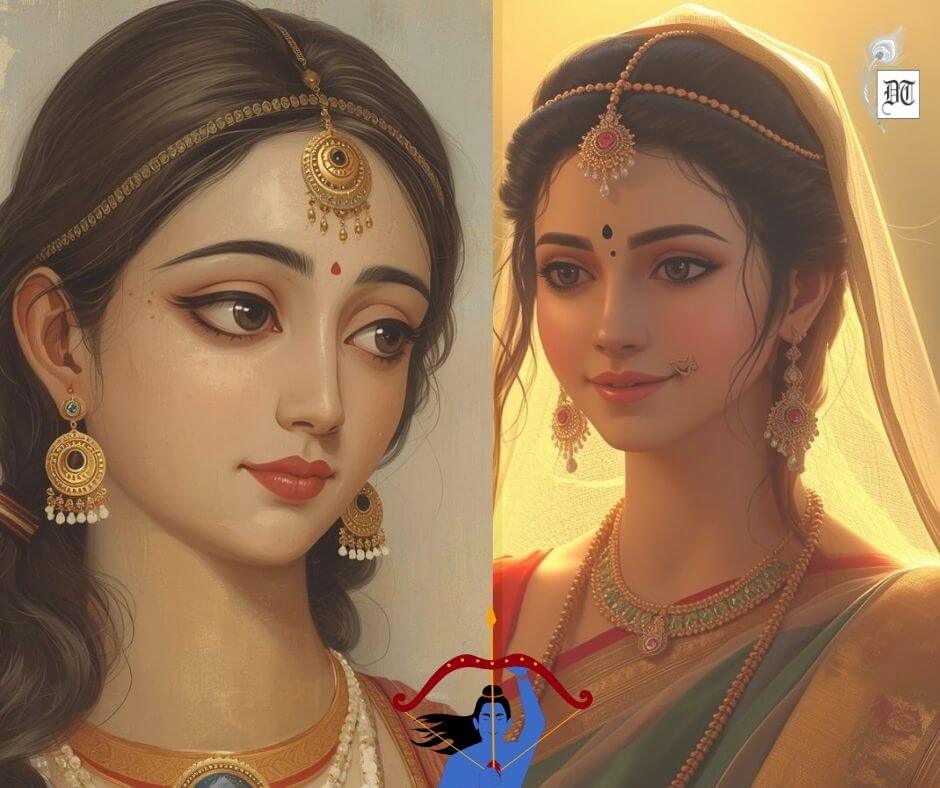
Sohini exposes the “erasure economy” of Shanta, Dasharatha’s firstborn, for Different Truths. A daughter systematically deleted from the Ramayana, sacrificed into silent exile to protect the patriarchal legacy’s sanctity.
Editor’s Note: The Erasure Economy of Mythology
The Ramayana functions as a forensic catalogue of male righteousness, but it operates on a strict erasure economy. For the “ideal man” (Rama) to exist as the undisputed axis of dharma, the true firstborn must be rendered invisible. Shanta’s existence is an explosive fact; she is not a supporting character, but a structural glitch that patriarchy “fixed” through textual displacement.
While Sita’s suffering is celebrated because it reinforces male heroism, Shanta’s sovereign competence offers no such reward. She solved a kingdom-wide drought through diplomacy and strategic marriage, yet she was rewarded with a “quiet deletion.” In the world of epic storytelling, a woman who fails is a lesson, but a woman who succeeds without a man is a threat.
***
The Ramayana is a civilisational epic obsessed with lineage, obedience, and the spectacle of male virtue. It catalogues the grief of fathers, the righteousness of sons, the exile of princes, and the trial of wives with near-forensic devotion. Yet one figure—quietly foundational, deeply consequential—vanishes almost completely from the canonical imagination: Shanta, the eldest child of King Dasharatha.
She is not merely forgotten. She is systematically erased.
Shanta, elder sister to Rama, Lakshmana, Bharata, and Shatrughna, is mentioned fleetingly in Valmiki’s Ramayana and more clearly in later Puranic and regional retellings. Her existence disrupts the epic’s patriarchal architecture. An eldest daughter destabilises the carefully curated masculine genealogy of Ayodhya. And so, like many women in epics who do not conveniently serve the moral education of men, Shanta is quietly removed from the frame.
The Inconvenient Firstborn
Shanta was born to Dasharatha and Kaushalya before Rama. This single fact is explosive.
The Ramayana is deeply invested in birth order as destiny. Rama is the eldest son, the inheritor, the axis around which dharma rotates. But Shanta predates him. She is the true firstborn of Ayodhya.
And therein lies the problem.
A firstborn daughter challenges a patriarchal cosmology where inheritance, legitimacy, and moral authority flow exclusively through sons. In ancient monarchic cultures, the firstborn establishes continuity. If that firstborn is female, the system falters. Rather than confront this, the epic relocates her—literally and textually.
Shanta is adopted by King Romapada of Anga, Dasharatha’s friend. This “adoption” is framed in a benign, even affectionate manner. But it serves a crucial ideological purpose: it removes the eldest child from the line of succession, allowing the epic to present Rama as the uncontested first.
This is not a narrative accident. It is narrative engineering.
Exile Without a Forest
The Ramayana is full of exile, but Shanta’s exile is unique. Rama’s exile is dramatic, public, and sanctified by moral theatre. Shanta’s is silent, domestic, and final.
She is exiled not to a forest, but to irrelevance.
Unlike Rama, she does not return. Unlike Sita, she is not tested. Unlike Kaikeyi, she is not vilified. She is simply edited out. Her displacement happens early enough for the epic to forget her entirely.
Patriarchy prefers its women either glorified or demonised. The woman who simply exists—older, competent, unnecessary to male growth—is the most dangerous of all.
The Woman Who Solved a Kingdom’s Crisis
Ironically, when Shanta reappears briefly in the narrative, it is not as a daughter or sister, but as a political problem-solver.
Anga suffers a devastating drought. Crops fail. The land withers. The king seeks counsel, and the solution that emerges is deeply symbolic: the kingdom requires a brahmachari, a pure ascetic, to perform a rain-bringing ritual.
Enter Rishyasringa, a sage raised in absolute isolation from women.
It is Shanta who is tasked with the impossible mission of bringing him to Anga. Through intelligence, persuasion, and emotional nuance, she introduces Rishyasringa to civilisation. He performs the ritual. Rain falls. The kingdom is saved.
Let us pause.
Shanta is a woman who:
- Restores ecological balance
- Navigates diplomacy between kingdoms
- Transforms an ascetic worldview
- Is rewarded with marriage, not punishment
She is effective, strategic, and successful.
And therefore, she must disappear again.
Competence is More Threatening Than Transgression
Sita is revered because she suffers. Kaikeyi is condemned because she schemes. Shanta does neither. She succeeds.
Patriarchal epics can accommodate female pain and female villainy. What they cannot accommodate is female competence without male supervision.
Shanta’s intelligence solves a crisis without invoking Rama, Vishwamitra, or any male saviour. She does not require divine intervention. She does not need to be tested. She does not even need to be redeemed.
And so, she is excised.
The Sister Who Did Not Wait
One of the most revealing contrasts in the Ramayana is between Shanta and Sita.
Sita waits:
- She waits in the forest.
- She waits in captivity.
- She waits for rescue.
- She waits for validation.
Shanta does not wait.
She moves. She negotiates. She acts.
This is deeply unsettling in a narrative that constructs ideal womanhood as patient endurance. Sita becomes the moral centre because her suffering reinforces male heroism. Shanta’s agency offers no such reinforcement.
There is no scene where Rama rescues Shanta.
No moment where Lakshmana defends her honour.
No battlefield where Bharata renounces power for her sake.
Her story refuses to revolve around men.
Erasing the Elder Sister to Elevate the Son
To make Rama the embodiment of ideal kingship, the epic requires a clean genealogical slate. An elder sister complicates that symmetry.
Imagine if Shanta had remained in Ayodhya:
- As Dasharatha’s firstborn
- As Kaushalya’s eldest child
- As Rama’s senior
Every gesture of Rama’s obedience would be reframed—not as filial sacrifice, but as negotiation with an elder sister’s precedence.
The Ramayana cannot afford that ambiguity.
So, Shanta is written out early, efficiently, and almost politely.
From Textual Silence to Cultural Amnesia
What is most telling is not just Shanta’s marginalisation in Valmiki’s text, but her near-total absence in popular retellings.
- She does not feature in Ramleela performances
- She is absent from Amar Chitra Katha
- She is missing from television adaptations
- She is invisible in devotional discourse
This is cultural consensus at work. Patriarchy does not merely silence—it ensures silence is inherited.
Shanta’s story survives only in footnotes, commentaries, and regional tellings that refuse total erasure.
A Pattern, Not an Exception
Shanta is not alone. She belongs to a lineage of women erased because they disrupt linear patriarchy:
- Urmila, whose emotional labour enables Lakshmana’s heroism
- Mandavi and Shrutakirti, wives without trials and therefore without narratives
- Renuka, decapitated for transgression
- Ahalya was turned to stone for male betrayal
The difference is that Shanta does not even get punished.
She gets deleted.
Why Shanta Matters Now
In contemporary India, Shanta’s erasure feels chillingly familiar.
She is the daughter sent away so the son can shine.
The woman whose competence is acknowledged privately and erased publicly.
The elder sister who sacrifices visibility for family harmony.
She is every woman who made things work behind the scenes and was told, later, that she was never central.
To remember Shanta is to challenge the moral economy of the Ramayana itself. It is to ask whether dharma can exist without acknowledging the women it marginalises to appear coherent.
Let Shanta Speak
Perhaps Shanta does not speak in the epic because silence was imposed on her. Or perhaps she does not speak because she already acted—and action was her language.
In a tradition obsessed with male renunciation and female endurance, Shanta represents a third possibility: female agency without spectacle.
And that, more than anything else, is why patriarchy obliterated her.
Competitive Feminist Mythology: Shanta and the Global Sisterhood of Erasure
Shanta’s obliteration is not an anomaly of the Ramayana; it is a structural feature of epic storytelling across cultures. Patriarchal mythologies, regardless of geography, exhibit a shared instinct: women who complicate male lineage are removed, minimised, or mythologised into irrelevance.
Antigone: The Sister Who Refused to Be Decorative
In Greek mythology, Antigone—like Shanta—is a sister whose moral authority threatens masculine sovereignty. She challenges King Creon not through seduction or hysteria, but through ethical clarity. Her crime is not rebellion, but conviction. And for that, she must die.
Unlike Shanta, Antigone is punished overtly. Greek patriarchy allows women to speak—briefly—before silencing them spectacularly. Indian patriarchy prefers a quieter erasure. Shanta does not get a tragic end; she gets no ending at all.
Both are warnings: a woman who asserts moral precedence over kingship cannot be allowed continuity.
Medea vs Shanta: The Woman Who Acts Is Either a Monster or a Ghost
Medea is remembered because she transgresses violently. She kills. She avenges. She terrifies. Patriarchy preserves her as a cautionary tale.
Shanta, on the other hand, acts successfully and benevolently. She saves a kingdom, brings rain, restores order—without bloodshed or chaos. And so, she cannot even be demonised.
The choice is telling:
- A woman who disrupts violently is archetypally a monster.
- A woman who disrupts competently is erased entirely.
Shanta is what Medea would have been had she behaved “properly”—and that is precisely why she disappears.
Picture design by Anumita Roy

Sohini Roychowdhury is a renowned Bharatanatyam dancer, choreographer, artistic director, speaker, social activist, and professor of Natyashastra. She founded Sohinimoksha World Dance & Communications in Madrid/Berlin/Kolkata/New York. A visiting professor of dance at 17 universities worldwide, she won several awards, including the “Mahatma Gandhi Pravasi Samman” by The House of Lords, the Priyadarshini Award for Outstanding Achievement in Arts, and the Governor’s Commendation for Distinguished World Artiste. She has also authored several books, including ‘Dancing with the Gods’.


 By
By
 By
By
 By
By
“…narrative accident” versus “narrative engineering” elegant theorisation by a distinguished spirit!
Thank you so much for enlightening this ignoramus, who admits to being overwhelmed by this scholarly approach relevant to all historical Indians, irrespective of their belief system. Our mother whispered the ‘Ram-Sita’ in our ears, lying on charpai cots on the roof on hot summer nights, a pedestal fan whirring, moquito nets ready to be lowered in case of a power breakdown. And our Ma’asee had sent us chocolates in a tin , the lid of which was painted with Lord Ram and Lady Sita jee. One-mum never went as far as the first-born. Neither does A. K. Narayan in his English adaptation which, to thank my mother, I nudged my children to read.
This is a brilliantly enlightening narrative about silencing/deleting women from the epics that seek primarily to interpellate the reader to the patriarchal ideologies of superiority of men to women. Mythologies have a far deeper impact on the human mind than the real stories. In this sense, the complicity of mythology and persistent patriarchy in erasing/deleting/vilifying women who don’t conform to the patriarchy-sanctified image of an ideal womanhood is quite evident. Thanks for this beautiful essay with its transcultural sweep in nailing this complicity.