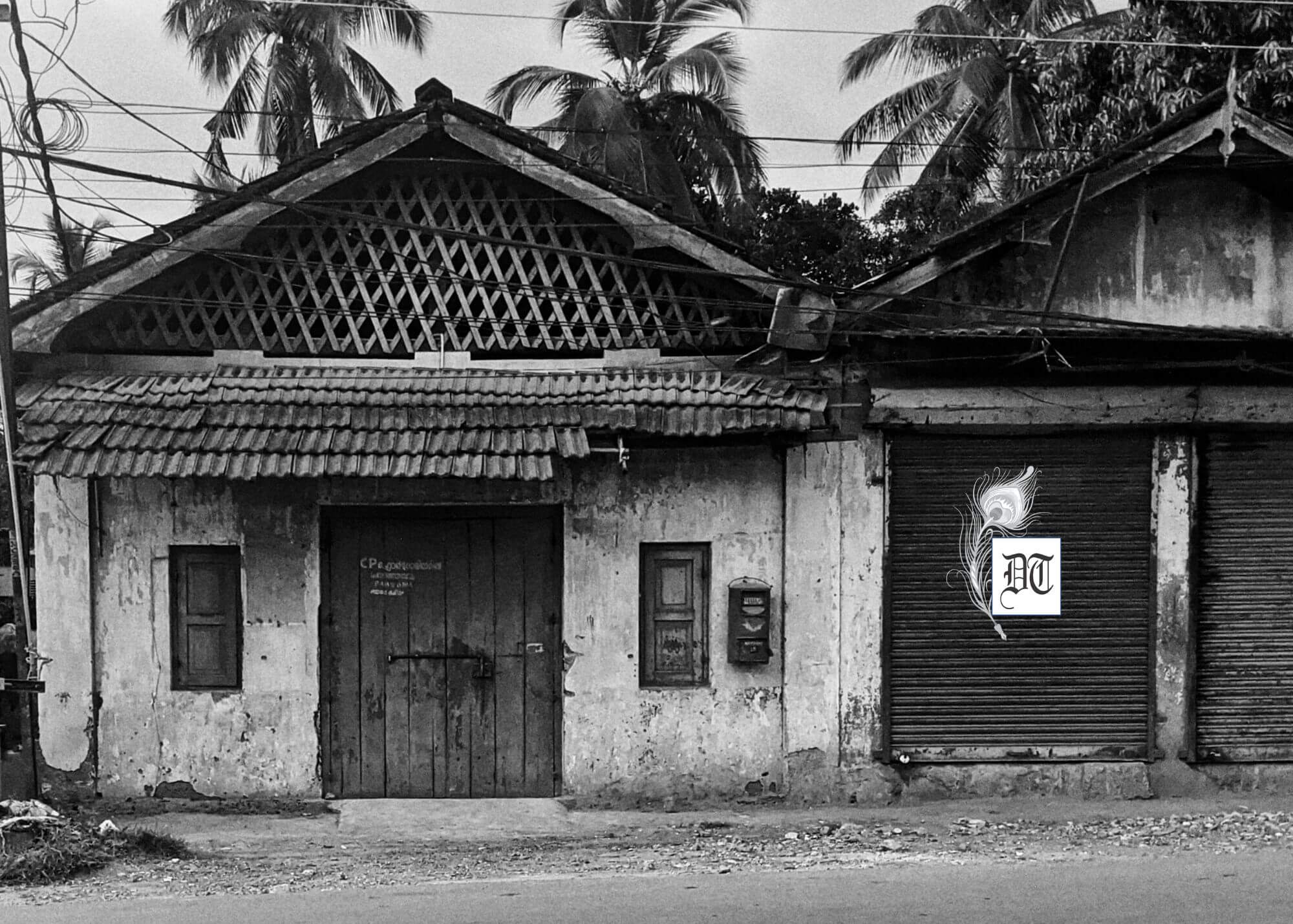
Prof Bhaskar explores the complex realities and hidden tragedies within West Bengal’s small towns, revealing their unique struggles and evolution, exclusively for Different Truths.
At the outset, it should be noted that all small towns are not alike; therefore, what follows is not a generalisation for all small towns in West Bengal, as it may not be applicable elsewhere in India.
Based on my very recent and not-so-distant experience of visiting the Indian Himalayan region and the plain land of West Bengal, I developed an idea that may differ from that of the prudent people. The idea is that the small towns that precariously exist as satellite towns in spite of the robust existence of big metropolitan cities show multiple types of tragedy—tragedy in human life, of course. Let me elaborate.
Is Small Beautiful?
‘Small is beautiful’—so said Schumacher. The small towns, most of the time, show the opposite – these are neglected, used as a dumping ground, as colonies. The crises accumulated during the monsoon because of the absence of municipal services. The more tragic is the small town that is peaceful due to the absence of motorable roads and the absence of criminals with commercial interests. ….
Relocation of People
The intergenerational variations in thinking in living led to the relocation of people over time. The village-orientated living remained almost unchanged when the villages became rurban (rural with urban facilities), while the newly educated new generation of young people preferred modern living to rural or rurban living. Hence, a gap emerged in the intra-family that changed the nature of the family itself. The rurban living of the middle class reflected ‘old age homes’ in many situations; their educated sons and daughters preferred to live in modern flats in metropolitan cities.
Orphaned Small Towns
The absence of the educated young population led to the absence of modern utilities in small towns or the demand for these in public administration, like municipalities. The elderly people seemed dedicated to the memory or recapitulation of the collective life that they had. The restricted mobility of the elderly sections also restricted the development possibilities of the small towns – development understood as developed motorable roads, drainage, shopping malls, educational institutions of quality and health institutions of credibility.
Colonised Small Towns
An example may help here to overcome confusion. If Panihati Municipality is considered as an example in North 24 Parganas (alternatively in extended Kolkata), then the habitations of the small town of Agarpara are surely a colony or dumping ground of the municipality. It is a different issue that Agarpara is not known, probably because of the absence of people with nuisance value or the absence of commercial interest. Development economics generally escapes the analysis of the need for internal colonies of major towns, though it deals with environmental issues and the dumping of hazardous waste. In the international context, also areas of adjoining countries are required for dumping, though these are not formal colonies, like the adverse use of the Mexico border by the United States for dumping.
Some of the small towns become satellites of metropolitan cities and become the dumping space of the latter. Generally, the small towns that are the conversions of villages or extensions of villages cannot resist being the internal colonies because of one more major factor, which is the absence of political leadership from within the small towns. In my example, no state-level political leader, like a member of the state assembly or a higher-level member of Parliament, was selected from the population of the small town of Agarpara that comes under the Panihati Assembly constituency and Dumdum Parliamentary constituency. Politics matters for the outcome – tragedy or comedy.
Happy Small Towns
Be it happiness by desire or by compulsion, the residual population in the small towns remains happy despite dilapidated roads, a dearth of adequate public utilities and so on. Socio-cultural archaic fabric helps prolong this happiness. Increasing income, of course, led to a rising number of cars for private use in such small towns, but self-driven cars are generally not visible for a lack of confidence in the elderly population and the absence of competent youth. As mentioned earlier, the educated youth from the middle section left for better well-being in metropolitan cities and abroad. What remains is the nostalgia of the elderly population in the middle section. Helplessness-derived happiness is tragic.
Tragedy of Small Towns or Tragedy of People?
It seems difficult to answer the above question in a single word for towns, as the geographic area of settled people cannot be separated from the people. Some people migrate or become mobile with or without rootedness, the latter never coming back to revisit the root. The question involves livelihood and aspirations and hence education and jobs as corollaries. It is difficult to opine who is responsible for the tragedy of small towns unless they become large cities. It is also not obvious that size expansion leads to comedy in public life.
Geography does not suffer unless it is a natural disaster like an earthquake or landslide; in the ultimate analysis, it is people who suffer. Some people, mostly manual workers, are accustomed to living at the bottom of the material utilities and have little education. It is the middle section that suffers, whether expressed. The platform of expression is also constrained by numerous political-economic factors and forces. Hence, the tragedy gets prolonged.
Changing Scenario
Nothing is permanent – so is the character of the small town. While it evolved as a town from its earlier existence as a village, it started taking a vertical shape, understood by the shape of buildings, rising density of population, and a greater number of heterogeneous families in a single skyscraper building built by a real estate dealer with no attachment to the facilities for the occupants. The youth left; the elderly people were left behind unless the latter were shifted to old age homes by the former. The space started being occupied by the entry of new populations from adjoining regions that were understood by in-migrants to be poorer or culturally hostile. This means demographic rearrangement.
Thus, small towns not only drive out a section of the population, but they also draw them in. It’s evolution. The result is not obvious.
Picture design by Anumita Roy

Prof. Bhaskar Majumder, an eminent economist, is the Professor of Economics at GB Pant Social Science Institute, Allahabad. He was the Professor and Head of the Centre for Development Studies, Central University of Bihar, Patna. He has published nine books, 69 research papers, 32 chapters,15 review articles and was invited to lectures at premier institutes and universities over 50 times. He has 85 papers published in various seminars and conferences.
He also worked in research projects for Planning Commission (India), World Bank, ICSSR (GoI), NTPC, etc. A meritorious student, Bhaskar was the Visiting Scholar in MSH, Paris under Indo-French Cultural Exchange Programme. He loves speed, football and radical ideology.



 By
By
 By
By
 By
By