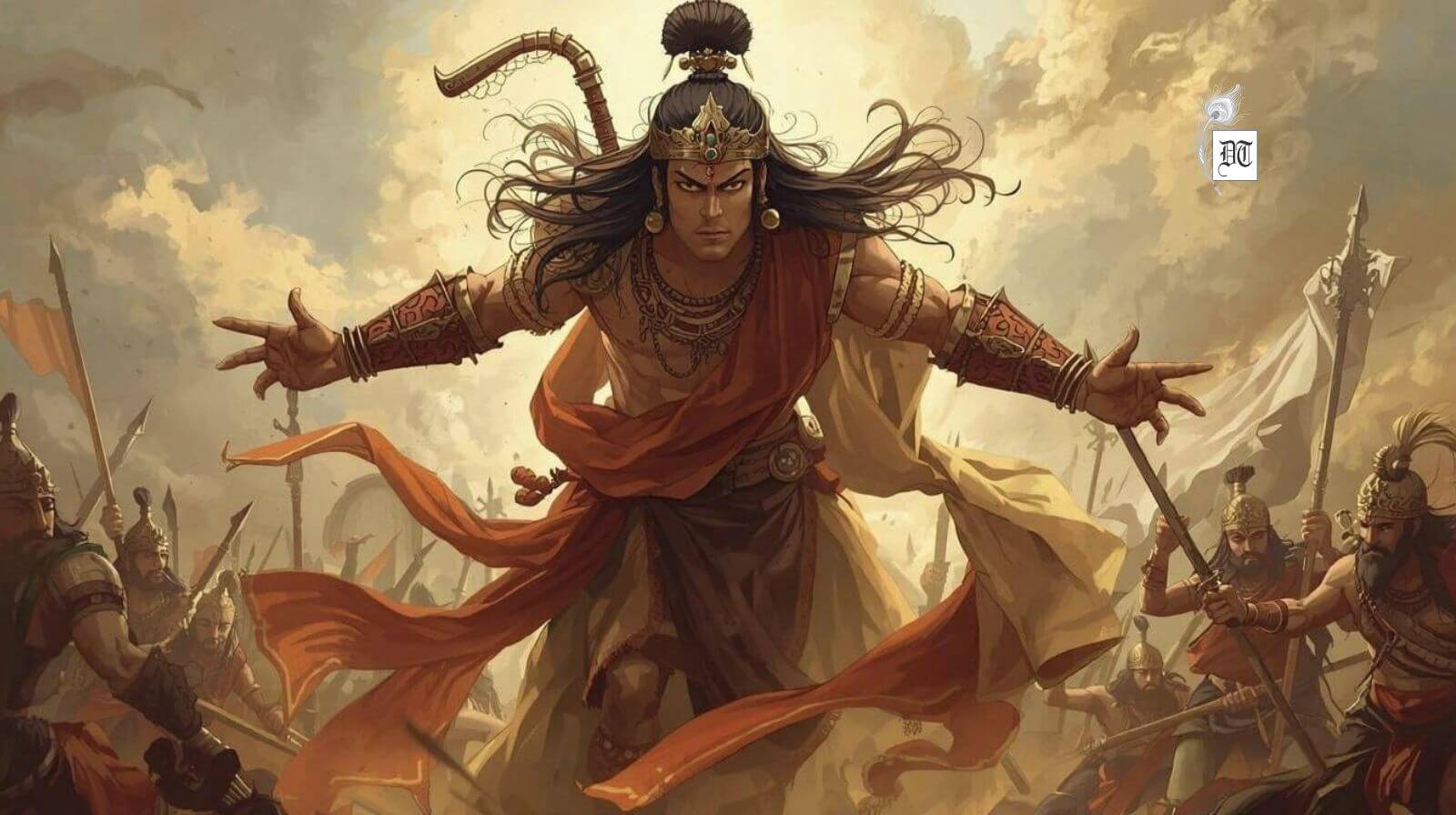
Sohini and Rishi elucidate Shikhandi’s journey from a rejected princess to the warrior who felled Bhishma, exposing the lethal intersection of patriarchy and dogma for Different Truths.
If the Mahabharata were only about war, Shikhandi would be a footnote. But the epic is really about who gets to define dharma—and who is destroyed when dharma hardens into dogma. In that sense, Shikhandi is not marginal at all. Shikhandi is the epic’s most radical disruption.
Born of injustice, shaped by rage, and completed through transformation, Shikhandi exposes the fault lines of a civilisation that could imagine cosmic time, fluid reincarnation, and talking serpents—yet still panicked at a body that refused to stay put.
Amba: When Patriarchy Calls Itself Dharma
Shikhandi’s story begins with Amba, a woman crushed not by desire but by male honour. Abducted by Bhishma, rejected by her lover Shalva, and refused by Bhishma himself, Amba becomes collateral damage in a masculine game of vows and reputation.
No villain twirls a moustache here. That is the point. Every man involved believes he is acting righteously. And yet Amba’s life is ruined.
This is patriarchy at its most lethal: when no one feels responsible because everyone is “just following dharma”.
Amba’s penance is not meek. It is incandescent. Shiva grants her the boon that she will be the cause of Bhishma’s death—an extraordinary concession in an epic where women are more often rewarded with patience than power. Amba burns herself alive, choosing rebirth over submission.
Shikhandini: Raised Male, Policed Female
Reborn as Shikhandini, child of King Drupada, Amba enters a world that desperately needs sons. Drupada raises Shikhandini as male—educates her in weapons, war, and kingship—while hiding the inconvenient truth of her body.
The epic here is brutally honest: gender is already a performance, already enforced by costume, training, and public agreement. Biology only becomes relevant when marriage threatens to expose the lie.
When that exposure looms, Shikhandini flees—not out of shame, but for survival.
The Yaksha Exchange: Gender as Gift, Not Curse
In the forest, Shikhandini meets the Yaksha Sthunakarna. What follows is one of the Mahabharata’s most astonishing moments: a consensual exchange of gender.
This is not punishment. This is not divine correction. It is solidarity.
The Yaksha gives up his male form so Shikhandi may live as he truly is. Kubera’s curse—forcing the Yaksha to remain female until Shikhandi’s death—adds a sharp moral edge: transformation always has a cost, and someone always pays it.
Long before modern debates on gender transition, the epic imagines identity not as a fixed destiny but as something negotiated, relational, and deeply ethical.
Kurukshetra: Bhishma’s Moral Collapse
On the battlefield, Shikhandi becomes Bhishma’s undoing—not by strength, but by principle.
Bhishma refuses to fight someone who is a woman. His vow, once noble, now renders him impotent. Arjuna uses Shikhandi as cover; Bhishma falls.
This is no trick. It is a judgement.
Bhishma is defeated by the very rigidity he worshipped. Shikhandi exposes how “honour” often protects power rather than justice. Dharma, the epic suggests, cannot survive without self-questioning.
Western Counterparts: Shikhandi Was Never Alone
Shikhandi’s story is not an outlier. Across cultures, mythology repeatedly returns to figures who cross, collapse, or confuse gender—often at moments of crisis.
Tiresias (Greek mythology): Perhaps Shikhandi’s closest Western analogue, Tiresias lives as both man and woman after angering the gods. Like Shikhandi, Tiresias carries memory across genders—and is punished for knowledge others lack. His blindness mirrors society’s fear of those who see too much.
Caeneus (Greek mythology): Born female, Caenis is raped by Poseidon and asks to be transformed into an invulnerable man. Caeneus becomes a warrior no weapon can harm—until enemies crush him under their weight. Violence cannot defeat him; social panic can.
Iphis (Ovid’s Metamorphoses): Raised as a boy to escape infanticide, Iphis falls in love with a woman and prays to be transformed. The gods comply. Unlike Shikhandi, Iphis’s story ends neatly—revealing Rome’s discomfort with ambiguity and preference for divine “correction”.
Achilles on Skyros: Disguised as a woman to avoid war, Achilles cross-dresses until desire betrays him. Unlike Shikhandi, Achilles’ gender transgression is temporary, strategic, and ultimately forgiven—because masculine heroism remains intact.
Joan of Arc (historical-mythic): Condemned partly for wearing men’s clothes, Joan’s fate echoes Shikhandi’s: a warrior who violated gender codes and paid with her life once war’s usefulness ended.
Across cultures, the pattern is unmistakable: gender-crossing figures appear at moments when old orders are cracking. They are tolerated when useful, destroyed when inconvenient, and mythologised once safely dead.
After the War: Disposal of the Disruptor
Shikhandi does not receive a hero’s end. He is killed by Ashwatthama in a night massacre, after the war has abandoned all pretence of dharma.
It is a telling conclusion. The one who exposed the hollowness of moral codes is eliminated when morality collapses entirely.
Why Shikhandi Still Unsettles Us
Shikhandi is dangerous not because of gender ambiguity, but because of moral clarity. He remembers injustice across lifetimes. He refuses erasure. He proves that systems built on exclusion will eventually be undone by those they discard.
In a world still anxious about bodies, binaries, and belonging, Shikhandi reminds us that mythology has always known what society pretends to forget:
Identity is fluid. Power is afraid of it. And justice often arrives in forms we are trained not to recognise.
Picture design by Anumita Roy
Cowritter:

Rishi Dasgupta, a Masters in Economics from the University of St. Andrews, Scotland, is a millennial, multilingual, global citizen, currently pursuing a career in the UK. An accomplished guitarist and gamer, his myriad pursuits extend to the study of the ancient philosophies and mythologies of India. ‘Adi Shiva: The Philosophy of Cosmic Unity’ is Rishi’s second book as co-author.

Sohini Roychowdhury is a renowned Bharatanatyam dancer, choreographer, artistic director, speaker, social activist, and professor of Natyashastra. She founded Sohinimoksha World Dance & Communications in Madrid/Berlin/Kolkata/New York. A visiting professor of dance at 17 universities worldwide, she won several awards, including the “Mahatma Gandhi Pravasi Samman” by The House of Lords, the Priyadarshini Award for Outstanding Achievement in Arts, and the Governor’s Commendation for Distinguished World Artiste. She has also authored several books, including ‘Dancing with the Gods’.


 By
By

 By
By