
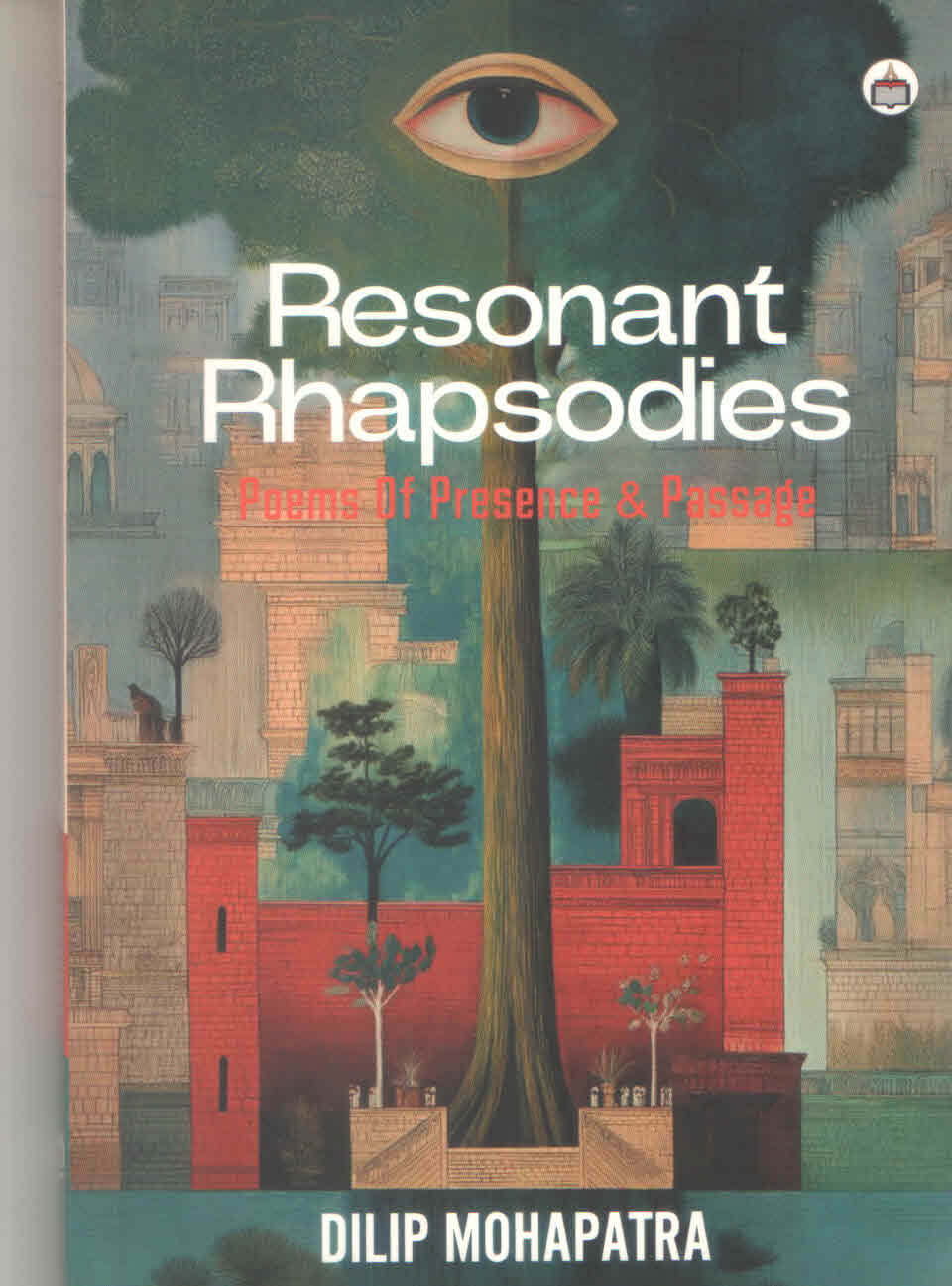

Pankajam’s insightful review of Dilip Mohapatra’s Resonant Rhapsodies on DifferentTruths.com unveils poems dancing between randomness, rhythm, presence, and passage—timeless gems for poetry lovers.

AI Summary
· Pankajam Kottarath praises Dilip Mohapatra’s tenth collection, Resonant Rhapsodies (Authorspress, 2026), for its 69 evocative poems across seven sections, blending universal themes like transience, life’s flow, and social satire with intellectual depth and humour.
· Highlights include poignant pieces on dementia (“Lest I Forget”), environmental loss (“Echoes of the Past”), human flaws (“Control Freaks”), and resilience (“Almost There”), offering “aha” moments for serious readers.
· Mohapatra transforms everyday chaos into rhythmic insights, proving poetry’s endless vitality— a must-read investment for poetry enthusiasts craving profound, relatable verses.
Resonant Rhapsodies is Dilip Mohapatra’s tenth poetry collection. As in earlier collections, this book is also not an easy read for nonchalant readers. Many of his lines offer themselves for open interpretations and truly give different readers different perspectives. Each poem here is distinct in aura, notions, feelings, and rhythms; they instantly converse with serious readers’ hearts and intellect, and if one can pause between the lines, they can experience the aha moment that the poet intended to offer. His themes are well thought out and have a universal appeal among all age groups.
Mohapatra has proved through his collections of poems beyond doubt that his thoughts and themes can never go deplete as he can find poetry even in trivial things, his own experiences, things seen and felt which others might ignore and he makes them gleam with his vast vocabulary, depth of awareness, intellectual analysis, cognitive perceptions and his ever-impressive satiric expressions, which come to him quite innately. As the sub-title suggests, poems in this collection establish the need for change and transience.
This book contains 69 poems segregated into seven divisions, and each section carries meaningful and beautiful quotes which set the mood in motion into the poems they represent. The curtain raiser by ChatGPT and a wonderful foreword by Ambika Anand give deep insight into the poems that follow.
The first section, ‘The Universe in Motion,’ with the quote, “In the dance of randomness and rhythm, even chaos hums to an unseen tune,” seems absolutely relatable. In this review, I want to include at least one poem from each section, if not more.
The poem “Between Nowhere and Every Where” with a tagline ‘poised between the centre of the world and its edge’, the poet says that in his efforts to escape from himself, he stands at the crossroads of nowhere and everywhere on no man’s land, and these lines encapsulate his mindset then:
I am lost
in the cusp of singularities
wondering
how I may escape
from the certain uncertainties
and uncertain certainties.
In poem “Lost and Found”, from the Section ‘Time, Money and the House of Life’, the poet narrates his apprehensions down his memory lane about losses in life like subsiding passions, signs of ageing like crow’s feet around corners of eyes, friends and well-wishers enquiring about your health, your own children insisting wheel chair for you during journeys, all losses in life, but when you accept an invitation to join old buddy’s meet in a remote island, an occasion to meet and hug each other and exchange old memories, you rediscover the old joys which you thought were lost forever. The readers, especially the senior citizens, can very well relate to such a stage of craving we all cling to.
‘And Life Flows On…’ the poet clearly draws the cycle of life that starts from a drop containing an ocean emerging from a pulsating darkness into incandescence, and from one’s first cry, the drop becomes a stream, then into a gurgling river trickling through rocky paths that flows seeking the ocean, where it meets the tides in its estuary.
But the flow continues
in the merger
of the drop in the ocean
And as the sun sucks it up, it falls in drops to start all over again, and life flows on and on.
The poet wants to instigate here that all of us are in a flow, the flow that never stops seeking the ultimate and then it is another flow even after the merger. Here, only the form changes; the spirit is the same. The philosophy here can be applied to human life as well.
In poem titled ‘Almost There’, the poet reminds us of situations in life making us desperate, such as you are almost there in the race when somebody overtakes just before you touch the finishing line; you are unable to excel in academics despite hard efforts; a girl becomes already committed by the time you gather courage to propose to her and you miss the much awaited elevation despite a higher ranking appraisal. The poem takes an unexpected turn here when you intend to go on a vacation, and you miss the flight, but the same flight went on flames, leaving no survivors, and the poem concludes with such:
And the murmur in your ears
becomes loud and clear
‘Don’t you despair
You were almost there.’
Here Mohapatra drives to the readers’ minds that whatever happens, happens for our good. Perhaps even the difficult life events might be intended to serve a greater purpose, and it is for us to see hardships as challenges and lessons. It’s our faith and mindset that keep us at peace.
‘Lest I forget’ is a touching poem dealing with dementia as the focal theme, wherein the son visits his mother affected with loss of memory, with some oranges for her. While he is about to leave, the old lady calls out to her son, saying:
Uncle, can you peel it for me
Feed me clove by clove
Lest I forget.
In just these three lines, Mohapatra can express the gravity of the deep emotional disturbance it can elicit.
In ‘Echoes of The Past’, the poet narrates the thoughts of a woman who looks into the distant past through times telescope and imagines her great-great granddaughter while clearing the attic of her ancestral home sees pictures that of cerulean sky, green gardens, water flowing under a bridge, Eiffel tower, Statue of Liberty, Niagara Falls, all no longer existed in her text books and she speaks loudly to herself:
Oh, those days must be great-
They had gardens
Rivers and birds
And even mornings!
The message is loud and clear here that this earth is only leased to us, and we are all responsible to return it to our next generation in the same way. But if we continue to destroy the natural resources, the earth is going to be barren soon, making life difficult on earth for which we are answerable. The undertone and anguish over the degradation of nature are visible in these lines. It’s the social responsibility of every poet to address this grave issue, and Mohapatra does it in his own inimitable style with poetic precision.
‘Voice of Silence’ is another beautiful poem which tells that silence too has a voice of its own; in its soundlessness, it speaks in wordless syllables expressing grief, defiance, dissent, protest, steadfastness, etc., and silence is like a sleeping volcano. Words unuttered have the power of becoming louder than spoken words.
‘Lust If You Must’ speaks about one’s ravenous cravings, unholy longings and unseen immorality conveniently blamed on Apple and the Serpent, doing serious injustice to the basic instincts of righteousness and self-denials, and the poet reminds you that you are just a human rooted to the real world. This poem is a reminder to improve human bonding, trust and social connection. The concluding lines are here:
…Your transient journey
from dust to dust
ride the highs of
Oxytocin
and lust if you must.
‘Control Freaks’ is about people with bloated self-concept, who keep a sharp vigil, intervene and interfere in everything, keeping a bold face, locking their insecurities, maybe because of their fear of failure. This again is a poem significant on social issues. The concluding lines are here, which need no elaboration:
Their needs to control others
control them
and in their unwillingness to
accept imperfections
they try to
master all
but they miss the one domain
that matters –
Self-control.
Poem titled ‘Peeping Toms’ with the tag line ‘in every keyhole a mirror waits’ is about digital world scammers, and the poet has this to forewarn to those who indulge in such shady acts – “whoever digs a pit for others, only himself has to fill.” But at the same time, the users should also be alert.
‘The Art of Stealing’ is a poem chasing the roots of stealing, which starts as an innocent beginning and grows into irresistible urges, and one hides behind the veil of kleptomania. Their adventure then progresses into the digital world, infringing copyrights and even masking as apostles of love, setting honey traps, a primordial instinct. The poet here wonders and poses a qualm:’Is it a necessary evil to keep things on an even keel!’ But there is an inherent advice here to nip it in the bud.
Mohapatra amply exhibits his humour in the poem titled ‘Backup Plans’, wherein he analyses God’s masterplan of keeping eyes, ears, hands, legs, all in pairs, but the soul, a single one. The protagonist tries to convince his wife to create her clone as a backup, he gets this reply, and that puts a smile on the readers’ faces:
“Just try that stunt”, she said
eyes wide
“You’ll meet your God
from the other side.”
I am compelled to keep many beautiful poems in this collection out of this review, and the poetry lovers are requested to explore them. I assure you that the investment in this book would be worth your time and money.
Wishing all the very best to poet Dilip Mohapatra.
Cover image sourced by the reviewer.


 By
By
 By
By
 By
By
 By
By